
Accotink, VA Real Estate: The Definitive Guide to Stream Valley Living, Historic Accotink Village, Lake Accotink & Fort Belvoir Gateway
Executive Summary & Essential Community Takeaways
- Historic Mill Village & Regional Watershed Spine: Anchored by the historic 18th-century village of Accotink on Route 1 and spanning the 25-mile Accotink Creek watershed, Accotink represents an essential geographic and cultural corridor connecting southern Fairfax County with the central Piedmont.
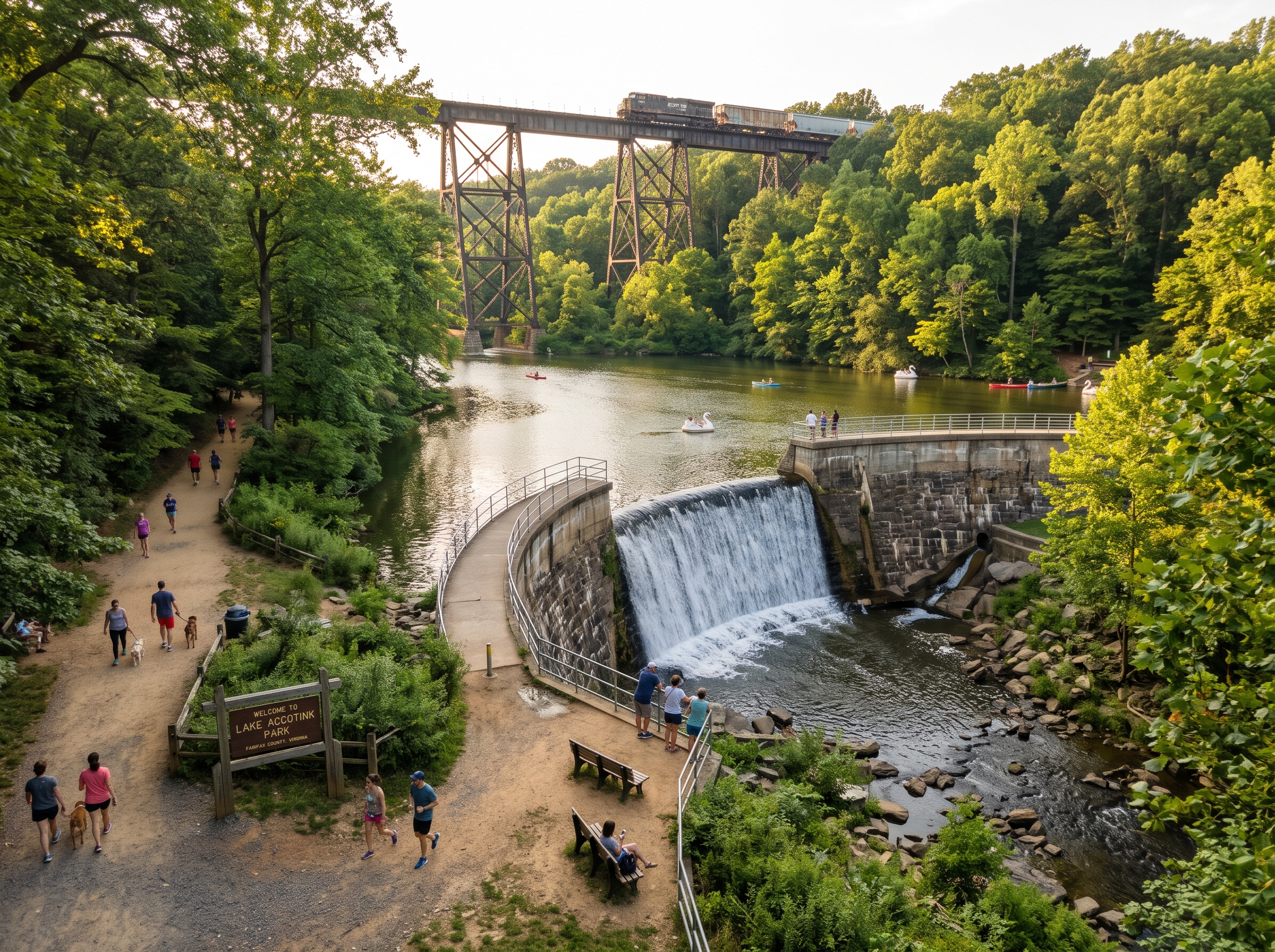
- 493-Acre Lake Accotink Park Crown Jewel: Centered on a 55-acre freshwater lake, historic Norfolk Southern railroad trestle, boat marina (kayaks, canoes, pedal-boats), antique carousel, miniature golf, and miles of mountain biking trails.
- Continuous Cross County Trail (CCT) Access: Traversed by the premier 40-mile Gerry Connolly Cross County Trail along Accotink Creek, providing continuous off-road hiking, running, and cycling from Great Falls south to Occoquan.
- Mid-Century Craftsmanship & Zero Mandatory HOA: Classic single-family residential sectors feature red-brick ramblers, split-levels, and traditional colonials on mature quarter- to half-acre lots with zero mandatory HOA dues or restrictive covenants.
- Direct Gateway to Fort Belvoir & National Army Museum: Directly bordering Fort Belvoir's primary entry points along Route 1 and Backlick Road, offering under-five-minute access to Tulley Gate, Fort Belvoir Community Hospital, DLA headquarters, and the National Museum of the U.S. Army.
- Multimodal Commuter Reach: Minutes from Interstate 95 (Exits 166 and 167), Fairfax County Parkway (Route 286), the Franconia-Springfield Metrorail (Blue Line) and VRE terminal, and Lorton VRE station.
1. Spatial Morphology, Geographic Coordinates & Territorial Extents
Accotink, Virginia, represents both an essential historical community and an expansive environmental greenway in Fairfax County. Centered geographically around coordinates 38°43′10″ N latitude and 77°09′35″ W longitude at the historic village site near Route 1 and Backlick Road, the broader Accotink territory follows the 25-mile course of the Accotink Creek watershed northwest through the Piedmont uplands, encompassing Lake Accotink Park (coordinates 38°47′30″ N, 77°13′00″ W) at elevations ranging from 50 feet near the Potomac tidal estuaries to over 240 feet above sea level in the northern stream valleys.
The spatial territory is organized along natural hydrologic contours and major transportation corridors. To the south and east, the historic village of Accotink directly abuts the Fort Belvoir Military Reservation and the coastal marshlands of Accotink Bay. To the west, the boundary blends into the residential subdivisions of Newington, Saratoga, and Springfield along Backlick Road, Alban Road, and the Franconia-Springfield Parkway. To the north, the Accotink Stream Valley meanders through Lake Accotink, bordering Kings Park, Ravensworth, and Annandale.
Administratively, the Accotink area encompasses lands within the Mount Vernon, Franconia, and Braddock Magisterial Districts of Fairfax County. Depending upon specific neighborhood platting, postal addresses correspond to Fort Belvoir / Accotink (ZIP code 22060) or Springfield (ZIP codes 22150, 22151, and 22152). Unlike rigid gridiron developments, Accotink's spatial layout follows the serpentine curves of the stream valley, preserving hundreds of acres of untouched woodland canopies and providing continuous wildlife and pedestrian connectivity through the center of southern Fairfax County.
2. Colonial & Industrial Genesis: Washington's Gristmill, Quaker Abolitionists & The Post Road
The documented heritage of Accotink reflects more than three centuries of Virginian agriculture, industry, and social reform. The name "Accotink" originates from the local Algonquian Native American dialect, translating roughly to "at the end of the hill" or "on the hill," denoting the prominent bluffs rising above the creek basin.
During the 18th century, General George Washington recognized the hydraulic power of Accotink Creek, acquiring land and constructing a commercial gristmill along the creek to process grains produced at his Dogue Run and Mount Vernon farms. Washington's mill was celebrated for producing superfine flour that was shipped across the Atlantic to the West Indies and Europe.
In the 1840s and 1850s, Accotink Village became the focal point of a historic social experiment. A community of anti-slavery Quakers from Pennsylvania and New Jersey—led by prominent abolitionist Chalkley Gillingham—purchased large tracts of land from the former Washington estates. The Quakers established timber sawmills and gristmills in Accotink Village that operated exclusively with free wage labor rather than enslaved labor, demonstrating the economic viability of a free-labor agricultural economy in antebellum Virginia.
During the American Civil War, Accotink Village and the Accotink Creek crossings were fiercely contested transport choke points along the Old Post Road between Alexandria and Fredericksburg. Union troops encamped throughout the valley to defend bridges and railroad lines against Confederate cavalry raids led by Colonel John S. Mosby. In 1917, the federal government acquired the southern half of the Accotink district to establish Camp A.A. Humphreys (later renamed Fort Belvoir), permanently intertwining the community with the nation's military defense.
3. The Accotink Stream Valley & Lake Accotink Park: 493-Acre Freshwater Sanctuary
The crown jewel of outdoor recreation in the community is Lake Accotink Park, an expansive 493-acre regional park operated by the Fairfax County Park Authority. The park centers on a 55-acre freshwater lake created by an impoundment dam originally built by the United States Army during World War I to supply drinking water for Fort Belvoir.
Lake Accotink Park offers a comprehensive suite of outdoor recreational facilities:
- Historic Norfolk Southern Railroad Trestle: An iconic visual landmark towering above the lake, this towering active railroad bridge spans the water, carrying freight and passenger trains across the stream valley against a backdrop of dense hardwood forest.
- Full-Service Marina & Boating: Offering seasonal rentals of canoes, single and tandem kayaks, and pedal-boats, as well as a public boat launch for non-motorized private watercraft. The lake is stocked with largemouth bass, channel catfish, and sunfish, making it a beloved fishing haven.
- Family Entertainment Complex: Featuring an antique hand-carved wooden carousel, an 18-hole miniature golf course, large shaded picnic pavilions with outdoor charcoal grills, and modern playground structures.
- Multi-Use Trail System: A continuous 3.8-mile crushed-stone trail loops completely around Lake Accotink, providing runners, hikers, and mountain bikers with scenic water vistas and rolling forest terrain with minimal road crossings.
4. Architectural Typologies: Mid-Century Red-Brick Ramblers, Split-Levels & Classic Colonials
The residential housing stock of Accotink reflects the golden era of post-war American suburban construction, characterized by solid masonry, generous structural proportions, and expansive lots:
- Mid-Century Brick Ramblers (1950s–1970s): Sprawling single-story residences featuring durable regional red-brick façades, low-pitched gable roofs, wide overhanging eaves, and large picture windows that flood main living rooms with natural daylight. These homes typically offer three to four bedrooms on the primary level, complemented by full finished walkout basements that double the living footprint.
- Multi-Level Split-Levels & Split-Foyers: Highly popular for their functional vertical zoning, these homes separate formal entertaining areas from private family bedrooms and ground-level recreation suites. Ground levels feature floor-to-ceiling brick masonry fireplaces, direct sliding-glass walkout access to private stone patios, and integrated garage bays.
- Traditional Center-Hall Colonials: Embodying timeless Virginian architectural symmetry, these two-story residences showcase formal central entry foyers, flanking living and dining rooms, rear-oriented family gathering rooms, four to five upper-level bedrooms, and attached two-car garages on third- to half-acre lots.
- Established Townhome Clusters: Located in select sectors along Backlick Road and Route 1, Accotink features classic multi-level brick-front townhomes offering three finished levels, private fenced rear courtyards, and dedicated reserved parking.
5. Distinct Residential Enclaves: Historic Village, Stream Valley Neighborhoods & Woodlawn Border
The Accotink area encompasses several distinct residential pockets, each offering unique lifestyle characteristics:
Historic Accotink Village Corridor: Centered along Backlick Road and Route 1 near Fort Belvoir, this historic enclave features a mixture of established mid-century homes, character-filled cottages, and small commercial establishments that date back to the community's early 20th-century origins. Residents enjoy unmatched proximity to Fort Belvoir's main gates and Route 1 amenities.
Accotink Stream Valley Enclaves: Winding northward along Accotink Creek toward Springfield and Lake Accotink, these residential subdivisions feature quiet, tree-canopied streets and cul-de-sacs that terminate at protected park authority boundaries. Homeowners enjoy direct pedestrian paths leading straight into the Cross County Trail.
Woodlawn & Telegraph Road Borders: Situated along the eastern perimeter of the Accotink basin, these neighborhoods blend seamlessly with the historic Woodlawn plantation district, featuring generous half-acre wooded parcels, mature landscaping, and an estate-like ambiance.
6. Property Sovereignty: Fee-Simple Detached Living with Zero Mandatory HOA Dues
A standout institutional advantage of the single-family home market in Accotink is the absence of restrictive, mandatory Homeowners Associations across its established detached residential neighborhoods. Homeowners enjoy unencumbered fee-simple sovereignty. There are no mandatory monthly or annual HOA fees, no rigid architectural committees dictating exterior paint colors or landscaping species, and no burdensome procedural rules regarding parking work vehicles, personal boats, or trailers.
Property owners possess the freedom to personalize their homes, expand their footprints, construct detached workshops or garden pavilions, and install private fencing without navigating lengthy approval processes. Neighborhood pride and maintenance are sustained organically through long-term homeownership, active voluntary civic associations, and deep community pride.
For buyers who prefer turnkey maintenance, select townhome communities in the area operate with localized HOAs that oversee common grounds maintenance, private snow removal, and dedicated parking enforcement.
7. Modern Interior Transformations: Great Room Expansions, High-Capacity Systems & Outdoor Patios
Because Accotink's original mid-century homes were built with solid dimensional lumber, cast-iron drain lines, and concrete sub-foundations, they provide an exceptional framework for contemporary modernization:
- Open-Concept Living Transformations: Removing non-load-bearing walls between original compartmentalized kitchens and living rooms to create expansive great rooms anchored by 8- to 10-foot quartz preparation islands, designer pendant lights, custom soft-close cabinetry, and professional-grade stainless steel appliances.
- Primary Suite Reconfigurations: Modernizing primary bathrooms with frameless glass showers, custom porcelain wall tile, quartz-topped double vanities with brushed nickel hardware, and expanded walk-in closets.
- Lower-Level Walkout Refinements: Converting full daylight basements into secondary family living suites, private executive home offices, dedicated fitness rooms, and guest quarters with full baths.
- Outdoor Entertaining Sanctuaries: Capitalizing on expansive quarter- to half-acre wooded backyards by constructing custom multi-level composite decks, natural flagstone patios, built-in masonry fire pits, and fully fenced private lawns.
- High-Performance Mechanical Upgrades: Replacing original heating systems with high-efficiency multi-stage electric heat pumps, tankless continuous water heaters, architectural-grade shingle roofs, and 200-amp electrical panels.
8. Parks, Greenways & Stream Recreation: Gerry Connolly Cross County Trail (CCT) & Wildlife
Traversing directly through the heart of Accotink is the Gerry Connolly Cross County Trail (CCT), a premier 40-mile continuous multi-use pathway that connects Great Falls on the Potomac River in northern Fairfax County all the way south to Occoquan Regional Park.
In Accotink, the CCT follows the natural contours of Accotink Creek along paved and packed-gravel paths. Residents can step onto the trail directly from neighborhood access points to embark on long-distance cycling trips, marathon training runs, or peaceful weekend walks under a continuous canopy of mature hardwoods.
The Accotink Stream Valley functions as an essential ecological wildlife corridor, supporting white-tailed deer, red foxes, river otters, beaver colonies, great blue herons, and migratory songbirds that thrive in the preserved riparian wetlands.
9. Environmental Hydrology: Accotink Creek Watershed, Chesapeake Bay RPAs & Riparian Buffers
The environmental hydrology of Accotink is defined by the Accotink Creek watershed, one of Fairfax County's largest drainage basins covering more than 50 square miles of territory before discharging into Accotink Bay, Gunston Cove, and the Potomac River.
Fairfax County rigorously protects the creek basin through Environmental Quality Corridors (EQCs) and Resource Protection Areas (RPAs) established under the Chesapeake Bay Preservation Act. These legal covenants permanently restrict commercial and residential construction along the floodplains, guaranteeing that Accotink's lush green stream corridors will remain permanently preserved for future generations.
These protected riparian buffers filter stormwater runoff, stabilize stream banks, and moderate local microclimates, keeping neighborhood temperatures cooler during humid mid-Atlantic summer months.
10. Fairfax County Public Schools (FCPS): Woodlawn, Saratoga, Island Creek & Secondary Pyramids
Fairfax County Public Schools (FCPS) consistently ranks among the premier public school systems in the United States, providing Accotink families with rigorous academics, cutting-edge STEM curricula, and comprehensive fine arts programming:
- Distinguished Elementary Schools: Depending upon specific neighborhood boundaries, elementary students attend Woodlawn Elementary School, Saratoga Elementary School (celebrated for its strong community reading and STEAM initiatives), or Island Creek Elementary School.
- Middle School Pyramids: Students advance to Key Middle School or Whitman Middle School, offering honors coursework, world language instruction, and supportive transitional environments for young adolescents.
- Secondary High School Pyramids: High school students graduate from John R. Lewis High School, Hayfield Secondary School, or Mount Vernon High School. Each institution offers exhaustive Advanced Placement (AP) courses, dual-enrollment college credits, career academies, championship athletic teams, and award-winning fine arts departments.
11. Strategic Military Proximity: The Fort Belvoir Gateway, National Army Museum & Defense Hubs
Few communities in Northern Virginia offer closer proximity to major military and defense institutions than Accotink. Directly bordering the western and northern boundaries of the Fort Belvoir Military Reservation, Accotink provides a stress-free commute for service members and defense civilians:
- Fort Belvoir Main Post & Primary Gates: Residents reach Tulley Gate, Lieber Gate, and Pence Gate in two to five minutes via Route 1 and Backlick Road, avoiding lengthy highway gridlock.
- National Museum of the United States Army: Located right at Fort Belvoir along Route 1, this magnificent cultural landmark honors American soldiers across two and a half centuries of national service.
- Defense Logistics Agency (DLA) Headquarters: Operating as the Department of Defense's primary combat logistics agency, located right within Fort Belvoir.
- Alexander T. Augusta Military Medical Center: Delivering comprehensive tertiary medical, surgical, and emergency care to military personnel, retirees, and their families.
12. Multimodal Commuter Infrastructure: Route 1, Backlick Road, I-95 Express & Franconia Metro/VRE
Accotink delivers an exceptionally versatile multimodal transportation network connecting residents to major regional employment centers:
- Route 1 (Richmond Highway) & Backlick Road: Primary arterial spines providing direct connectivity to Fort Belvoir, Alexandria, the Capital Beltway (I-495), and the Pentagon.
- Interstate 95 & 95 Express Lanes: Accessible via Exit 166 (Backlick Road / Fairfax County Parkway) and Exit 167 (Fuller Heights Road), offering dynamically tolled Express Lanes directly into downtown Washington, D.C.
- Franconia-Springfield Metrorail & VRE Station: Located less than ten minutes north, providing rapid Metrorail Blue Line service into Alexandria, Reagan National Airport, and Washington, D.C., as well as VRE Fredericksburg Line commuter rail.
- Fairfax County Parkway (Route 286): Providing rapid northwest arterial transit connecting Accotink directly with Burke, Fairfax Station, the City of Fairfax, and Reston.
- Saratoga Park-and-Ride Hub: Minutes away on Barta Road, offering free parking and dedicated Fairfax Connector express commuter buses directly to the Pentagon.
13. Virginia Statutory Assessment Framework Under Code § 58.1-3201 & Fairfax County Mass Appraisal Equalization
Real property taxation across Accotink is governed strictly by the statutory mandates of the Code of Virginia § 58.1-3201, which requires that all real estate subject to taxation must be assessed at one hundred percent (100%) of its true fair market value. The Commonwealth of Virginia enforces this uniform standard across all jurisdictions, ensuring equitable tax distribution without arbitrary fractional adjustments or speculative assessments.
To establish fair market value, the Fairfax County Department of Tax Administration (DTA) conducts an annual computerized mass appraisal equalization. Certified appraisal specialists evaluate closed arm's-length sales of comparable single-family homes and townhomes within the Accotink submarket over the prior calendar year, adjusting for specific physical and location variables:
- Finished Living Area & Volume: Accurate measurement of gross above-grade living square footage, excluding unconditioned garage and storage spaces.
- Basement Finish & Walkout Capabilities: Differentiated valuation of fully finished lower-level living areas, walkout grade access, and full bathrooms.
- Lot Topography & Park Adjacency: Premium adjustments reflecting parcel acreage, cul-de-sac positioning, and rear borders backing directly onto protected stream valley parkland.
- Documented Capital Improvements: Verified property enhancements recorded through Fairfax County building permits, including expanded kitchens, modern primary baths, multi-level composite decks, and finished basements.
Fairfax County mails annual assessment notices to property owners in late February. Homeowners retain the statutory right to request an administrative review with the Department of Tax Administration, with subsequent appeal avenues available through the independent Fairfax County Board of Equalization (BOE) and the Circuit Court.
14. Comparative Analysis Matrix: Accotink vs. Surrounding Communities
Prospective homebuyers exploring southern Fairfax County frequently compare Accotink with neighboring communities. The comparative matrix below highlights key structural, governance, and lifestyle distinctions:
| Community | Primary Eras | Dominant Architecture | HOA Governance | Signature Parks & Amenities | High School Pyramids |
|---|---|---|---|---|---|
| Accotink | 1955–1985 & Modern | Brick Ramblers, Split-Levels & Colonials | None (Vast Majority Detached) | Lake Accotink Park & Cross County Trail | Lewis, Hayfield & Mt. Vernon |
| Newington | 1965–1985 | Brick Ramblers, Split-Levels & Colonials | None (Detached) / Local (Townhomes) | Accotink Stream Valley & Loisdale Park | Lewis, Hayfield & South County |
| Woodlawn | 1950–1980s | Mid-Century Brick Ramblers & Splits | None (Voluntary Civic Assocs) | Woodlawn Estate & Pope-Leighey House | Mount Vernon High School |
| Springfield | 1950–1975 | Brick Ramblers, Split-Levels & Splits | None (Voluntary Civic Assocs) | Lake Accotink Park & Town Center | West Springfield & Lewis High |
| Groveton | 1945–1980 | Mid-Century Brick Ramblers & Colonials | None (Voluntary Civic Assocs) | Huntley Meadows Park & Beacon Center | West Potomac High School |
| Fort Belvoir | Military / Mixed | Privatized Military Housing & Quarters | Installation Governance | Fort Belvoir Marina & Army Museum | Mount Vernon High School |
15. Frequently Asked Questions Regarding Accotink, VA Real Estate
What are the geographic boundaries and spatial dimensions of the Accotink area?
The Accotink corridor spans the southern and central sections of Fairfax County (ZIP codes 22060, 22150, 22151, and 22152, Mount Vernon and Franconia Districts). It is anchored by the historic village of Accotink along Route 1 (Richmond Highway) and Backlick Road directly bordering Fort Belvoir, and follows the 25-mile Accotink Creek watershed northwest through Lake Accotink Park into Springfield and Annandale.
What is the historical origin of Accotink Village?
Accotink traces its roots to an Algonquian Native American settlement along Accotink Creek. In the 18th century, George Washington operated a gristmill along the creek. In the mid-19th century, a group of abolitionist Quaker settlers established timber sawmills and free-labor gristmills at Accotink Village. The community later served as an essential stop on the Old Post Road and saw action during the Civil War prior to the 1917 founding of Camp A.A. Humphreys (Fort Belvoir).
What recreational facilities does Lake Accotink Park feature?
Lake Accotink Park is a 493-acre regional park centered around a 55-acre freshwater lake and an iconic historic railroad trestle. The park offers canoe, kayak, and pedal-boat rentals, an antique carousel, miniature golf, multiple picnic pavilions, miles of natural surface and paved mountain biking trails, and direct access to the 40-mile Gerry Connolly Cross County Trail.
What architectural styles predominate throughout Accotink neighborhoods?
The residential landscape of Accotink features mid-century brick ramblers, multi-level split-levels, and split-foyers constructed primarily between the 1950s and 1970s on mature, tree-canopied lots, alongside classic Center-Hall Colonials, transitional single-family homes, and established brick-front townhome clusters.
Does Accotink have a mandatory Homeowners Association (HOA)?
The vast majority of detached single-family homes across the original Accotink and stream valley neighborhoods operate with zero mandatory HOA dues or restrictive architectural committees, providing complete property sovereignty. Townhome clusters maintain localized HOAs for common grounds and parking maintenance.
Which Fairfax County Public Schools serve the Accotink area?
Depending on specific neighborhood boundaries, elementary students attend Woodlawn Elementary, Saratoga Elementary, or Island Creek Elementary. Middle school students attend Key Middle School or Whitman Middle School, and high school students graduate from John R. Lewis High School, Hayfield Secondary School, or Mount Vernon High School.
What is Accotink's proximity to Fort Belvoir and defense agencies?
Accotink directly borders the western perimeter of Fort Belvoir. Residents enjoy two- to five-minute access to Tulley Gate, Lieber Gate, Fort Belvoir Community Hospital, Defense Logistics Agency (DLA) headquarters, and the National Museum of the United States Army, making it one of Northern Virginia's closest residential defense communities.
How does the Gerry Connolly Cross County Trail connect through Accotink?
The 40-mile Gerry Connolly Cross County Trail (CCT) traverses directly through Accotink along the banks of Accotink Creek. It provides continuous off-road pedestrian, running, cycling, and equestrian connectivity from Great Falls on the Potomac River south through Lake Accotink and the Accotink Stream Valley to Occoquan Regional Park.
What commuter transit and highway corridors serve Accotink?
Accotink provides exceptional multimodal connectivity via Route 1 (Richmond Highway), Backlick Road, Telegraph Road, Fairfax County Parkway (Route 286), and Interstate 95 (Exits 166 and 167). Commuters reach the Franconia-Springfield Metrorail (Blue Line) and VRE station in under ten minutes.
How does Fairfax County assess real property values across Accotink?
Under Code of Virginia § 58.1-3201, all real property is assessed annually at 100 percent of true fair market value. The Fairfax County Department of Tax Administration (DTA) conducts computerized mass appraisal equalizations annually based on verified arm's-length sales of comparable homes within specific neighborhood submarket codes.
Navigating Real Estate in Accotink & Southern Fairfax County
Whether you are preparing to list a mid-century brick rambler or colonial in the Accotink Stream Valley, seeking a property minutes from Fort Belvoir's primary gates, or evaluating residences near Lake Accotink Park and the Cross County Trail, partner with trusted Northern Virginia real estate authority Elena Gorbounova for discreet, data-driven representation.