
Belle Haven, VA Real Estate: The Definitive Guide to Spatial Morphology, Historic Country Club Estates, Potomac River Shoreline & Parkways
Executive Summary & Essential Community Takeaways
- Prestige Potomac River Enclave: Belle Haven is an unincorporated census-designated place (CDP) in Fairfax County's Mount Vernon Magisterial District, distinguished by direct frontage along the tidal Potomac River and the scenic George Washington Memorial Parkway, situated immediately south of historic Old Town Alexandria.
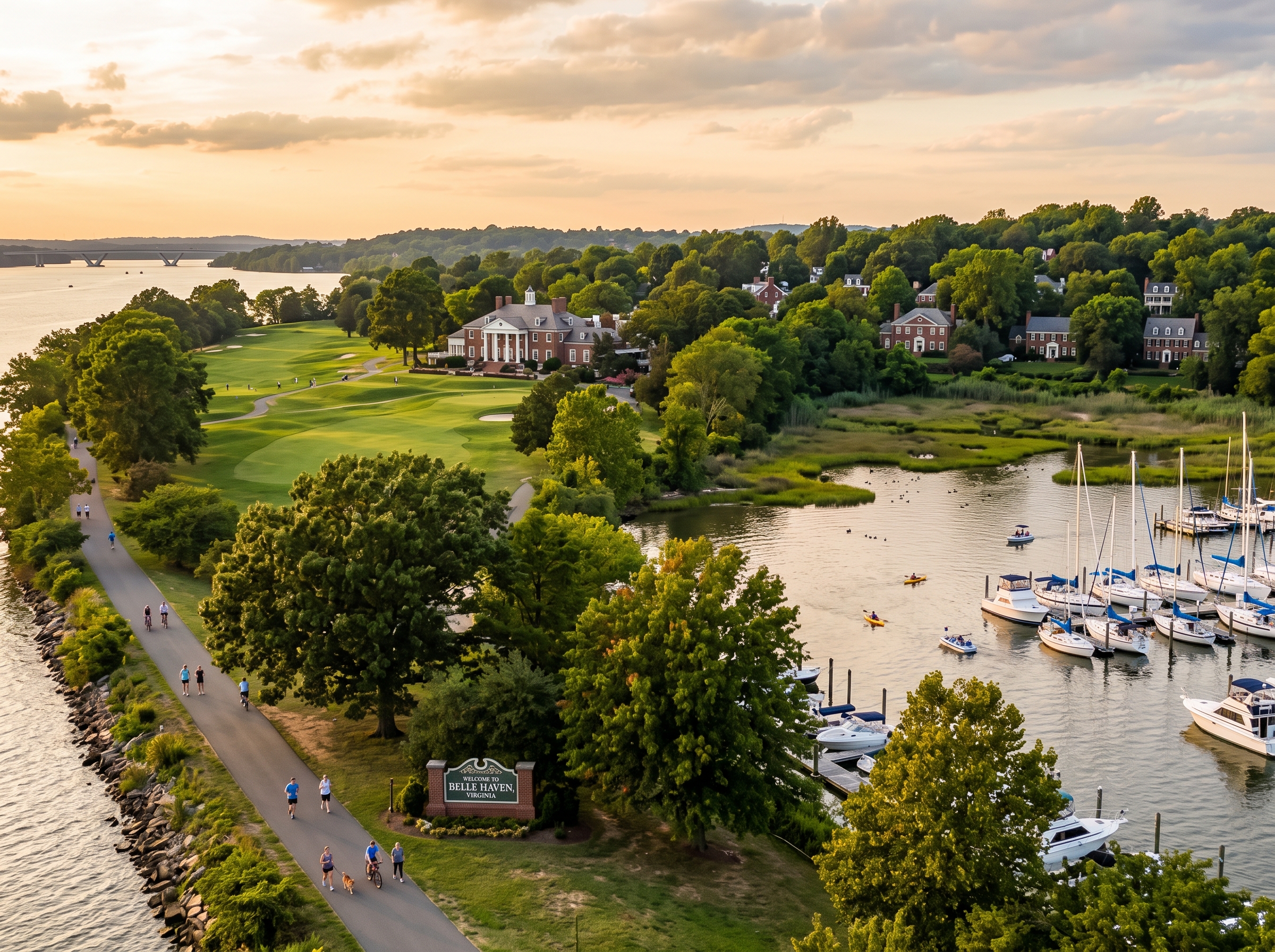
- Centennial Country Club Heritage: Centered around the historic Belle Haven Country Club (chartered in 1924), featuring an 18-hole championship golf course renovated by Arthur Hills, indoor and outdoor tennis centers, Olympic swimming facilities, and a waterfront dining clubhouse overlooking Hunting Creek and the Potomac.
- Rare Architectural Pedigree: Showcases an extraordinary collection of 1920s through 1950s custom stone, brick, and slate-roofed estates executed in authentic Georgian Revival, Tudor, and French Provincial typologies, complemented by mid-century homes in Belle Haven Terrace and bespoke modern luxury infill.
- Protected Natural Sanctuaries & River Trails: Borders the 485-acre Dyke Marsh Wildlife Preserve (a protected federal tidal freshwater wetland) and the Belle Haven Marina, linked directly by the 18-mile paved Mount Vernon Trail connecting Mount Vernon to Washington, D.C.
- Premier FCPS Academic Pyramid: Zoned to Fairfax County Public Schools within the West Potomac High School pyramid (featuring the AP Capstone program and specialized West Potomac Academy), supported by Carl Sandburg Middle School (a Full-Time AAP Level IV Center) and Belle View Elementary School.
- Virginia Statutory Assessment Standards: Evaluated under Virginia Code § 58.1-3201 at 100 percent of fair market value by the Fairfax County Department of Tax Administration (DTA), with semi-annual tax installments due on July 28 and December 5.
1. Spatial Morphology, Boundaries & Regional Geography
Belle Haven occupies one of the most picturesque geographical positions in the Commonwealth of Virginia. Situated in the northeastern corner of Fairfax County within the Mount Vernon Magisterial District (postal ZIP code 22307), this unincorporated census-designated place (CDP) spans approximately two square miles along the western shoreline of the tidal Potomac River.
The spatial perimeter of Belle Haven is defined by natural watercourses, federal parkways, and historic transportation corridors:
- North Boundary: Hunting Creek and the municipal corporate border of the independent City of Alexandria, marking the direct transition into Old Town Alexandria and Jones Point Park.
- East Boundary: The tidal shoreline of the Potomac River and the federally protected George Washington Memorial Parkway corridor, offering unobstructed river vistas and access to Dyke Marsh.
- South Boundary: Belle View Boulevard and the historic garden community of Belle View, transitioning toward New Alexandria and Fort Hunt.
- West Boundary: Richmond Highway (U.S. Route 1), Fort Hunt Road (Route 629), and the hillside neighborhood of Huntington, connecting the community westward toward the Capital Beltway.
2. Historical Evolution: 18th-Century Alexandria Roots, 1920s Country Club Founding & Estate Era
The name "Belle Haven" predates the American Revolution, carrying profound historical resonance across the National Capital Region.
The Original Belle Haven Settlement (1730–1749)
In the early 1730s, Scottish merchants and colonial tobacco planters established a thriving tobacco trading post and wharf along the natural deepwater cove where Hunting Creek enters the Potomac River. They named the settlement Belle Haven—a French rendering of "beautiful harbor" or named in tribute to early patentee Hugh West's plantation. When the Virginia House of Burgesses chartered a formal town at the site in 1749, the municipality was officially christened Alexandria in honor of the Alexander family, who owned much of the original patent land. However, local residents and mariners continued to refer to the pastoral bluffs south of Hunting Creek as Belle Haven for generations.
The 1920s Founding of Belle Haven Country Club & Estates
In the early 1920s, real estate visionary David N. Hoover recognized the immense residential potential of the rolling, wooded ridges overlooking the Potomac River just south of Alexandria. In 1924, Hoover and a coalition of prominent Washington and Virginia civic leaders chartered the Belle Haven Country Club, laying out a championship 18-hole golf course and constructing an elegant, multi-story clubhouse.
Surrounding the golf course, Hoover platted an exclusive residential community of curvilinear parkways, deep front setbacks, and generous half-acre to three-quarter-acre parcels. The architectural guidelines required substantial, architect-designed custom residences built of natural stone, fieldstone, solid red brick, and slate roofing. Leading regional architects were commissioned to construct grand Georgian Revival, Tudor, and French Eclectic homes, establishing Belle Haven as one of Northern Virginia's most distinguished addresses.
Post-WWII Maturation & The GW Parkway Corridor
Following World War II, the development of the George Washington Memorial Parkway provided Belle Haven with a direct, landscaped commuter artery running north to the Pentagon and downtown Washington, D.C. During the 1950s and 1960s, additional subdivisions were platted along the neighborhood's western fringe—including Belle Haven Terrace and Belle Haven Meadows—introducing high-quality brick ramblers and split-levels that expanded the community's residential diversity.
3. Residential Enclaves, Neighborhood Typologies & Architectural Anatomy
Belle Haven exhibits an architectural continuum rarely matched in Northern Virginia, balancing preserved early-20th-century estates, mature mid-century suburban homes, and bespoke modern luxury infill.
| Residential Subdivision / Enclave | Primary Architectural Style | Construction Era | Typical Lot Dimensions | Fairfax County Zoning |
|---|---|---|---|---|
| Historic Belle Haven Estates | Georgian Revival, Tudor, French Provincial | 1924 – 1955 | 0.40 to 0.85 Acre Lots | R-2 (Low-Density Single-Family) |
| Belle Haven Terrace | Mid-Century Brick Ramblers & Split-Levels | 1952 – 1968 | 0.25 to 0.40 Acre Parcels | R-3 (Suburban Single-Family) |
| Belle Haven Meadows & Fort Hunt Fringe | Traditional Brick Colonials & Cape Cods | 1958 – 1978 | 0.28 to 0.45 Acre Lots | R-3 / R-4 (Single-Family Residential) |
| Custom Infill Estates (Scattered) | Transitional Georgian & Modern Classical | 2008 – Present | 0.40 to 0.75 Acre Replacement Lots | R-2 (Custom Single-Family Infill) |
| Belle View Border Enclaves | Post-War Brick Garden Condos & Townhomes | 1948 – 1954 | High-Density Garden Parcels | R-20 / R-30 (Multi-Family Residential) |
Historic Belle Haven Estates: The Architectural Crown Jewel
Winding through streets such as Belle Haven Road, Forest Drive, and Edgehill Drive, the core historic estates of Belle Haven represent museum-grade early-20th-century residential architecture. Homes feature:
- Heavy Flemish and English bond masonry exteriors utilizing authentic hand-molded Virginia red clay brick and native Potomac fieldstone.
- Steeply pitched gabled and hipped rooflines crowned with genuine Buckingham Virginia natural slate shingles and lead-coated copper gutters and downspouts.
- Classical porticos supported by fluted ionic or tuscan columns, dentil-molded cornices, Palladian windows, and solid mahogany entry doors with leaded glass transoms.
- Interior craftsmanship including plaster walls, heart-pine and quartersawn white oak flooring, hand-carved fireplace mantels with marble surrounds, and formal grand staircases.
Belle Haven Terrace & Mid-Century Enclaves
Situated on gently rising topography westward toward Fort Hunt Road, Belle Haven Terrace features well-built single-story brick ramblers and multi-tier split-levels constructed during the 1950s and 1960s. These residences offer functional single-level living, full daylight basements, attached garages, and deep backyard gardens shaded by mature specimen magnolias, weeping cherries, and tulip poplars.
Modern Luxury Custom Infill Estates
Over the past two decades, select older properties on generous parcels have been acquired for custom replacement builds. Designed to harmonize with Belle Haven's classical architectural aesthetic, these new estates incorporate:
- Generous footprints spanning 5,000 to over 7,500 finished square feet across three finished levels.
- Chef kitchens featuring dual marble waterfall islands, professional commercial-grade gas ranges, integrated refrigeration, and prep sculleries.
- Primary owner retreats featuring private covered terraces with Potomac River views, dual dressing rooms, and radiant heated marble bath floors.
- High-efficiency geothermal heat pump systems, commercial-grade spray foam insulation, and advanced smart-home lighting and climate automation.
4. Structural Anatomy, Building Eras & Technical Due Diligence
Purchasing and preserving real estate in Belle Haven demands technical understanding of historic masonry assemblies, coastal plain moisture mechanics, and modern building codes:
Historic 1920s–1950s Masonry Assemblies
- Solid Masonry Walls & Mortar Composition: Early Belle Haven homes were constructed with multi-wythe solid brick masonry or stone veneer backed by structural hollow clay tile or early cinder block. Repointing requires historic lime-based mortar; utilizing modern high-Portland cement mortar can trap moisture and cause spalling of historic brick faces.
- Slate Roof Assemblies & Copper Valley Linings: Original Buckingham slate roofs have lifespans exceeding a century if properly maintained. Technical inspections should evaluate individual cracked slates, copper valley flashing integrity, and chimney masonry counterflashing.
- Plumbing Supply & Subsurface Drainage: Original supply lines were heavy brass or copper, while waste lines utilized cast iron. Prospective purchasers must commission a fiber-optic video camera sewer scope inspection of the sewer lateral from the cleanout to the street main to check for scale buildup, root penetration, or pipe settlement.
- Electrical Service Capacity: Original installations often featured 60-amp or 100-amp split-bus panels with ungrounded knob-and-tube or cloth-sheathed wiring. Upgrading to a modern 200-amp or 400-amp service panel with AFCI and GFCI protection is essential to support modern residential loads.
Chesapeake Bay RPA Regulations & Foundation Drainage
- Resource Protection Area (RPA) Buffers: Due to proximity to Hunting Creek, Cameron Run, and the Potomac River, portions of Belle Haven lie within Fairfax County's 100-foot Resource Protection Area buffers under the Chesapeake Bay Preservation Ordinance. Any building expansion, pool installation, or tree removal within an RPA requires county approval and mitigation planting plans.
- Foundation Waterproofing & Soil Mechanics: Situated on coastal plain marine clays and alluvial silts, basement foundations require positive exterior slope grading away from walls, continuous foundation drain tile systems, and reliable sump pumps with battery backup systems.
5. Public Education Infrastructure: FCPS School Pyramids & Academic Profiles
Belle Haven is served exclusively by Fairfax County Public Schools (FCPS), recognized nationally for academic distinction, advanced placement opportunities, and specialized career academies. The community is anchored primarily by the West Potomac High School Pyramid.
| School Facility | Grade Levels | Pyramidal Feeder Alignment | Curriculum Programs & Academic Honors |
|---|---|---|---|
| West Potomac High School | Grades 9 – 12 | West Potomac Pyramid | AP Capstone Diploma, West Potomac Academy (Health Sciences, Biotech, TV Production), Beyond the Page Theatre |
| Carl Sandburg Middle School | Grades 7 – 8 | West Potomac Pyramid | Full-Time Advanced Academic Programs (AAP Level IV Center), Honors Math, World Languages |
| Belle View Elementary School | Pre-K – Grade 6 | West Potomac Pyramid | Spanish Partial Dual-Language Immersion, Advanced Academic Programs (AAP), Responsive Classroom |
| Waynewood Elementary School (Border) | Pre-K – Grade 6 | West Potomac Pyramid | Advanced Academic Programs (AAP), Math Olympiad, National Blue Ribbon School of Excellence |
West Potomac High School & The Specialized Academy
West Potomac High School offers a comprehensive secondary curriculum enriched by the AP Capstone Program (comprising AP Seminar and AP Research). Furthermore, the campus hosts the West Potomac Academy, an elite professional learning center offering specialized coursework in medical sciences, physical therapy, pharmacy technology, culinary arts, television and media production, and cyber security. The school is also celebrated for its award-winning fine arts and "Beyond the Page" theatre programs.
Carl Sandburg Middle School AAP Level IV Center
Belle Haven middle school students attend Carl Sandburg Middle School, an official Full-Time AAP Level IV Center. Sandburg delivers an accelerated curriculum in English, science, social studies, and accelerated mathematics (Geometry Honors and Algebra I Honors). Additionally, rising eighth graders in Belle Haven are eligible to participate in the competitive regional admissions process for Thomas Jefferson High School for Science and Technology (TJHSST) in nearby Lincolnia.
6. Transportation Logistics, GW Parkway Corridors & Metrorail Access
Few residential communities in the Washington metropolitan area offer the commuter elegance and multimodal logistics of Belle Haven, providing direct highway, transit, and trail connectivity.
The George Washington Memorial Parkway (GW Parkway)
The George Washington Memorial Parkway borders Belle Haven to the east, functioning as a scenic, landscaped commuter expressway free of commercial traffic and commercial billboards:
- Old Town Alexandria: 3 to 5 minutes north, offering direct access to boutique dining, historic King Street, and regional business centers.
- Reagan National Airport (DCA): 8 to 10 minutes north, providing domestic air travel without freeway congestion.
- The Pentagon & Crystal City (Amazon HQ2): 12 to 15 minutes north via the parkway and Route 1.
- Downtown Washington, D.C.: 15 to 20 minutes across the 14th Street Bridge or Memorial Bridge directly into the National Mall and downtown office core.
Metrorail Connectivity (Yellow Line)
The Huntington Metrorail Station (the southern terminus of the Yellow Line) is located approximately 1.2 miles northwest of Belle Haven. The station provides multi-level commuter parking, covered bike storage, and a direct one-seat heavy-rail transit ride to:
- King Street-Old Town: 4 minutes.
- Reagan National Airport: 9 minutes.
- Pentagon & L'Enfant Plaza: 15 to 18 minutes.
- Gallery Place-Chinatown: 22 minutes.
Major Highway Arterials
- Interstate 495 (Capital Beltway) & Woodrow Wilson Bridge: Located one mile north, providing immediate access to the 495 Express Lanes, National Harbor in Maryland, and Interstate 95/395.
- Richmond Highway (U.S. Route 1): Anchors western access, offering direct arterial connection to local shopping centers, Fort Belvoir, and the future Embark Bus Rapid Transit (BRT) line.
7. Environmental Topography, Potomac River Shoreline & Wildlife Preserves
Belle Haven is situated upon the picturesque coastal bluff topography of the Atlantic Coastal Plain, where rolling hardwood knolls overlook tidal wetlands, freshwater marshes, and the broad expanse of the Potomac River.
Dyke Marsh Wildlife Preserve
Immediately bordering Belle Haven to the south and east is the Dyke Marsh Wildlife Preserve, a 485-acre freshwater tidal wetland managed by the National Park Service as part of the George Washington Memorial Parkway. As one of the largest remaining freshwater marshes in the Washington metropolitan area, Dyke Marsh is an ecological sanctuary featuring:
- Over 300 recorded bird species, serving as a critical stopover along the Atlantic Flyway for migratory waterfowl, warblers, and shorebirds.
- Active nesting territories for bald eagles, osprey, barred owls, and great blue herons.
- A 0.75-mile accessible gravel boardwalk trail extending through marshland to an observation platform overlooking the Potomac River.
Belle Haven Marina & The Mount Vernon Trail
- Belle Haven Marina: Situated along the riverbank off the GW Parkway, the historic marina provides sailboat moorings, dry boat storage, ramp launching facilities, stand-up paddleboard/kayak rentals, and a renowned community sailing school.
- Mount Vernon Trail: An 18-mile continuous paved recreational and commuter greenway traversing directly through Belle Haven. Cyclists, runners, and walkers utilize the trail for daily exercise and non-motorized commuting north into Old Town Alexandria and Washington, D.C., or south to historic Mount Vernon.
- Belle Haven Country Club Fairways: The private 18-hole championship golf course provides a sweeping greenway buffer of manicured turf, sand hazards, and mature willow and oak groves along the tidal shoreline.
8. Real Estate Assessment Cycles & Virginia Statutory Tax Framework
Real estate taxation in Belle Haven operates strictly under the legal framework established by the General Assembly of the Commonwealth of Virginia and the administrative authority of Fairfax County. Because Belle Haven is an unincorporated census-designated place within Fairfax County, property owners pay real estate taxes exclusively to Fairfax County, with zero supplemental town or city tax millages.
Virginia Code Title 58.1-3201: The 100% Fair Market Value Mandate
Under Virginia Code § 58.1-3201, all real property in Virginia must be assessed for tax purposes at one hundred percent (100%) of its true fair market value. The Fairfax County Department of Tax Administration (DTA) conducts comprehensive annual reassessments of every taxable parcel in Belle Haven. Valuations are determined through annual mass appraisal market equalization based on verified arm's-length sales of comparable properties within identical neighborhood submarket codes, accounting for lot size, river views, topography, structural improvements, and property condition.
Annual Assessment Calendar & Payment Schedules
- January 1 (Statutory Effective Date): Property assessments are legally established as of January 1 of each calendar year, reflecting real estate market transactions occurring during the preceding twelve months.
- Late February (Assessment Notice Distribution): The DTA mails official Notice of Real Estate Assessment cards to all property owners, itemizing land value, structural improvement value, and total equalized taxable valuation.
- Semi-Annual Payment Deadlines: Real estate tax payments in Fairfax County are billed in two equal installments:
- First Installment: Statutorily due on or before July 28.
- Second Installment: Statutorily due on or before December 5.
- Countywide Dedicated Levies: Properties in Belle Haven are subject to the Countywide Stormwater Management Service District Tax, dedicated to stream valley restoration, dam safety, and Chesapeake Bay runoff mitigation.
Statutory Assessment Appeals Mechanism
Property owners who believe their annual assessment exceeds fair market value, is non-uniform compared to contiguous properties, or contains clerical errors have the legal right to challenge the valuation through a formal two-tiered process:
- Administrative Review: An informal appeal submitted directly to the Department of Tax Administration, typically required by early April. An assigned county residential appraiser reviews structural data, square footage calculations, physical property condition, and relevant sales comps.
- Board of Equalization (BOE) Appeal: A formal evidentiary appeal submitted to the citizen-led Board of Equalization of Real Estate Assessments, typically requiring filing by June 1. If dissatisfied with the BOE ruling, property owners retain the statutory right to file a petition with the Circuit Court of Fairfax County under Virginia Code § 58.1-3984.
9. Frequently Asked Questions Regarding Belle Haven, VA Real Estate
Is Belle Haven an independent municipality or an unincorporated community in Fairfax County?
Belle Haven is an unincorporated census-designated place (CDP) governed directly by the Fairfax County Board of Supervisors within the Mount Vernon Magisterial District. Although it carries an Alexandria postal address for mailing purposes, it is not part of the independent City of Alexandria. Municipal services, public education (FCPS), police protection, and land-use zoning are administered entirely by Fairfax County.
What was the historical origin of the name "Belle Haven"?
The name "Belle Haven" dates to the early eighteenth century when Scottish merchants and tobacco planters established a port settlement along Hunting Creek and the Potomac River, naming it Belle Haven (French for "beautiful harbor"). Although the adjacent settlement was incorporated as Alexandria in 1749, the historic name was revived in the 1920s during the development of the Belle Haven Country Club and its surrounding residential estates.
What role does the Belle Haven Country Club play in the neighborhood?
Founded in 1924, the Belle Haven Country Club is a private, member-owned club that serves as the social and recreational centerpiece of the community. It features an 18-hole championship golf course renovated by Arthur Hills, a waterfront clubhouse overlooking the Potomac River, indoor and outdoor tennis centers, an Olympic-sized swimming facility, athletic training fitness centers, and fine dining amenities.
What architectural typologies define residential properties in Belle Haven?
Belle Haven is celebrated for architectural diversity and historic integrity: classic 1920s to 1950s Georgian Revival, English Tudor, and French Provincial custom stone and brick residences set on mature half-acre lots; mid-century split-levels and ramblers in Belle Haven Terrace; and modern custom infill estates that blend contemporary luxury with traditional architectural detailing.
Which public schools serve the Belle Haven community?
Belle Haven is served by Fairfax County Public Schools (FCPS) within the West Potomac High School pyramid. Students attend West Potomac High School (home to the AP Capstone program and the West Potomac Academy for specialized health sciences and communications), Carl Sandburg Middle School (a Full-Time AAP Level IV Center), and Belle View Elementary School (offering Spanish partial immersion and AAP curriculum).
What natural preserves and waterfront recreation areas are located in Belle Haven?
Belle Haven sits along the Potomac River shoreline adjacent to the Dyke Marsh Wildlife Preserve, a 485-acre tidal freshwater wetland managed by the National Park Service. It also hosts the Belle Haven Marina (providing sailboat moorings, boat rentals, and sailing instruction) and the paved 18-mile Mount Vernon Trail running along the George Washington Memorial Parkway.
How is commuter transit structured from Belle Haven to Washington, D.C.?
Belle Haven offers exceptional commuter logistics: the scenic George Washington Memorial Parkway provides direct, traffic-light-free driving north to Old Town Alexandria (5 minutes), Reagan National Airport (10 minutes), and downtown Washington, D.C. (15 to 20 minutes). Public transit users benefit from the nearby Huntington Metrorail Station (Yellow Line terminus), situated just over one mile to the west.
What technical and structural considerations apply when purchasing historic homes in Belle Haven?
Buyers of 1920s to 1950s historic residences should conduct specialized inspections of slate roofs and copper flashing, evaluate true masonry cavity walls and lime mortar joints, commission fiber-optic camera sewer scope inspections of underground cast iron lines to detect root intrusion, and verify that electrical service panels have been upgraded to 200-amp circuit breakers.
What zoning designations govern residential development in Belle Haven?
Parcels in Belle Haven are zoned primarily R-2 or R-3 (Residential Single-Family) by Fairfax County, permitting low-density detached residences on generous quarter-acre to three-quarter-acre lots. Properties along Hunting Creek or the Potomac River are also subject to Fairfax County Chesapeake Bay Preservation Ordinance regulations and Resource Protection Area (RPA) buffer requirements.
How are real estate assessments and property taxes governed in Belle Haven?
Under Virginia Code § 58.1-3201, all real property in Belle Haven is assessed annually at 100 percent of fair market value by the Fairfax County Department of Tax Administration (DTA). Property owners receive annual assessment notices in February, pay real estate taxes semi-annually on July 28 and December 5, and retain statutory appeal rights through the county Board of Equalization.
10. Academic References, Historic Archives & Statutory Legal Disclaimers
This architectural monograph, environmental assessment, and regional real estate reference treatise incorporates verified historical archives, public planning documents, and statutory legal frameworks:
- Fairfax County Comprehensive Plan: Area IV, Mount Vernon Magisterial District Plan & Belle Haven Community Planning Guidance, Fairfax County Department of Planning and Development, Fairfax, Virginia.
- National Park Service (NPS): Dyke Marsh Wildlife Preserve Environmental Impact Statement & George Washington Memorial Parkway Historical Survey, U.S. Department of the Interior, Washington, D.C.
- Belle Haven Country Club Historical Archives: Centennial Founding Records, Golf Course Architectural Surveys, and Clubhouse Documentation (1924–2024), Alexandria, Virginia.
- Fairfax County Public Schools (FCPS): Office of Facilities Planning, West Potomac High School Pyramid Boundary Alignment Directory, Gatehouse Administration Center, Falls Church, Virginia.
- Code of Virginia (Statutory Authority): Title 58.1 (Taxation), § 58.1-3201 (Fair Market Value Mandates) and § 58.1-3370 (Board of Equalization Procedures), Commonwealth of Virginia, Richmond, Virginia.
- United States Geological Survey (USGS): Alexandria and Mount Vernon 7.5-Minute Topographic Quadrangles, Potomac River and Hunting Creek Hydrologic Surveys, Reston, Virginia.
Statutory Research & Regulatory Notice: This architectural monograph, environmental review, and submarket treatise is published strictly for informational, educational, and spatial orientation purposes. Real estate boundaries, school attendance zones, country club membership policies, and tax assessment schedules are subject to ongoing administrative modifications by the Fairfax County Board of Supervisors, the Fairfax County School Board, and the Virginia Department of Transportation (VDOT). This publication does not constitute formal appraisal valuations, structural architectural inspections, or legal counsel. Prospective purchasers and property owners must verify official parcel-specific records directly with the Fairfax County Department of Tax Administration (DTA) and Land Development Services (LDS).