
City of Fairfax, VA Real Estate: The Definitive Guide to Independent Municipality Governance, Old Town Heritage & Architectural Enclaves
1. Executive Summary & Foundational Takeaways
The City of Fairfax, Virginia, occupies a uniquely privileged and distinct geopolitical standing in Northern Virginia. Covering approximately 6.3 square miles in the geographic heart of the region, Fairfax is an independent city under the constitutional framework of the Commonwealth of Virginia. It is completely independent of the surrounding Fairfax County municipal administration, operating its own autonomous City Council, Mayor, City Manager, Police Department, Fire and Rescue Department, and public works infrastructure.
Originally established in 1805 as the Town of Providence around the historic 1799 Fairfax County Courthouse, the municipality was renamed the Town of Fairfax in 1859 and incorporated as an independent city in 1961. This sovereign municipal status provides homeowners with distinct advantages: highly responsive municipal services (frequently demonstrated by expedited winter storm clearance and community-scale street maintenance), dedicated local zoning control, and an intimate civic environment centered around historic Old Town Fairfax.
Residential real estate in the City of Fairfax ranges from mid-century ramblers and split-levels in established enclaves like Country Club Hills and Mosby Woods to custom-built modern craftsman infill estates, luxury brownstones, and mixed-use elevator residences in the downtown core. The city is further anchored by its contractual partnership with Fairfax County Public Schools (FCPS) for instructional delivery across city-owned school campuses, the municipal CUE Bus transit network, immediate access to the Vienna/Fairfax-GMU Metrorail Station, and direct adjacency to the flagship research campus of George Mason University.
The Six Structural Pillars of City of Fairfax Real Estate
- Constitutional Independent City Autonomy. Politically separate from Fairfax County since 1961, providing self-directed property taxation, hyper-local zoning, dedicated police and fire departments, and direct citizen access to City Hall.
- Unique City-County School Partnership. The City of Fairfax School Board owns the four city educational facilities, while instructional operations and staffing are seamlessly delivered through a contractual agreement with Fairfax County Public Schools (FCPS), culminating at Fairfax High School with full TJHSST eligibility.
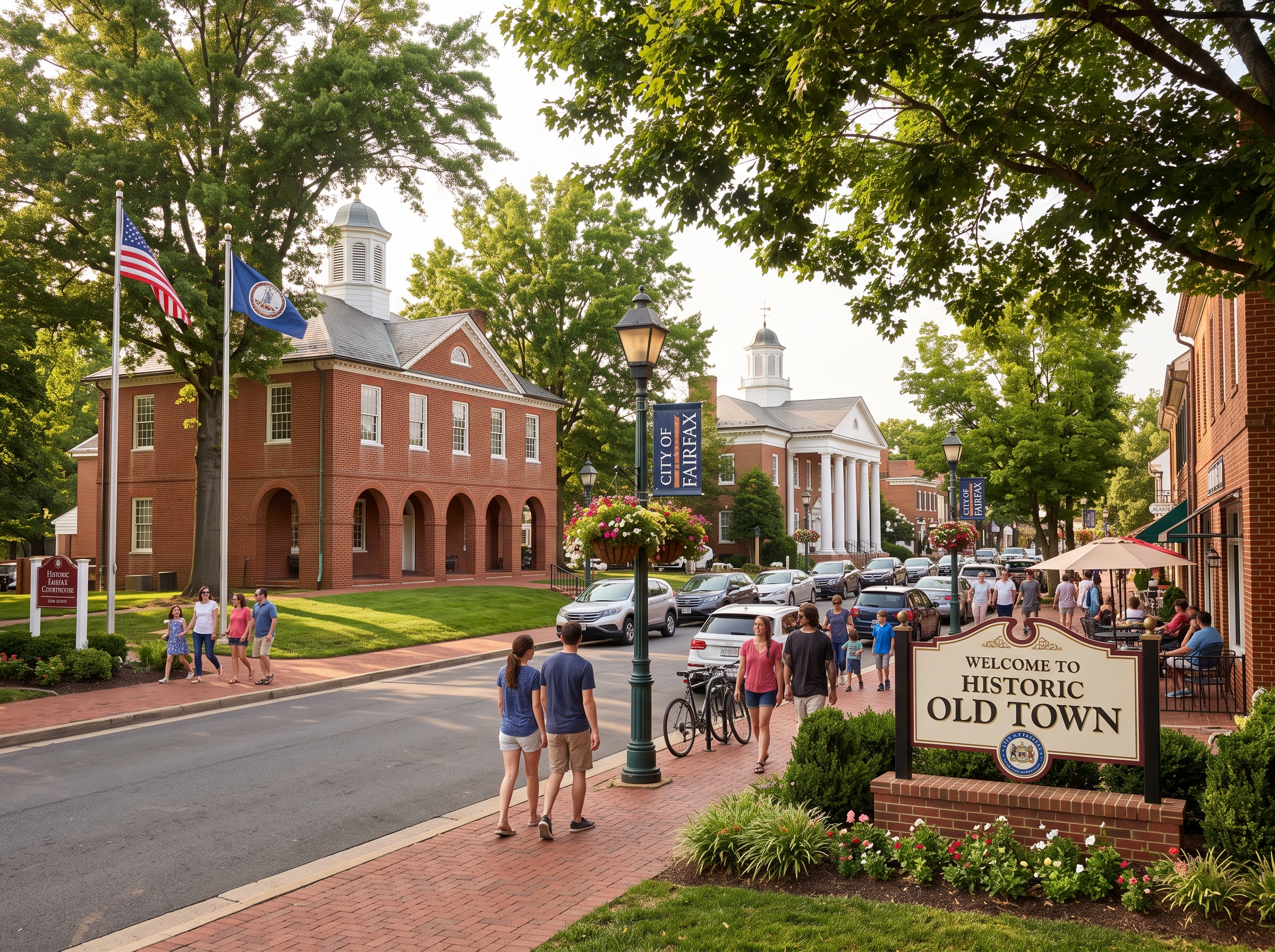
- Historic Old Town Cultural Epicenter. A walkable, vibrant downtown district marrying late-eighteenth-century historic landmarks with Old Town Square, splash pads, regional festivals, independent dining, and modern mixed-use infill.
- Municipal CUE Bus & Metrorail Nexus. Seamless local transit via the city-operated City-University-Energysaver (CUE) bus system connecting residential neighborhoods and George Mason University directly to the Vienna/Fairfax-GMU Metrorail Station on the Orange Line.
- George Mason University Academic Synergy. Immediate southern adjacency to Virginia's largest public research institution (R1 status), driving permanent housing demand among faculty, medical professionals, research scientists, and graduate students.
- Green Stream Valleys & Active Parks. Preservation of the 90-acre Daniels Run stream valley corridor, Van Dyck Park, and expanding paved multi-modal pathways interconnecting residential subdivisions with civic centers and parklands.
2. Geopolitical Identity & Independent Municipal Governance
Prospective homebuyers and real estate investors often misunderstand the jurisdictional relationship between the City of Fairfax and Fairfax County. Under Virginia law, all incorporated cities are independent jurisdictions that do not belong to any county. Consequently, the City of Fairfax is completely sovereign from the Fairfax County Board of Supervisors.
The City operates under a Council-Manager form of government. The governing body consists of an elected Mayor and six City Council members elected at large for two-year terms, who appoint a professional City Manager to direct day-to-day administrative operations. Key municipal departments operating under independent city authority include:
- City of Fairfax Police Department: Autonomous municipal law enforcement providing neighborhood patrols, specialized traffic safety, and dedicated community policing.
- City of Fairfax Fire Department: Operating two career fire and rescue stations in coordination with the volunteer fire corporation, maintaining premier regional emergency response times.
- Public Works & Transportation: Independent street maintenance, stormwater infrastructure, municipal leaf collection, and aggressive snow removal services.
- Parks & Recreation: Managing 25 municipal parks, community centers, and seasonal cultural programming.
Uniquely, the historic and modern Fairfax County Judicial Center—including the Fairfax County General District Court, Circuit Court, and County Adult Detention Center—is physically located on a 4-acre county-owned enclave within the municipal boundaries of the City of Fairfax. Under the 1961 city incorporation agreement, the county retained ownership of this historic seat of justice, creating a vibrant legal, professional, and civic community in the center of the City.
3. Historical Evolution: From Providence Courthouse to Modern Independent City
The origin of the City of Fairfax is fundamentally rooted in colonial and early American transportation and judicial geography. Following the creation of the District of Columbia in the 1790s, the original Fairfax County courthouse at Alexandria fell within the boundaries of the federal district. In 1799, county magistrates selected the crossroads of Little River Turnpike and Ox Road (modern Route 236 and Route 123) as the new county seat, completing the historic brick courthouse in 1800.
In 1805, the Virginia General Assembly formally incorporated the surrounding settlement as the Town of Providence. The town quickly developed into a bustling turnpike crossroads, supporting taverns, blacksmiths, general stores, and legal practices. During the American Civil War, the village was an intensely contested strategic prize; it was the site of the first land skirmish in Fairfax County (June 1861) and later witnessed the legendary March 1863 raid by Confederate partisan John Singleton Mosby, who infiltrated Union lines to capture Brigadier General Edwin H. Stoughton in his headquarters at the Truro rectory.
In 1859, the town was officially renamed Fairfax. Following World War II, Northern Virginia underwent unprecedented suburban expansion. To protect its local autonomy, retain independent zoning authority, and preserve its historic character, town leaders petitioned the General Assembly for an independent city charter, which took effect on July 1, 1961. Over the ensuing six decades, the City preserved its historic landmarks—including the 1800 Courthouse, the 1812 Ratcliffe-Allison-Pozer House, and the 1900 Old Town Hall—while executing award-winning downtown revitalization plans that transformed Old Town into a premier 21st-century civic hub.
4. Old Town Fairfax: Historic Core, Pedestrian Culture & Modern Mixed-Use Renaissance
Old Town Fairfax serves as the civic, cultural, and gastronomic heart of the municipality. Anchored by the intersection of Main Street (Route 236) and Chain Bridge Road (Route 123), Old Town combines meticulously preserved historic landmarks with energetic, pedestrian-oriented streetscapes.
The centerpiece of the district is Old Town Square, an award-winning public gathering plaza featuring an interactive splash fountain, landscaped gardens, a shaded pergola, and an outdoor performance stage. Throughout the year, Old Town Square hosts signature community events including the "Rock the Block" summer concert series, the Fall Festival, the Chocolate Lovers Festival, and seasonal holiday celebrations that draw residents from across Northern Virginia.
Surrounding the plaza, Old Town features an eclectic mix of independent culinary institutions, craft breweries, boutique coffee roasters, and specialty retailers. The downtown residential fabric has been thoughtfully expanded through high-end infill developments, introducing multi-story luxury brownstones with private elevators, brick-facade condominiums, and ground-floor retail that enable a true "live-work-play" lifestyle within walking distance of the City Library, City Hall, and civic gardens.
5. Housing Stock & Architectural Morphology
Because the City developed organically over two centuries, its residential architecture exhibits far greater diversity and character than single-developer planned communities. The housing stock falls into four primary architectural and developmental eras:
- Historic & Early Twentieth-Century Residences: Concentrated primarily within and immediately adjacent to the Old Town Historic District, featuring Victorian farmhouses, American Craftsman bungalows, and Federal-style brick dwellings with deep front porches and mature legacy shade trees.
- Mid-Century Ramblers & Split-Levels: Constructed between 1950 and 1970, neighborhoods such as Mosby Woods and Old Lee Hills feature solidly built brick ramblers, tri-level split-levels, and traditional center-hall colonials. These properties typically sit on mature quarter-acre to half-acre lots, prized for their solid construction and potential for modern expansion.
- Custom Contemporary & Craftsman Infill Rebuilds: Over the past two decades, strong market demand and generous lot configurations have fueled an active custom-infill movement. Builders acquire original mid-century homes and construct substantial modern craftsman, modern farmhouse, and transitional luxury estates featuring multi-car garages, chef kitchens, and expansive open floor plans.
- Modern Townhomes & Elevator Condominiums: Prominently situated along the Main Street, Northfax, and Fairfax Boulevard corridors, offering low-maintenance single-level living and multi-story luxury townhomes with rooftop terraces, tailored to downsizing long-time residents and busy professionals seeking maintenance-free convenience.
6. Prominent Neighborhoods & Residential Submarkets
The City of Fairfax comprises several distinctive residential enclaves, each offering unique topological, architectural, and community amenities:
- Country Club Hills: Bordering the prestigious Army Navy Country Club (Fairfax Course) to the east, this premier enclave features winding tree-canopied lanes, generous half-acre parcels, and rolling topography. The neighborhood has become a prime location for custom luxury rebuilds while retaining a peaceful, retreat-like setting.
- Mosby Woods: Platted in the early 1960s by renowned regional builder Yeonas, Mosby Woods is one of the city's most iconic and tight-knit subdivisions. Featuring distinctive brick-and-siding split-levels and ramblers, the neighborhood includes an active community pool association and immediate trail access to Daniels Run Park.
- Old Lee Hills: Situated just west of downtown, Old Lee Hills offers charming mid-century homes on quiet residential lanes within comfortable walking distance of Old Town dining, the City Library, and Van Dyck Park.
- Cambridge Station & Fairfax Acres: Nestled in the southern quadrant of the city near George Mason University, these leafy neighborhoods feature custom single-family homes on spacious parcels, attracting university faculty and professionals desiring easy access to the GMU campus.
- Cobblestone & Great Oaks: Intimate subdivisions developed in the late 20th century featuring brick-accented colonial homes, manicured cul-de-sacs, and direct proximity to city greenways and educational facilities.
- Old Town Core & Downtown Lofts: The urban enclave featuring contemporary residential townhomes, luxury flats, and boutique condominiums catering to residents who prioritize walkability and urban convenience over suburban yard maintenance.
7. Neighborhood & Submarket Comparative Matrix
The following analytical matrix summarizes the architectural, spatial, and transit profiles across seven prominent residential submarkets within the City of Fairfax:
| Neighborhood Enclave | Predominant Housing Typology | Era / Architectural Style | Walkability & Transit Access | Lot Sizes & Setbacks | Key Defining Characteristics |
|---|---|---|---|---|---|
| Country Club Hills | Single-Family Detached & Custom Infill | 1950s–1970s Ramblers; 2010s–Present Craftsman | Residential; CUE Bus along perimeter arterials | 0.33 to 0.75 Acres; Deep wooded setbacks | Adjacency to Army Navy Country Club; prestigious wooded topography; high infill velocity |
| Mosby Woods | Yeonas-Built Split-Levels & Colonials | 1960s Mid-Century Suburban | Pedestrian trail connections; direct CUE Bus lines | 0.25 to 0.40 Acres; Level suburban parcels | Community pool association; mature tree canopy; highly active civic association |
| Old Lee Hills | Brick Ramblers, Cape Cods & Rebuilds | 1940s–1960s Post-War; Recent Infill | High walkability to Old Town restaurants & parks | 0.25 to 0.50 Acres; Gridded leafy streets | Direct pedestrian proximity to Van Dyck Park and downtown cultural festivals |
| Old Town Core | Luxury Townhomes & Elevator Condominiums | 1800s Historic; 2000s–Present Urban Infill | Maximum walkability; CUE Bus & Metrorail shuttles | Zero lot line / Multi-family footprints | Urban lifestyle; immediate walk to dining, library, and Old Town Square concerts |
| Cambridge Station / Fairfax Acres | Detached Colonials & Traditional Ranches | 1960s–1980s Established Single-Family | Close proximity to GMU campus trails & CUE Bus | 0.30 to 0.60 Acres; Mature plantings | Quiet residential lanes; strong synergy with George Mason academic community |
| Cobblestone | Executive Colonials & Transitional Homes | 1980s–1990s Traditional Suburban | Cul-de-sac layout; direct link to Daniels Run trails | 0.25 to 0.45 Acres; Manicured parcels | Spacious multi-story floor plans; attached two-car garages; low turnover |
| Northfax Gateway | Mixed-Use Mid-Rise Flats & Infill Townhomes | 2010s–Present Modern Mixed-Use | High; Rapid access to Vienna Metrorail and I-66 | High-density planned urban development | Small Area Plan revitalization; retail integration; prime commuter orientation |
8. Public Education & The Unique City-County School Agreement
Public education within the City of Fairfax is governed through an innovative and highly successful inter-jurisdictional partnership that provides city residents with the best of both local ownership and regional academic power.
Under this structural model, the City of Fairfax School Board—an elected five-member board—owns, capital-funds, and maintains the city's four educational physical campuses:
- Fairfax High School: A comprehensive secondary institution featuring modern science academies, elite fine arts facilities, expansive athletic stadiums, and specialized career-readiness pathways.
- Katherine Johnson Middle School: Serving grades 7 and 8, named in honor of the pioneering NASA mathematician and Presidential Medal of Freedom recipient, featuring advanced STEM and humanities curricula.
- Daniels Run Elementary School: Situated adjacent to Daniels Run Park, offering innovative environmental science instruction and strong community engagement.
- Providence Elementary School: Providing comprehensive early childhood and primary education with state-of-the-art technological resources and language enrichment.
While the City School Board retains ownership and oversees capital improvements of these facilities, instructional services, curriculum standards, faculty hiring, and administrative operations are managed under a long-standing contractual agreement with Fairfax County Public Schools (FCPS). Consequently, City of Fairfax students benefit from FCPS's nationally recognized academic rigor, Advanced Placement (AP) course catalogs, special education services, and competitive athletic leagues. Furthermore, eligible City of Fairfax students participate in the competitive admissions process for Thomas Jefferson High School for Science and Technology (TJHSST), the regional governor's school consistently ranked among the top public high schools in the United States.
9. George Mason University (GMU) Nexus & Economic Synergy
Bordering the southern edge of the City of Fairfax lies the sprawling 677-acre flagship campus of George Mason University (GMU), the largest public research institution in the Commonwealth of Virginia. With an enrollment exceeding 39,000 students and an elite Carnegie Tier 1 (R1) research classification, GMU serves as a primary intellectual and economic engine for the City.
The proximity of GMU generates continuous housing demand across multiple market segments:
- Faculty & Executive Housing: Tenured professors, research scientists, and university administrators frequently settle in surrounding neighborhoods like Country Club Hills, Cambridge Station, and Old Lee Hills, seeking brief commute times and high-quality residential environments.
- Cultural & Athletic Venues: City residents enjoy immediate access to premier cultural programming at GMU's Center for the Arts (hosting international symphony orchestras, ballet companies, and theatrical productions) and major collegiate athletics and stadium concerts at EagleBank Arena.
- Intellectual Capital & Tech Incubation: The university's research institutes, Mason Enterprise Center, and collaborative innovation labs foster technology startups, government contracting spin-offs, and professional service firms throughout the city's commercial corridors.
10. Transportation Infrastructure, CUE Transit & Commuter Corridors
Situated at the historic transportation nexus of Northern Virginia, the City of Fairfax provides extraordinary multi-modal regional connectivity:
- The Municipal CUE Bus Network: The City-University-Energysaver (CUE) bus system is owned and operated directly by the City of Fairfax. Providing low-cost and fare-free transit with modern, clean buses, CUE operates two primary loops (Green and Gold routes) connecting every major residential neighborhood, commercial shopping center, Old Town Fairfax, and George Mason University with the Vienna/Fairfax-GMU Metrorail Station.
- Metrorail Orange Line Access: Located immediately north of the city limits across Interstate 66, the Vienna Metrorail Station provides a direct, one-seat rapid rail transit ride into the Rosslyn-Ballston corridor, downtown Washington, D.C., and Capitol Hill, eliminating highway congestion for daily commuters.
- Major Highway Arterials: The City is bisected by three of Northern Virginia's most vital corridors: Route 50 (Fairfax Boulevard) providing east-west transit toward Arlington and Chantilly; Route 29 (Main Street) connecting toward Centreville and Falls Church; and Route 123 (Chain Bridge Road) offering direct north-south transit connecting Oakton, Vienna, and Tysons to the north with GMU and Prince William County to the south.
- Interstate 66 (I-66) Direct Interchanges: Dual direct interchanges at Route 123 and Route 50 grant immediate access to I-66 Express Lanes, enabling rapid transit to Washington Dulles International Airport and the broader Capital Beltway (I-495).
- Bicycle & Multi-Modal Trails: The City continues to expand its dedicated off-street path infrastructure, highlighted by the George Snyder Trail, which provides a grade-separated, paved multi-use bicycle and pedestrian spine linking Old Town and Route 50 directly to the Vienna Metrorail station.
11. Parks, Stream Valleys & Recreation Amenities
Despite its historic urban crossroads character, the City of Fairfax has prioritized parkland preservation, dedicating substantial acreage to protected stream valleys and active recreational facilities:
- Daniels Run Park: A magnificent 90-acre wooded stream valley corridor slicing north-to-south through the center of the city. Featuring miles of paved and natural-surface pathways under a dense hardwood canopy, Daniels Run connects neighborhoods with schools, playgrounds, and wildlife habitats along the tributary streams of Accotink Creek.
- Van Dyck Park: The city's flagship 15-acre active recreation park located adjacent to Old Town. Amenities include lighted tennis and pickleball courts, basketball courts, athletic fields, a modern skateboard park, sand volleyball, children's play structures, and a perimeter exercise trail.
- Army Navy Country Club (Fairfax): Established on the eastern boundary of the city, this private country club features a championship 27-hole golf layout, tennis facilities, and a stately clubhouse, providing an expansive green sanctuary and scenic golf course vistas for adjacent homes.
- Accotink Creek Stream Valley Network: Connecting seamlessly with Fairfax County's regional trail systems, allowing ambitious cyclists and hikers to traverse southward all the way to Lake Accotink Park.
12. Commercial Corridors & Economic Revitalization
The City's economic strength is bolstered by dynamic retail and professional corridors that sustain a robust commercial tax base. The primary commercial artery is Fairfax Boulevard (Route 50), historically known as the "Boulevard of the Golden Mile."
Under the municipal Northfax Small Area Plan, the northern commercial gateway around Route 50 and Chain Bridge Road is undergoing a multi-phase urban transformation. Outdated auto-centric strip commercial centers are being converted into vibrant mixed-use town centers featuring pedestrian-friendly retail, modern apartments, structured parking, boutique grocery grocers, and public gathering greens.
Additional commercial anchors include Fairfax Circle, Kamp Washington, and downtown Old Town, which collectively support essential medical practices, legal chambers, financial institutions, and specialized retailers that insulate the City's municipal budget and reduce property tax dependency on residential owners.
13. Zoning Framework, Historic Preservation & Infill Redevelopment Dynamics
Because the City of Fairfax is an independent municipality, land use and development are governed entirely by the City of Fairfax Zoning Ordinance, completely separate from Fairfax County's zMOD regulations. This gives city officials and residents direct oversight of community development:
- Residential Zoning Classifications: Predominant single-family zones include R-1 (Residential Low Density) and R-2 (Residential Medium Density), which establish minimum lot sizes, maximum lot coverage ratios, and building setback requirements designed to protect existing neighborhood character and tree canopies.
- Board of Architectural Review (BAR): Properties situated within the designated Old Town Historic District are subject to design oversight by the City's Board of Architectural Review. Any exterior alterations, structural demolitions, additions, or new construction must adhere to historic preservation guidelines to protect eighteenth-, nineteenth-, and early twentieth-century streetscapes.
- Teardown & Custom Rebuild Dynamics: Strong consumer appetite for new construction within established, mature neighborhoods has made infill redevelopment an active force in neighborhoods like Country Club Hills and Old Lee Hills. The City strictly enforces stormwater management, erosion control, and urban tree canopy conservation requirements on all new construction sites.
14. Real Estate Market Dynamics: Tenured Ownership & Long-Term Value Drivers
The City of Fairfax residential real estate market is characterized by exceptionally low turnover and sustained structural demand. Several underlying market dynamics define the submarket:
- High Ownership Tenure: Many residents establish deep roots in the community, remaining in their homes for decades due to neighborhood cohesion, walkable amenities, and reliable city municipal services. This produces chronically low inventory levels across detached single-family neighborhoods.
- Diverse Buyer Demographics: The market consistently attracts a balanced mix of buyers: young professionals drawn to Old Town walkability and Vienna Metrorail access; growing families seeking Fairfax High School pyramid credentials; GMU faculty and legal professionals working at the Fairfax County Judicial Center; and empty-nesters downsizing from larger estate acreage in western Fairfax County into low-maintenance city residences.
- Independent Tax Base Stability: Real estate property in the City of Fairfax is assessed annually at 100 percent of fair market value pursuant to Virginia Code Title 58.1-3201. Because the City maintains a balanced commercial tax base along Route 50 and downtown, it funds premium municipal services while maintaining competitive real estate tax rates.
15. Strategic Advisory & Buyer/Seller Due Diligence Framework
Navigating real estate transactions within the City of Fairfax requires meticulous verification of municipal boundaries, zoning overlays, and jurisdictional distinctions:
- Jurisdictional Address Verification: Many postal addresses designated as "Fairfax, VA 22030, 22031, or 22032" are physically located in unincorporated Fairfax County rather than the independent City of Fairfax. Buyers must cross-reference public land records and tax maps to verify whether the property pays taxes to the City of Fairfax or Fairfax County, which dictates municipal services, voting wards, and school assignments.
- School Attendance Boundaries: While all city residents attend City of Fairfax schools (Fairfax High, Katherine Johnson Middle, Daniels Run, or Providence Elementary), some unincorporated county neighborhoods immediately adjacent to the city also feed into the Fairfax High pyramid. Precise verification with official FCPS boundary locators is essential.
- Historic Overlay & HOA Regulations: Properties located in the Old Town Historic District require BAR approval for exterior modifications, while subdivisions such as Mosby Woods and Country Club Hills maintain active community associations with specific architectural and pool covenant guidelines.
- Stormwater & Tree Preservation Covenants: Buyers planning substantial additions or teardown-and-rebuild projects must examine city-specific lot coverage calculations, tree canopy preservation requirements, and critical root zone protections before completing architectural drawings.
16. Frequently Asked Questions Regarding City of Fairfax Real Estate
Is the City of Fairfax an independent city or a part of Fairfax County?
Under the unique constitutional structure of the Commonwealth of Virginia, the City of Fairfax is an independent city, completely separate from Fairfax County. It possesses its own independent municipal government, City Council, Mayor, City Manager, Police Department, Fire and Rescue Department, and public works. City homeowners pay independent city real estate taxes rather than Fairfax County property taxes.
How does public schooling work in the City of Fairfax if it is an independent city?
The City of Fairfax School Board owns the four city educational facilities—Fairfax High School, Katherine Johnson Middle School, Daniels Run Elementary, and Providence Elementary. Under a long-standing contractual agreement, instructional delivery, curriculum, and faculty administration are operated by Fairfax County Public Schools (FCPS). Students graduate with standard FCPS diplomas and participate in all county academic programs, including admission to Thomas Jefferson High School for Science and Technology (TJHSST).
Why is the Fairfax County Judicial Center located inside the City of Fairfax?
The historic Fairfax County Courthouse was constructed in 1799–1800 at the historic crossroads of Little River Turnpike and Ox Road before the town or city incorporated. When the City of Fairfax separated from Fairfax County in 1961 as an independent city, the 1961 transition charter established a permanent county enclave allowing Fairfax County to retain and expand its primary judicial complex inside the municipal limits of the City.
What is the CUE Bus transit system?
The City-University-Energysaver (CUE) Bus is a municipal transit service owned and operated directly by the City of Fairfax. It provides comprehensive, low-cost and fare-free transit connecting residential neighborhoods, commercial hubs, Old Town Fairfax, George Mason University, and the Vienna/Fairfax-GMU Metrorail Station on the Washington Metrorail Orange Line.
What architectural styles predominate across City of Fairfax residential neighborhoods?
The City features an eclectic architectural heritage. Historic Old Town showcases late-eighteenth, Victorian, and early-twentieth-century colonial revival structures alongside modern luxury infill townhomes and elevator condominiums. Surrounding subdivisions like Country Club Hills, Mosby Woods, and Old Lee Hills feature mid-century brick ramblers, split-levels, and an accelerating wave of custom-built modern craftsman and modern farmhouse single-family rebuilds.
How are real estate property taxes assessed in the City of Fairfax?
In accordance with Virginia Code Title 58.1-3201, real property in the City of Fairfax is assessed annually at 100 percent of fair market value by the City's Office of the Commissioner of the Revenue and real estate assessment division. Real estate tax rates are established annually by the City of Fairfax City Council during its spring budgetary cycle.
What is George Mason University's relationship to the City of Fairfax?
George Mason University's flagship campus borders the southern municipal limit of the City. The university serves as a primary intellectual, cultural, and economic engine for the City, anchoring demand for faculty and professional housing, student-accessible amenities, athletic events at EagleBank Arena, and fine arts performances at the Center for the Arts.
What major commuter highway corridors serve the City of Fairfax?
The City of Fairfax sits at the historic crossroad of Northern Virginia. Route 50 (Fairfax Boulevard) and Route 29 (Main Street) traverse the city east-to-west, while Route 123 (Chain Bridge Road) runs north-to-south connecting directly to Interstate 66, Oakton, Vienna, and Tysons to the north and GMU and Burke to the south.
What is the Northfax Small Area Plan?
The Northfax Small Area Plan is a comprehensive municipal redevelopment framework established by the City of Fairfax to transform the northern gateway around Route 50, Route 29, and Chain Bridge Road into a walkable, mixed-use urban district featuring multi-family residential, retail, civic plazas, and enhanced pedestrian connectivity to the nearby Vienna Metrorail station.
What park and trail networks are situated within the City of Fairfax?
The City is anchored by Daniels Run Park, a 90-acre wooded stream valley corridor with multi-use trails connecting neighborhoods from Old Town to Fairfax High School. Other major recreational hubs include the 15-acre Van Dyck Park, Kutner Park, Gateway Park, and continuous connections to the broader Accotink Creek Stream Valley trail network.
17. Municipal & Architectural Data Verification Checklist
Essential Public Records Checklist for Prospective Buyers
- Municipal Boundary Confirmation. Confirm parcel jurisdiction through the City of Fairfax GIS Real Estate Assessment database to ensure city municipal tax status versus Fairfax County.
- Fairfax High School Pyramid Enrollment. Verify school assignments directly with the City School Board and FCPS boundary locator systems for the upcoming academic calendar year.
- Historic District Guidelines. Review Board of Architectural Review (BAR) certificates of appropriateness if purchasing property within the Old Town historic perimeter.
- Lot Coverage & Impervious Surface Limits. Inspect R-1 and R-2 zoning dimensional requirements, setback limitations, and stormwater management credits for proposed structural additions.
- CUE Bus & Metrorail Schedule Verification. Examine local CUE Gold and Green line time schedules for doorstep transit access to the Vienna/Fairfax-GMU Metrorail station.
Informational & Research Monograph Notice: This research monograph is published exclusively for educational, historical, and community research purposes. All municipal boundaries, school facilities, architectural classifications, zoning codes, and transit routes are compiled from published public records of the City of Fairfax, Virginia, and Fairfax County Public Schools.
Equal Housing Opportunity: All real estate practices adhere strictly to the Federal Fair Housing Act, the Virginia Fair Housing Law, and local human rights ordinances. No representations are made regarding property valuations or mortgage underwriting terms. Prospective buyers and sellers are advised to consult licensed Virginia real estate attorneys, land use planners, and the City of Fairfax Department of Community Development and Planning for property-specific zoning verifications.