
Difficult Run, VA Real Estate: The Definitive Guide to 58-Square-Mile Watershed Living, Multi-Acre Wooded Estates, Cross County Trail & Premier School Feeder Pyramids
Executive Summary & Essential Community Takeaways
- Fairfax County's Premier Environmental Watershed: Draining an expansive 58-square-mile basin across northern and western Fairfax County (ZIP codes 22182 and 22066), the Difficult Run corridor represents one of the most ecologically protected, affluent, and visually magnificent residential districts in the Commonwealth.
- Secluded Multi-Acre Custom Estates: Showcases an exceptional portfolio of bespoke custom manors, contemporary cedar retreats, and modern transitional farmhouses situated on private one- to five-acre wooded lots, with zero mandatory HOA dues.
- Direct Access to the Cross County Trail (CCT): Bordered by the contiguous parklands of the Difficult Run Stream Valley Park, providing dozens of miles of paved and equestrian nature trails that connect directly to the 45-mile W&OD Trail, Lake Fairfax Park, and the Potomac River gorge at Great Falls National Park.
- Nationally Recognized Feeder Pyramids: Students attend some of the nation's premier public institutions, including Colvin Run and Forestville Elementary, Cooper Middle School, and the top-tier Langley High School and Oakton High School pyramids.
- Rapid Highway & Metrorail Mobility: Immediate proximity to Route 7 (Leesburg Pike), the Dulles Toll Road (Route 267), Hunter Mill Road, and the Wiehle-Reston East Silver Line Metrorail station, reaching Tysons Corner in 10 minutes and downtown D.C. in 25 minutes.
- Environmental Quality Corridor (EQC) Protections: Protected by Fairfax County Resource Protection Area (RPA) buffers, ensuring low-density preservation, pristine drinking water aquifers, and permanent wildlife corridors.
1. Spatial Morphology, Geographic Coordinates & The 58-Square-Mile Watershed Basin
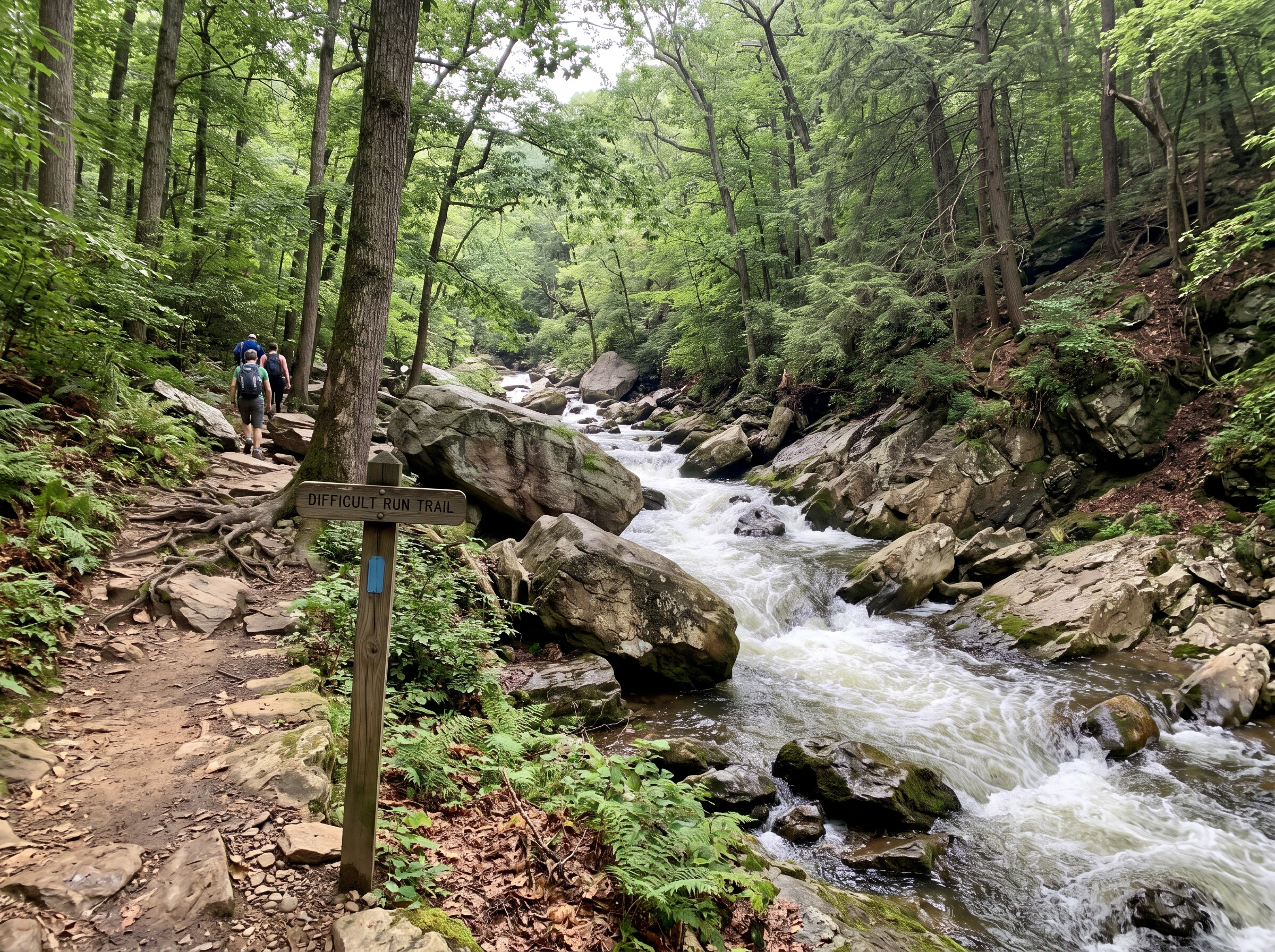
Difficult Run represents the premier environmental and luxury acreage residential corridor in northern and western Fairfax County. Spanning an expansive 58-square-mile hydrologic drainage basin, Difficult Run is the single largest watershed in the county. The primary tributary meanders for more than 35 linear miles from its headwaters near the Town of Fairfax, flowing northward through Oakton, Vienna, and Reston before cutting through a steep, dramatic rocky gorge and emptying directly into the Potomac River below the Great Falls.
Geographically centered at coordinates 38°57′20″ N latitude and 77°19′40″ W longitude, the Difficult Run estate corridor sits at elevations ranging from 220 feet above sea level near its Potomac confluence to more than 460 feet along its forested Piedmont ridgelines. The territorial landscape is bounded by prominent regional roadways: Route 7 (Leesburg Pike) to the north, Hunter Mill Road and Lawyers Road to the south and east, and the Reston Parkway / Dulles Toll Road transit corridor to the west.
Administratively, the Difficult Run corridor spans the Hunter Mill and Dranesville Magisterial Districts of Fairfax County. Residential addresses across the area carry Vienna (ZIP code 22182), Great Falls (ZIP code 22066), or Oakton (ZIP code 22124) postal designations. Spatial design across Difficult Run is characterized by expansive two- to five-acre woodland parcels, meandering country lanes with minimal commercial intrusion, stone gateposts, and mature tree canopies that create an enchanting pastoral atmosphere within minutes of Northern Virginia's premier commercial engines.
2. Colonial History & Mill Heritage: Powering Fairfax County's Early Economy
The curious name "Difficult Run" traces its roots to 18th-century colonial exploration. Early European settlers and cartographers traveling inland from Alexandria and the Potomac River encountered steep granite rock outcrops, rapid water currents, and dense swampy bottomlands, declaring the river a "difficult run" to navigate on foot or horseback.
Despite its rugged reputation, the powerful waterflow of Difficult Run became the industrial backbone of colonial and 19th-century Fairfax County. Settlers constructed numerous water-powered gristmills, timber sawmills, and iron works along its banks. The most celebrated surviving testament to this era is Colvin Run Mill, built circa 1811 along a major tributary of Difficult Run, which provided the vital technology necessary to grind wheat and corn into commercial flour for regional distribution.
During the American Civil War, the secluded ravines and timber stands along Difficult Run provided tactical cover for Confederate cavalry units, notably Colonel John S. Mosby's 43rd Virginia Cavalry battalion, who used the heavily forested river crossings along Hunter Mill Road to conduct surprise raids on Union pickets monitoring the western approaches to Washington, D.C.
3. Difficult Run Stream Valley Park & The Cross County Trail (CCT) Network
The civic and recreational heart of the community is the Difficult Run Stream Valley Park, an expansive public greenway protected and maintained by the Fairfax County Park Authority:
- Fairfax County Cross County Trail (CCT) Backbone: The Difficult Run corridor forms the primary northern section of the 40-mile Cross County Trail, which spans the entire county from Great Falls to the Occoquan River. Residents enjoy miles of continuous, multi-use hiking, running, mountain biking, and equestrian riding trails weaving directly through their backyards.
- Contiguous Parkland Connectivity: The trail network connects seamlessly with Lake Fairfax Park (featuring a 18-acre lake, marina, water park, and campgrounds), Fred Crabtree Park, and the 45-mile paved Washington & Old Dominion (W&OD) Railroad Regional Trail.
- Potomac River Gorge Excursions: At its northern terminus, the Difficult Run trail traverses rugged rocky bluffs that open onto the Potomac River, offering spectacular views of Mather Gorge and connecting directly into the national trail network of Great Falls National Park.
4. Architectural Typologies: Custom Brick Manors, Modern Farmhouses & Woodland Retreats
Residential properties throughout the Difficult Run corridor represent the zenith of custom estate craftsmanship in Northern Virginia. Rather than standard builder subdivisions, the landscape features custom homes designed to harmonize with the rolling, forested terrain:
- Stately Brick & Stone Georgian Manors: Providing 6,000 to over 10,000 square feet of finished living space, these classic residences feature full-brick or hand-chiseled stone elevations, slate roofs, circular driveway approaches with center fountains, two-story grand entry foyers, banquet-scale formal dining rooms, executive paneled studies with masonry fireplaces, chef's commercial kitchens, and walkout finished daylight basements with wine cellars and private home theaters.
- Modern Transitional Farmhouse Luxury: A popular design across custom infill properties over the past decade, these multi-acre homes blend classic rural warmth with modern luxury. Hallmarks include board-and-batten white siding, black commercial casement windows, standing-seam metal roof accents, 10-foot ceilings, expansive great rooms with exposed timber beams, and multi-slide pocket doors opening to covered outdoor entertaining verandas with built-in stone fireplaces and infinity-edge swimming pools.
- Contemporary Woodland Lodges & Cedar Retreats: Designed by renowned regional architects, these residences feature walls of glass, soaring vaulted cedar ceilings, cantilevered multi-level decks, and natural stone fireplaces engineered to offer panoramic views of the protected forest canopy and stream valley.
5. Fee-Simple Property Sovereignty: Zero Mandatory HOA Dues & Equestrian Freedom
A defining advantage of acquiring an estate in Difficult Run is the complete absence of mandatory Homeowners Association (HOA) dues or burdensome design covenants. The vast majority of custom acreage parcels operate under pure fee-simple deed ownership:
- Equestrian Land Use: Due to generous parcel dimensions (often 2 to 5 acres or more), many properties are zoned to allow private horse stables, riding paddocks, barns, and direct private trail access into the Difficult Run equestrian pathway system.
- Private Outbuildings & Guest Suites: Homeowners enjoy the flexibility to build detached guest carriage houses (ADUs), multi-vehicle car collector garages, personal tennis and pickleball courts, and resort-style swimming pools.
- Unmatched Privacy & Setbacks: Substantial lot frontages and dense mature evergreen perimeter buffers provide absolute privacy and peace, creating a serene woodland sanctuary just minutes from major metropolitan commercial centers.
6. Feeder School Pyramids: Top-Performing Fairfax County Public Institutions
Families residing in the Difficult Run corridor benefit from access to some of the highest-ranked public schools in the United States within the Fairfax County Public Schools (FCPS) system:
- Premier Elementary Academies: Depending on the specific parcel location, students attend top-ranked elementary schools including Colvin Run Elementary, Forestville Elementary, Waples Mill Elementary, or Sunrise Valley Elementary, recognized for innovative STEM learning labs and Advanced Academic Programs (AAP).
- Cooper Middle School & Carson Middle School: Intermediate students benefit from rigorous accelerated mathematics, science olympiad, and exemplary instrumental music departments.
- Langley High School Pyramid: Serving northern sections of the corridor, Langley High School is consistently ranked the #1 or #2 public high school in Virginia by U.S. News & World Report, recognized for elite AP Capstone diplomas, extraordinary college admissions, and championship athletics.
- Oakton High School Pyramid: Serving southern sections of the corridor, Oakton High School offers nationally ranked academic curricula, cutting-edge STEM and computer science academies, and state-championship performing arts.
7. Environmental Ecology: Environmental Quality Corridors & Forest Canopy
The extraordinary ecological integrity of Difficult Run is safeguarded by Fairfax County's Environmental Quality Corridor (EQC) and Resource Protection Area (RPA) policies adopted under the Chesapeake Bay Preservation Act. These regulations protect contiguous 100-foot forested buffers along all stream banks, preventing encroaching development, filtering surface runoff, and maintaining crystal-clear water quality.
The surrounding forest canopy represents an ancient oak-hickory upland ecosystem dominated by towering white oaks, northern red oaks, American beeches, tulip poplars, and flowering dogwoods. These protected greenbelts serve as permanent migratory sanctuaries for white-tailed deer, red foxes, pileated woodpeckers, barred owls, and freshwater game fish.
8. Commuter Mobility: Route 7, Dulles Toll Road & Silver Line Metrorail
Despite its quiet country setting, Difficult Run offers swift commuter transit to all major commercial destinations in the National Capital Region:
- Route 7 (Leesburg Pike): The recently expanded multi-lane expressway provides high-speed transit east to Tysons Corner in approximately 10 minutes and west into Loudoun County.
- Dulles Toll Road (Route 267): Located less than five minutes south via Hunter Mill Road, delivering direct access east to the Capital Beltway (I-495) and west to Washington Dulles International Airport.
- Silver Line Metrorail Stations: Commuters are situated within five to seven minutes of both the Wiehle-Reston East Station and Reston Town Center Station, providing one-seat rapid rail transit to Tysons, Arlington, and downtown Washington, D.C.
- Washington Dulles International Airport (IAD): Located approximately 12 to 15 minutes west, providing non-stop domestic and international commercial flights.
9. Surrounding Village Life & Cosmopolitan Retail: Great Falls, Reston & Vienna
Difficult Run residents enjoy an enviable position at the geographic nexus of Northern Virginia's most charming historic towns and modern cosmopolitan shopping destinations:
- Great Falls Village Centre: Located minutes northeast, offering intimate open-air cafes, artisan bakeries, award-winning French and Italian bistros, seasonal farmers markets, and community holiday gatherings.
- Reston Town Center: Located five minutes west, providing an urban downtown district with luxury boutiques, celebrated fine-dining steakhouses, an upscale multi-screen cinema, and an outdoor seasonal ice-skating pavilion.
- Historic Town of Vienna: Located five minutes southeast along Maple Avenue and Church Street, featuring beloved independent bookstores, gourmet delicatessens, craft coffee roasteries, and annual community festivals.
- Tysons Galleria: Positioned 10 minutes east along Route 7, offering premier luxury retail with flagship boutiques including Chanel, Gucci, Prada, and Louis Vuitton.
10. Aquatic, Equestrian & Golf Recreation: Oak Marr & Regional Clubs
Recreational opportunities surrounding Difficult Run are comprehensive and diverse:
- Oak Marr Recreation Center & Golf Course: Located along the southern edge of the corridor, this premier Fairfax County Park Authority facility features an Olympic-sized 50-meter indoor swimming pool, a modern fitness center, diving complex, and an executive 9-hole par-3 golf course and lit driving range.
- Prestigious Private Golf & Country Clubs: Minutes from premier championship golf courses, including Westwood Country Club in Vienna, River Bend Club in Great Falls, and Hidden Creek Country Club in Reston.
- Equestrian Facilities: Surrounded by private horse boarding stables, dressage arenas, and scenic bridle paths weaving through the stream valley parkland.
11. Strategic Corporate & Tech Proximity: Tysons & Dulles Tech Corridor
Difficult Run sits at the center of Northern Virginia's corporate wealth. Senior executives, tech founders, and defense leaders enjoy short, hassle-free commutes to leading regional employers:
- Tysons Corporate Epicenter: Located 10 minutes east, home to global corporate headquarters including Capital One, Freddie Mac, Hilton Worldwide, Booz Allen Hamilton, and MITRE.
- Reston / Herndon Tech Hub: Located five minutes west, home to regional campuses for Amazon Web Services (AWS), Microsoft Azure, Google Cloud, Oracle, and Cisco Systems.
- Aerospace & Defense Anchors: Immediate highway access to corporate campuses for General Dynamics, Northrop Grumman, Leidos, CACI, and Boeing.
12. Virginia Statutory Assessment Framework Under Code § 58.1-3201 & Fairfax County Mass Appraisal Equalization
Real property taxation across the Difficult Run estate corridor is governed strictly by the statutory mandates of the Code of Virginia § 58.1-3201, which requires that all real estate subject to taxation must be assessed at one hundred percent (100%) of its true fair market value. The Commonwealth of Virginia enforces this uniform standard across all jurisdictions, ensuring equitable tax distribution without arbitrary fractional adjustments or speculative assessments.
To establish fair market value, the Fairfax County Department of Tax Administration (DTA) conducts an annual computerized mass appraisal equalization. Certified appraisal specialists evaluate closed arm's-length sales of comparable custom estates and single-family properties within Difficult Run over the prior calendar year, adjusting for specific physical and location variables:
- Gross Above-Grade Living Square Footage: Precise measurement of finished above-grade living area, accounting for multi-story volume foyers, grand ballrooms, and finished custom wings.
- Parcel Acreage & Environmental Topography: Valuation differentiation reflecting one-, two-, and five-plus-acre parcel dimensions, private gated access, and mature perimeter woodland buffers backing onto protected parkland.
- Custom Architectural Finishes: Evaluation of exterior masonry craftsmanship (hand-laid stone, full brick, slate roofing) and high-end interior millwork.
- Ancillary Luxury Outbuildings: Documented valuation of detached guest carriage houses, climate-controlled collector garages, custom equestrian stables, tennis courts, and in-ground swimming pool facilities verified through Fairfax County building permits.
Fairfax County mails annual assessment notices to property owners in late February. Homeowners retain the statutory right to request an administrative review with the Department of Tax Administration, with subsequent appeal avenues available through the independent Fairfax County Board of Equalization (BOE) and the Circuit Court.
13. Comparative Analysis Matrix: Difficult Run vs. Surrounding Luxury Communities
Prospective homebuyers exploring luxury acreage real estate in northern Fairfax County frequently compare Difficult Run with neighboring high-end enclaves. The comparative matrix below outlines key structural, architectural, and governance distinctions:
| Community | Primary Eras | Dominant Architecture | HOA Governance | Signature Amenities | High School Pyramids |
|---|---|---|---|---|---|
| Difficult Run | 1980s–Present & Custom | Custom Manors on 1–5+ Wooded Acres | None (Zero Mandatory HOA) | Difficult Run Stream Valley & Cross County Trail | Langley & Oakton High |
| Great Falls | 1970s–Present & Custom | Custom Luxury Estates on 2–5 Acres | Minimal / None (Detached) | Great Falls National Park & Village Centre | Langley High School |
| Oakton | 1970–Present & Infill | Custom Colonials & Acreage Estates | Varied / Minimal HOAs | Oak Marr Rec Center & Difficult Run Trails | Oakton & Madison High |
| Wolf Trap | 1970s–Present & Infill | Custom Luxury Colonials on 0.5–2 Acres | None (Acreage) / Local (Enclaves) | Wolf Trap National Park for Performing Arts | Madison & Langley High |
| Dranesville | Historic & Custom Modern | Multi-Acre Custom Brick & Stone Manors | None (Zero Mandatory HOA) | Dranesville Tavern & Colvin Run Mill | Langley & Herndon High |
| McLean | 1950s–Present & Custom | Grand Custom Manors on 0.5–2 Acres | Minimal / Subdivision HOAs | Potomac River Estates & Tysons Corner | Langley & McLean High |
14. Frequently Asked Questions Regarding Difficult Run, VA Real Estate
What are the geographic boundaries and spatial dimensions of the Difficult Run corridor in Fairfax County?
The Difficult Run residential corridor spans approximately 35 linear miles of stream valley draining a vast 58-square-mile watershed basin in northern and western Fairfax County (ZIP codes 22182 and 22066). It encompasses parts of Oakton, Vienna, Reston, and Great Falls, bounded by Route 7 (Leesburg Pike) to the north, Hunter Mill Road and Lawyers Road to the south and east, and Reston Parkway to the west.
What is the historical and ecological significance of Difficult Run?
Difficult Run is the largest environmental watershed in Fairfax County, named during colonial settlement for the challenging rocky terrain and swift rapids faced by early explorers traveling inland from the Potomac River. It powered 18th- and 19th-century gristmills, including Colvin Run Mill, and today constitutes a protected environmental and wildlife sanctuary.
What architectural styles predominate throughout the Difficult Run residential enclave?
Difficult Run is renowned for custom luxury single-family homes situated on private one- to five-acre heavily wooded parcels. Dominant architecture includes custom brick Georgian manors, modern transitional farmhouses with board-and-batten siding, European country stone lodges, and contemporary cedar woodland retreats featuring circular motor courts and swimming pools.
Does the Difficult Run corridor have mandatory Homeowners Associations (HOAs)?
The vast majority of custom acreage estates across Difficult Run operate with zero mandatory HOA dues. Homeowners enjoy unencumbered fee-simple property sovereignty, allowing for private equestrian stables, riding paddocks, detached guest houses, and custom sports courts.
What parklands and trails exist along Difficult Run?
Residents enjoy direct access to the Difficult Run Stream Valley Park and the Fairfax County Cross County Trail (CCT), offering miles of paved and natural-surface trails for hiking, trail running, mountain biking, and horseback riding connecting directly to the 45-mile W&OD Trail, Lake Fairfax Park, and Great Falls National Park.
Which Fairfax County Public Schools serve Difficult Run residents?
Depending on neighborhood boundaries, Difficult Run is served by premier FCPS elementary schools such as Colvin Run, Forestville, and Sunrise Valley. Intermediate students attend Cooper Middle or Carson Middle, feeding into the nationally ranked Langley High School, Oakton High School, or South Lakes High School pyramids.
What commuter transit corridors and Metrorail stations serve Difficult Run?
Commuters enjoy immediate arterial access to Route 7 (Leesburg Pike), the Dulles Toll Road (Route 267), Hunter Mill Road, and Lawyers Road. The Wiehle-Reston East and Reston Town Center Metrorail Silver Line stations are located within five to ten minutes, connecting directly into Tysons, Arlington, and downtown Washington, D.C.
What shopping, dining, and village centers surround Difficult Run?
Residents are situated minutes from Great Falls Village Centre, Reston Town Center, the Town of Vienna, and Tysons Corner Galleria, offering world-class dining, boutique shopping, farmers markets, and medical centers.
What environmental conservation regulations protect Difficult Run?
Properties along Difficult Run are governed by strict Fairfax County Environmental Quality Corridor (EQC) and Resource Protection Area (RPA) buffers under the Chesapeake Bay Preservation Act, safeguarding water quality, mature native hardwood forests, and wildlife migration corridors.
How does Fairfax County assess property values across the Difficult Run estate corridor?
Pursuant to Code of Virginia § 58.1-3201, all real property is assessed annually at 100 percent of true fair market value. The Fairfax County Department of Tax Administration (DTA) conducts computerized mass appraisal equalizations analyzing verified arm's-length sales of comparable acreage estates and custom homes within Difficult Run's designated submarket codes.
Navigating Real Estate in Difficult Run & Northern Fairfax County
Whether you are preparing to list a custom multi-acre woodland manor bordering Difficult Run Stream Valley, seeking an equestrian acreage property with zero HOA fees, or evaluating residences within the Langley and Oakton pyramids, partner with trusted Northern Virginia real estate authority Elena Gorbounova for discreet, data-driven representation.