
Dunn Loring, VA Real Estate: The Definitive Guide to Historic Origins, Metrorail Connectivity & Infill Architecture
1. Executive Summary & Foundational Takeaways
Dunn Loring, Virginia, holds an exceptional, storied pedigree within the residential topography of Fairfax County. Encompassing postal ZIP code 22027, Dunn Loring bears the profound historic distinction of being the earliest platted residential subdivision in Fairfax County, chartered in 1886. Positioned precisely between the Town of Vienna to the west, Tysons to the north, and Merrifield to the south, Dunn Loring blends late-nineteenth-century village heritage with modern transit-oriented prominence.
Administratively situated within the Providence Magisterial District, Dunn Loring is an unincorporated census-designated place (CDP) governed directly by the Fairfax County Board of Supervisors. This governance reality provides residents with premier county services, law enforcement, and infrastructure under a single county real estate tax assessment, free from the secondary municipal taxes or autonomous town council oversight found in neighboring incorporated jurisdictions.
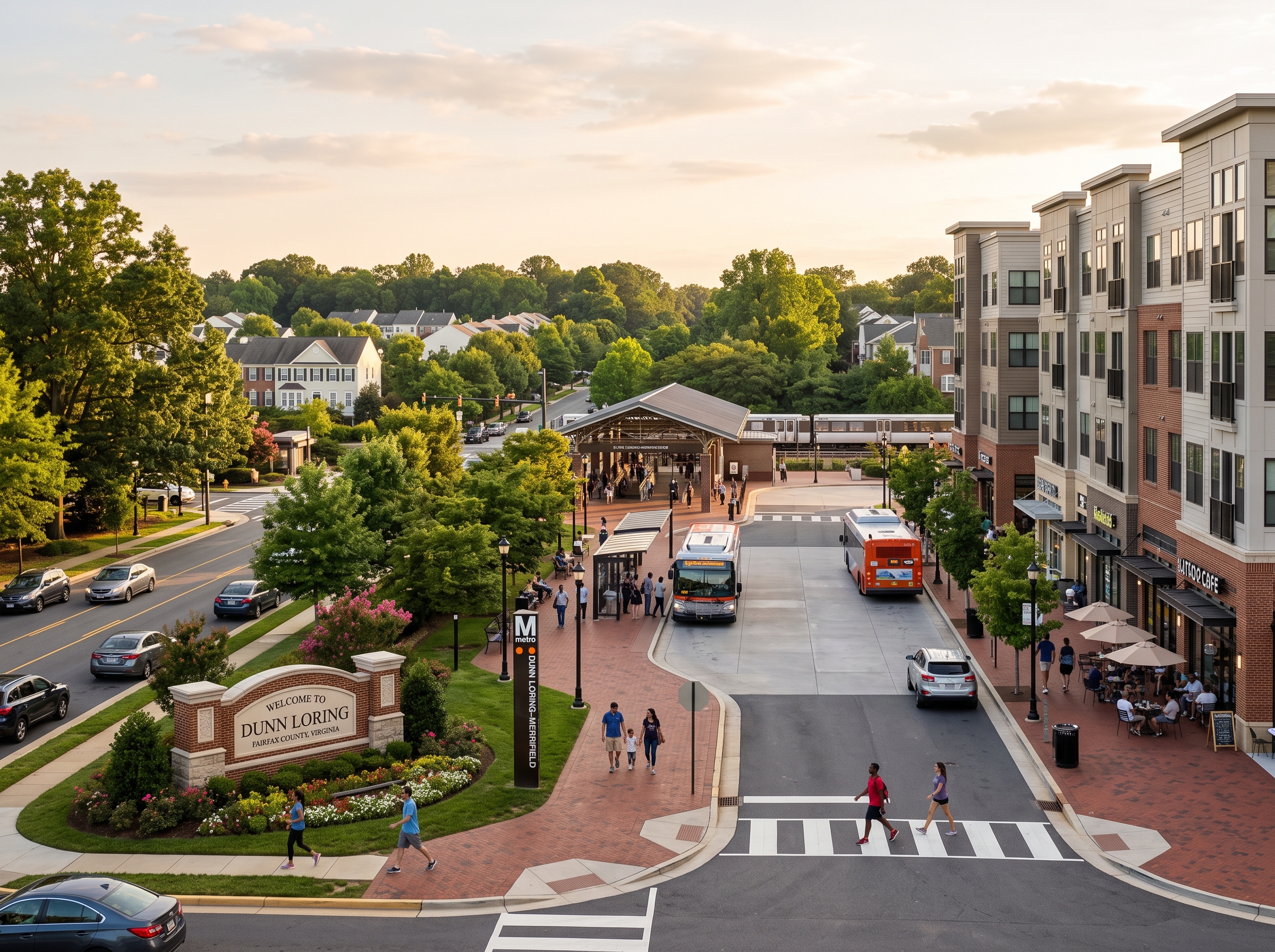
Anchored by the Dunn Loring-Merrifield Metrorail Station on the Orange Line and bisected by the historic Washington & Old Dominion (W&OD) Trail, the submarket offers immediate multimodal transit alongside expansive, wooded half-acre parcels. Its housing fabric represents a fascinating chronological continuum: restored Victorian farmhouses, early twentieth-century Craftsman bungalows, classic 1960s split-levels in Dunn Loring Woods, and dramatic multi-million-dollar modern luxury infill estates.
The Six Structural Pillars of Dunn Loring Real Estate
- Earliest Platted Subdivision Heritage (1886). A historic railroad town planned by General William McKee Dunn and Dr. George B. Loring along the W&OD corridor, characterized by generous residential parcels and ancient oak tree canopies.
- Direct Heavy-Rail Metrorail Infrastructure. Walkable access to the Dunn Loring-Merrifield Metrorail Station on the Washington Metro Orange Line, offering congestion-free transit to Arlington, the Pentagon, and downtown Washington, D.C.
- The W&OD Trail Linear Park Greenway. Direct access to the 45-mile paved regional park trail running through the community, functioning as an active non-motorized cycling commuter corridor and recreational spine.
- High-Value Infill Estate Capital Attraction. Substantial lot dimensions (averaging 0.35 to 0.75+ acres) driving significant investment in custom luxury craftsman, transitional, and modern farmhouse replacement estates.
- The George C. Marshall High School IB World Pyramid. Top-tier public secondary education within Fairfax County Public Schools (FCPS), featuring the prestigious International Baccalaureate (IB) Diploma Programme.
- Fee-Simple Independence Without Municipal Surtaxes. Overwhelmingly non-HOA single-family homeownership free from monthly association fees, combined with the fiscal advantage of paying no secondary incorporated town taxes.
2. Comprehensive Historical Evolution
The archival chronicle of Dunn Loring embodies the golden era of post-Civil War railroad expansion, military mobilization, and pioneer residential platting in Northern Virginia.
1886 Founding & The Loring Land Company
In 1886, General William McKee Dunn (former Judge Advocate General of the U.S. Army) and his son-in-law Dr. George Bailey Loring (former U.S. Congressman from Massachusetts and U.S. Commissioner of Agriculture under Presidents Garfield and Arthur) acquired approximately 600 acres of picturesque rolling farmland along the Alexandria, Loudoun & Hampshire Railroad (later the Washington & Old Dominion Railroad).
Dunn and Loring incorporated the Loring Land Company, officially filing the first recorded subdivision plat in the history of Fairfax County. The founders designed a visionary residential village featuring a passenger rail depot, a post office, a general store, and wide avenues named after indigenous trees—including Chestnut, Hickory, Oak, and Pine. They envisioned an idyllic retreat for federal statesmen, military officers, and merchants seeking escape from the summer heat of Washington, D.C.
Camp Russell A. Alger & The Spanish-American War (1898)
In May 1898, following the outbreak of the Spanish-American War, the federal government selected the rolling fields of Dunn Loring to establish Camp Russell A. Alger. Named in honor of the Secretary of War, the military base served as the primary mobilization and training camp for the Second Army Corps.
Over 33,000 volunteer troops from across the United States were garrisoned in canvas tent cities across Dunn Loring. The rail depot operated around the clock handling troop trains, munitions, and hospital provisions. Although the camp was decommissioned following the brief war, its presence spurred extensive infrastructure improvements, road grading, and national recognition for the crossroads settlement.
Suburban Expansion & The 1960s Dunn Loring Woods Boom
Throughout the first half of the twentieth century, Dunn Loring retained its rural railroad-village charm, dotted with Victorian farmhouses, orchards, and Sears kit homes. In the early 1960s, suburban developers platted Dunn Loring Woods south of the historic core.
Featuring solid brick split-levels, split-foyers, and ramblers, Dunn Loring Woods provided high-quality housing for federal civil servants and aerospace engineers working in the burgeoning capital region. The arrival of Interstate 66 and the construction of the Metrorail Orange Line extension in the 1980s permanently cemented Dunn Loring as an elite commuter address.
3. Physical Geography, Topography & Hydrology
Geologically situated on the upland crystalline Piedmont plateau, Dunn Loring features elevated, gently rolling topography with elevations varying from 310 to 410 feet above sea level. The bedrock comprises ancient metamorphic schist, granitic gneiss, and metagraywacke formations, providing exceptional structural bearing strength for custom infill construction.
Dunn Loring's hydrological network is divided into two primary regional watersheds:
- The Accotink Creek Watershed: Draining the southern and western sectors of Dunn Loring, tributary streams flow south toward Lake Accotink, creating lush wooded ravines that provide natural buffers between residential enclaves.
- The Wolf Trap Creek Watershed: Draining northern Dunn Loring, streams flow northward into Difficult Run before discharging into the Potomac River gorge.
Environmental conservation is strictly regulated by the Chesapeake Bay Preservation Act (CBPA) and Chapter 118 of the Fairfax County Code. Parcels abutting designated perennial stream channels are encumbered by statutory 100-foot Resource Protection Area (RPA) vegetative buffers. Within an RPA, the removal of mature trees and the construction of permanent impermeable structures are legally prohibited, preserving clean water quality and native wildlife corridors.
4. The Complete Dunn Loring Neighborhood Dossier
Dunn Loring is characterized by distinct residential micro-enclaves, each offering specific architectural profiles and parcel dimensions.
Historic Dunn Loring Village
The original 1886 platted core surrounding Gallows Road, Idylwood Road, and the W&OD Trail retains remarkable historic character. Featuring tree-named avenues, this enclave contains original late-nineteenth-century Victorian farmhouses with wrap-around porches, early twentieth-century Sears catalog bungalows, and sprawling half-acre parcels. In recent decades, this enclave has emerged as a premier canvas for custom builders constructing multi-million-dollar luxury infill estates.
Dunn Loring Woods
Developed primarily between 1962 and 1968, Dunn Loring Woods is an established community of over 500 single-family residences. Dominated by classic brick split-levels, split-foyers, and ramblers set upon flat, manicured lots averaging 0.25 to 0.35 acres, the neighborhood features mature street canopies, an active voluntary civic association, and the private Dunn Loring Swim Club, a beloved focal point for neighborhood social life.
Stenwood & Sandburg Corridors
Positioned along the western edge of Dunn Loring bordering Vienna, the Stenwood and Sandburg enclaves feature tranquil cul-de-sacs, direct walking paths to Stenwood Elementary School, and generous wooded lots. The neighborhood showcases a harmonious mix of well-maintained mid-century colonials and substantial custom infill homes.
Dunn Loring Metro Transit-Oriented Clusters
Situated immediately adjacent to the Metrorail station on Gallows Road are modern luxury transit-oriented communities, including Avenir Place and Halstead at Metro. These upscale developments offer contemporary mid-rise condominium flats, street-level Harris Teeter grocery conveniences, boutique dining, swimming pools, fitness clubs, and direct covered pedestrian bridge access to the Orange Line train platforms.
5. Architectural Typologies
Dunn Loring's residential housing inventory provides an authentic physical catalog spanning over 135 years of American domestic architecture:
- Victorian Farmhouses & Queen Anne Residences (1886–1910): Iconic historical homes featuring cross-gable rooflines, decorative turned-wood spindlework, wrap-around rocking-chair verandas, cedar clapboard siding, original heart-pine flooring, and stone foundations.
- Craftsman Bungalows & Sears Catalog Kit Homes (1915–1935): Single- and 1.5-story homes featuring wide overhanging eaves with exposed rafter tails, tapered front porch columns on brick piers, low-pitch gables, and handcrafted interior built-ins.
- Mid-Century Split-Levels & Brick Ramblers (1960–1972): The architectural backbone of Dunn Loring Woods. Staggered floor plans separating public living rooms from private upper-level bedroom wings and ground-level family rooms with brick wood-burning fireplaces.
- 21st-Century Custom Luxury Infill Mansions: Substantial custom estates constructed on original half-acre village lots. Showcasing modern farmhouse and transitional craftsman architecture, 10-foot ceilings, three-car garages, chef-grade culinary kitchens, multi-zone geothermal or high-efficiency HVAC, and outdoor entertaining loggias.
6. County Zoning & Land-Use Governance
Land use across Dunn Loring is governed by the Fairfax County Zoning Ordinance (zMOD), designed to safeguard low-density residential stability while managing transit-oriented nodes.
Low-Density Residential Districts
The single-family neighborhoods of Dunn Loring fall under established low-density classifications:
- R-1 District (Residential, One Unit/Acre): Applied to large-lot parcels along historic village avenues, mandating minimum lot sizes of 36,000 square feet, 150-foot lot widths, and 40-foot front setbacks.
- R-2 District (Residential, Two Units/Acre): Requiring minimum lot areas of 20,000 square feet, 100-foot lot widths, and 35-foot front setbacks, establishing generous spatial buffers between neighboring homes.
- R-3 District (Residential, Three Units/Acre): The dominant designation across Dunn Loring Woods, requiring 10,500-square-foot minimum lots and maximum building heights of 35 feet.
7. Educational Ecosystem & School Pyramids
Public education in Dunn Loring is provided by Fairfax County Public Schools (FCPS), anchored primarily by the acclaimed George C. Marshall High School Pyramid.
The George C. Marshall High School International Baccalaureate (IB) Pyramid
The secondary educational anchor for Dunn Loring is George C. Marshall High School (Statesmen), situated on University Drive. Marshall High is an authorized International Baccalaureate (IB) World School, celebrated for its rigorous IB Diploma Programme, AP/IB course blends, advanced STEM academies, and championship athletics in VHSL Class 6.
Marshall High is fed by Kilmer Middle School (renowned for its Science Olympiad and advanced humanities) and premier elementary feeder schools:
- Stenwood Elementary School: Located within Dunn Loring, Stenwood houses an official FCPS Advanced Academic Programs (AAP) Level IV center, offering full-time accelerated curricula for gifted elementary students.
- Shrevewood Elementary School: Celebrated for academic excellence, inclusive learning environments, and active parent-teacher community engagement.
Adjacent School Pyramids & Magnet Programs
Depending on specific residential boundary lines, select western streets in Dunn Loring feed into the James Madison High School pyramid in Vienna. High-achieving secondary students across Dunn Loring are eligible to apply through regional competitive screening to the Thomas Jefferson High School for Science and Technology (TJHSST).
8. Multi-Modal Commuting & Regional Arterials
Dunn Loring occupies an enviable position within the Northern Virginia transit grid, offering seamless multimodal options:
- Dunn Loring-Merrifield Metrorail Station: Heavy-rail transit on the Orange Line, providing direct commuter service west to Vienna and east to Ballston, Rosslyn, the Pentagon, and downtown Washington, D.C.
- The Washington & Old Dominion (W&OD) Trail: Passing directly through the heart of the community, this 45-mile paved linear park serves as a premier off-road non-motorized cycling commuter highway connecting to Vienna, Reston, and Arlington.
- Interstate 66 & The Capital Beltway: Immediate interchange access to I-66 and Interstate 495, enabling rapid highway commutes to Tysons, the Mosaic District, and Dulles International Airport.
- Arterial Road Network: Gallows Road, Idylwood Road, Cedar Lane, and Route 123 (Chain Bridge Road) provide fluid local connectivity across Fairfax County.
9. Parks, Community Life & Civic Institutions
Dunn Loring balances tranquil woodland residential privacy with abundant civic open spaces and recreational amenities:
W&OD Railroad Regional Park
The linear parkland of the W&OD Trail is the central recreational spine of Dunn Loring. Residents enjoy immediate trail access from neighborhood streets for walking, jogging, cycling, and rollerblading along shaded corridors framed by historic woodland canopies.
Dunn Loring Park & Neighborhood Playgrounds
Covering over 10 acres of protected woodland along Idylwood Road, Dunn Loring Park features tennis courts, basketball courts, picnic pavilions, children's playgrounds, and peaceful nature walking paths winding through the Accotink Creek tributary ravine.
The Dunn Loring Swim Club
A cherished community fixture since 1963, the private Dunn Loring Swim Club serves as the social epicenter for neighborhood families during summer months, featuring a 25-meter competitive lap pool, diving well, baby pool, shaded picnic groves, and competitive swim and dive teams (the Dolphins).
10. Fiscal Architecture, Taxation & HOA Nuances
Real estate ownership in Dunn Loring is governed by Virginia statutory property tax codes and Fairfax County fiscal policy.
Fairfax County Assessment & Single Tax Advantage
Under Virginia Code Title 58.1, real property in Dunn Loring is assessed annually at 100 percent of fair market value by the Fairfax County Department of Tax Administration. Because Dunn Loring is unincorporated, property owners pay a single unified real estate tax bill to Fairfax County. Homeowners do not pay secondary town municipal taxes, resulting in a substantial tax advantage compared to properties situated within the incorporated Town of Vienna.
Fee-Simple Freedom vs. Transit Condominiums
The single-family neighborhoods of historic Dunn Loring and Dunn Loring Woods are overwhelmingly non-HOA fee-simple communities. Property owners are free from mandatory monthly dues and private architectural review boards, enjoying full property sovereignty governed solely by Fairfax County building codes. Conversely, modern transit-oriented condominium buildings near the Metro concourse operate under mandatory associations managing structured parking, security systems, and capital reserve funds.
11. Strategic Buyer Guidance
Acquiring residential property in Dunn Loring requires structured due diligence tailored to property vintage:
- Historic Property Infrastructure Audits: For homes dating to the late 19th or early 20th century, evaluate foundation stone and brick mortar integrity, historical electrical knob-and-tube or ungrounded wiring replacements, and verify whether municipal sewer connections were completed or legacy septic drain fields remain.
- Basement Moisture in 1960s Split-Levels: In Dunn Loring Woods, inspect cinder-block foundation walls for hydrostatic moisture pressure, step cracking, and efflorescence. Verify perimeter drain tiles and sump pump operational integrity.
- Tree Canopy Protection & RPA Buffer Checks: When planning custom additions, pools, or replacement construction, examine county GIS environmental overlays to ensure proposed building footprints do not encroach upon statutory 100-foot RPA stream buffers.
12. Strategic Seller Guidance
Homeowners preparing to list property in Dunn Loring should execute targeted positioning:
- Highlight Underlying Land Equity: Generous lot dimensions (0.35 to 0.75+ acres) represent immense intrinsic value; emphasize parcel frontage, private woodland settings, and expansion potential compared to dense outer developments.
- Promote Metrorail & W&OD Walkability: Prominently feature exact walking times to the Dunn Loring Metrorail Station and W&OD Trail, a prime selling point for D.C. professionals and cycling enthusiasts.
- Feature the Marshall High School IB Feeder: Academic boundaries driving the George C. Marshall High School and Stenwood Elementary AAP pyramids generate substantial buyer demand; ensure school feeder zones are clearly highlighted.
13. Submarket Comparative Matrix
The following analytical matrix compares Dunn Loring with neighboring Northern Virginia suburban and municipal submarkets:
| Submarket | Governance Structure | Dominant Housing Stock | Typical Lot Dimensions | Transit & Highway Access | HOA Prevalence |
|---|---|---|---|---|---|
| Dunn Loring | Unincorporated Fairfax County (Providence District) | Victorian Farmhouses, 1960s Split-Levels, Custom Infill Mansions | 0.28 to 0.75+ Acres | Dunn Loring Metro (Orange), I-66, Gallows Rd, W&OD Trail | Predominantly Non-HOA Fee-Simple |
| Town of Vienna | Incorporated Municipality within Fairfax County | Historic Homes, Modest Ramblers, Substantial Infill Estates | 0.20 to 0.35 Acres | Route 123 (Maple Ave), Vienna Metro Access, W&OD Trail | Municipal Town Zoning, Strict ARB; Secondary Town Tax |
| Merrifield | Unincorporated Fairfax County (Providence District) | Urban Rooftop Townhomes, Luxury Condos, Mid-Century Ramblers | Urban Footprint to 0.30 Acres | Dunn Loring Metro, I-495 Beltway, I-66, Route 50/29 | Mandatory HOAs/Condos in Core; Non-HOA in Borders |
| Oakton | Unincorporated Fairfax County (Providence District) | Custom Luxury Colonials, Wooded Multi-Acre Estates | 0.50 to 2.00+ Acres | Route 123, I-66, Proximity to Vienna Metrorail | Mix of Non-HOA and Custom Planned Associations |
| McLean | Unincorporated Fairfax County (Dranesville District) | Grand Architectural Mansions, High-End Custom Infill | 0.50 to 1.50+ Acres | Route 123, GW Parkway, Silver Line Metro Access | Predominantly Non-HOA Fee-Simple Luxury Estates |
14. 10 Comprehensive Evergreen FAQs
1. What is the historical significance of Dunn Loring, Virginia?
Founded in 1886 by General William McKee Dunn and his son-in-law Dr. George B. Loring (U.S. Commissioner of Agriculture), Dunn Loring holds the distinction of being the earliest platted residential subdivision in Fairfax County. Developed around a dedicated passenger depot on the Washington and Old Dominion (W&OD) Railroad, the community was designed with tree-named avenues, historic Victorian farmhouses, and Sears catalog homes.
2. Is Dunn Loring an incorporated town or part of Fairfax County?
Dunn Loring is an unincorporated census-designated place (CDP) governed directly by the Fairfax County Board of Supervisors within the Providence Magisterial District. It is not an incorporated municipality. Property owners pay a single unified real estate tax bill to Fairfax County, avoiding secondary town municipal taxes.
3. Does Dunn Loring have direct Metrorail access?
Yes. Dunn Loring is served directly by the Dunn Loring-Merrifield Metrorail Station on the Washington Metro Orange Line, situated on Gallows Road. The heavy-rail transit facility features an integrated structured commuter garage, pedestrian bridges, and direct service west to Vienna and east to Ballston, Arlington, and downtown Washington, D.C.
4. What architectural home styles predominate in Dunn Loring?
Dunn Loring features an extraordinary architectural spectrum: restored late 19th-century Victorian farmhouses and Craftsman bungalows in the historic village core, established 1960s split-levels and brick ramblers in Dunn Loring Woods, and dramatic multi-million-dollar custom luxury infill craftsman and modern farmhouse estates on generous half-acre parcels.
5. Which public schools serve Dunn Loring residents?
Dunn Loring is served primarily by the George C. Marshall High School academic pyramid within Fairfax County Public Schools (FCPS). Marshall High is an authorized International Baccalaureate (IB) World School, fed by Kilmer Middle School and Stenwood Elementary School (featuring an FCPS Advanced Academic Programs Level IV center). Select western streets feed into the James Madison High School pyramid.
6. How does the W&OD Trail function within Dunn Loring?
The 45-mile paved Washington & Old Dominion (W&OD) Railroad Regional Park passes directly through Dunn Loring, tracing the historic rail line that gave birth to the town. The trail serves as a premier recreational greenway and an active non-motorized commuter highway for cyclists and runners commuting between Vienna, Falls Church, and Arlington.
7. Do neighborhoods in Dunn Loring have mandatory Homeowners Associations (HOAs)?
The vast majority of single-family residential properties in historic Dunn Loring and Dunn Loring Woods are completely fee-simple non-HOA properties, granting owners freedom from mandatory monthly assessments and private covenants. Conversely, modern transit-oriented condominium and townhome clusters near the Metro concourse operate under mandatory associations.
8. What major highways provide access to Dunn Loring?
Dunn Loring occupies an exceptional regional highway position, bordered by Interstate 66, Gallows Road, Route 123 (Chain Bridge Road), Route 7 (Leesburg Pike), and the Interstate 495 Capital Beltway, providing rapid access to Tysons, the Mosaic District, and Washington, D.C.
9. How is zoning regulated for custom infill construction in Dunn Loring?
Residential zoning is governed by Fairfax County zMOD under districts such as R-1 (1 unit/acre), R-2 (2 units/acre), and R-3 (3 units/acre). These classifications enforce minimum lot sizes, 30- to 35-foot front setbacks, and building height caps of 35 feet, preserving neighborhood tree canopies and spatial character during custom infill redevelopment.
10. How does Dunn Loring compare to neighboring Vienna and Tysons?
Dunn Loring provides the quiet, wooded, large-lot residential charm of Vienna and the world-class transit and commercial access of Tysons, without the secondary municipal taxes or strict Architectural Review Board restrictions of the incorporated Town of Vienna, or the high-density commercial congestion of Tysons.
15. Legal & Fair Housing Disclaimer
This real estate and community monograph is published strictly for educational, demographic, and historical research purposes. All municipal boundaries, zoning districts, school attendance zones, tax assessments, and transit plans are derived from official Fairfax County public records, the Washington Metropolitan Area Transit Authority (WMATA), and the Code of Virginia, and are subject to periodic administrative modification. Prospective purchasers, sellers, and investors must independently examine official subdivision plats, zoning codes, and deed encumbrances through licensed legal and real estate professionals prior to executing contractual agreements. This publication strictly adheres to Title VIII of the Civil Rights Act of 1968 (The Federal Fair Housing Act) and the Virginia Fair Housing Law, prohibiting discrimination on the basis of race, color, religion, sex, handicap, familial status, elderliness, or national origin.