
Fairfax Station, VA Real Estate: The Definitive Guide to Multi-Acre Estate Zoning, Occoquan Watershed Conservation & Elite School Pyramids
1. Executive Summary & Foundational Takeaways
Fairfax Station, Virginia, represents one of the most prestigious, environmentally protected, and tranquil luxury estate sanctuaries in the National Capital Region. Situated across the rolling topography of southern Fairfax County within the Springfield Magisterial District (encompassing postal ZIP code 22039), Fairfax Station is defined by its expansive one-to-five-acre private parcels, mature virgin hardwood forests, and profound sense of pastoral seclusion.
Unlike denser suburban corridors across Northern Virginia, Fairfax Station owes its enduring low-density morphology to landmark municipal conservation planning. In 1982, the Fairfax County Board of Supervisors enacted historic downzoning across the Occoquan Reservoir Water Supply Watershed, establishing R-C (Residential-Conservation) zoning requiring minimum five-acre parcel sizes to safeguard regional drinking water. Combined with R-E (Residential Estate, two-acre minimum) and R-1 (one-acre minimum) zoning, this regulatory shield permanently insulated Fairfax Station from commercial strip development and high-density tract subdivision.
Despite its idyllic woodland character, Fairfax Station offers exceptional regional access. Residents enjoy swift transit via the Burke Centre VRE Station (providing direct commuter rail to Crystal City and Washington Union Station), the Fairfax County Parkway (Route 286), and Route 123 (Ox Road). Academic excellence is anchored by two of Fairfax County Public Schools' most celebrated secondary programs: the South County High School and Robinson Secondary School (International Baccalaureate) pyramids, alongside bordering parklands including the 888-acre Burke Lake Park and Fountainhead Regional Park.
The Six Structural Pillars of Fairfax Station Real Estate
- 1982 Occoquan Watershed Conservation Downzoning. Stringent R-C (5-acre) and R-E (2-acre) minimum zoning mandates that permanently preserve dense forest canopies, stream valleys, and low-density estate character.
- Private Multi-Acre Estate Architecture. Custom-built executive manors, European chateaus, and equestrian properties with sweeping circular driveways, private tennis courts, and multi-stall horse facilities.
- Burke Centre VRE Commuter Rail Nexus. Located just minutes from the Burke Centre station, offering effortless, traffic-free rail transit into Alexandria, Crystal City, L'Enfant Plaza, and Washington Union Station.
- Elite FCPS Secondary Academic Pyramids. Neighborhoods feed into the acclaimed South County High School and Robinson Secondary School (IB Diploma Programme), with regional admissions access to TJHSST.
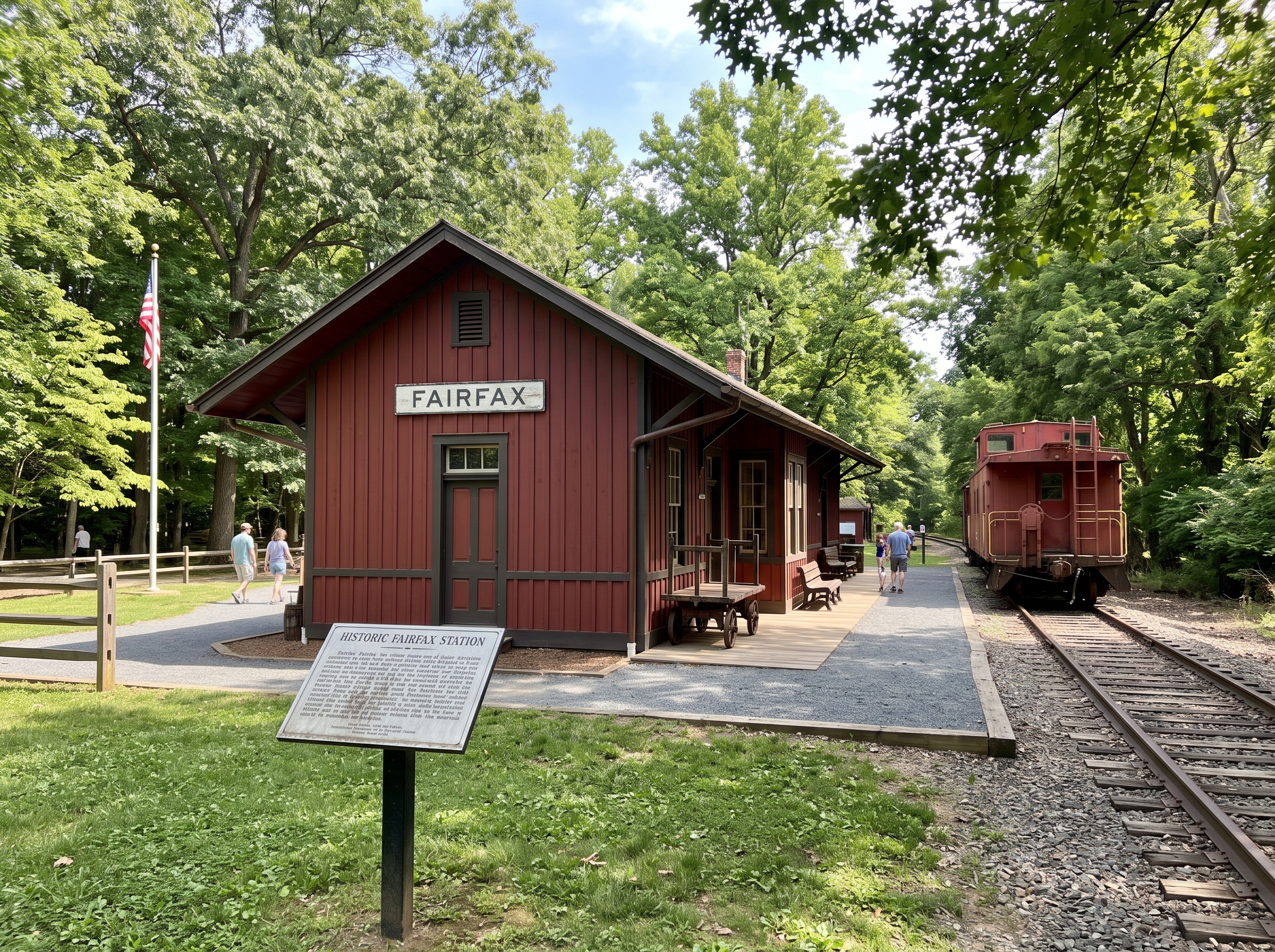
- Rich Civil War & Red Cross Heritage. Anchored by the historic 1852 Orange & Alexandria Railroad Depot where Clara Barton famously tended over 3,000 wounded soldiers, preserved today as the Fairfax Station Railroad Museum.
- Bordering Regional Parklands & Waterways. Bounded by the 888-acre Burke Lake Park, Fountainhead Regional Park marina, and Sandy Run Olympic rowing boathouse on the Occoquan Reservoir.
2. Geopolitical Identity & Unincorporated County Stewardship
Fairfax Station is an unincorporated residential community governed directly by the Fairfax County Board of Supervisors within the Springfield Magisterial District. Because it is not an incorporated municipality, Fairfax Station has no separate town mayor, town council, or municipal police force.
Public administration and life safety services are delivered directly by unified county agencies:
- Fairfax County Police Department (FCPD): Patrolled primarily by the West Springfield District Station (Station 5), providing dedicated neighborhood patrols and rural road traffic enforcement.
- Fairfax County Fire and Rescue: Station 43 (Crosspointe) and Station 41 (Crosspointe/Fairfax Station area) provide advanced life support, heavy rescue, and specialized rural water supply operations.
- Fairfax County Maintenance & Public Works: Oversight of stormwater management easements, county parklands, and environmental watershed monitoring.
Real property taxation in Fairfax Station operates strictly under Virginia Code Title 58.1-3201, which mandates annual real estate assessments at 100 percent of fair market value conducted by the Fairfax County Department of Tax Administration (DTA). Residents pay unified county property taxes without any supplemental town-level levies, providing exceptional tax efficiency for large-acreage homeowners.
3. Historical Evolution: From O&A Railroad Depot to Clara Barton's Relief
The heritage of Fairfax Station is inextricably linked to the construction of the Orange and Alexandria Railroad (O&A RR) in the early 1850s. Built to connect the port of Alexandria with Gordonsville and agricultural producers throughout the Piedmont, the railroad completed its modest wooden depot at Fairfax Station in 1852. The station quickly became a vital freight link, shipping timber, milk, and grain to urban markets.
During the American Civil War, the O&A Railroad became one of the most fiercely contested military logistical lifelines in North America. Following the devastating Second Battle of Bull Run (Manassas) and the Battle of Chantilly (Ox Hill) in late August and early September 1862, thousands of wounded Union soldiers were evacuated by rail to the depot at Fairfax Station.
Hearing of the dire medical crisis, Clara Barton—a former patent clerk who would later establish the American Red Cross—traveled to Fairfax Station by train. Operating under harrowing battlefield conditions with little sleep, Barton worked untiringly alongside army surgeons for several days, dressing wounds, preparing warm soup, and consoling more than 3,000 casualties.
Another enduring historical landmark is St. Mary's Historic Catholic Church on Route 123 (Ox Road). Constructed in 1858 by Irish immigrant laborers building the railroad, St. Mary's served as a temporary hospital during the Civil War and is listed on the National Register of Historic Places. The original wooden railroad depot was meticulously dismantled, moved, and reconstructed, now operating as the Fairfax Station Railroad Museum, a vibrant educational center celebrating rail heritage and Civil War medicine.
4. The Occoquan Reservoir Watershed & The 1982 Downzoning Legacy
The defining architectural and developmental characteristic of Fairfax Station is the landmark 1982 Occoquan Basin Downzoning, widely considered one of the most significant environmental land-use decisions in twentieth-century American municipal history.
The Occoquan Reservoir serves as a primary source of clean drinking water for hundreds of thousands of Northern Virginia residents. In the late 1970s, rapid suburban sprawl threatened to cover the watershed in high-density subdivisions, commercial asphalt, and heavy stormwater runoff. Recognizing the existential threat to water quality, the Fairfax County Board of Supervisors voted in 1982 to rezone more than 41,000 acres of land within the watershed to the R-C (Residential-Conservation) district, establishing a mandatory five-acre minimum parcel size.
While vigorously contested by speculative land developers at the time, the downzoning was upheld by the Virginia Supreme Court. This historic regulatory mandate established a permanent greenbelt across southern Fairfax Station, ensuring that future residential construction would be restricted to low-density executive manors, horse farms, and protected forest reserves.
5. Housing Stock & Architectural Morphology
Fairfax Station real estate is distinguished by its architectural individuality, expansive square footage, and generous lot configurations:
- Custom Executive Brick Colonials: Developed extensively between the 1980s and 2000s in neighborhoods like Station Landing and Hampton Forest. These stately residences feature symmetrical brick facades, two-story grand foyers, sweeping curved staircases, formal living and dining rooms, chef kitchens with granite/quartz islands, expansive primary bedroom wings, and side-load three-car garages.
- European & French Provincial Stone Manors: Sited on two-to-five-acre parcels throughout the R-E and R-C zones, these residences feature cut natural stone exteriors, slate-look architectural shingles, porte-cochères, soaring vaulted ceilings, temperature-controlled wine cellars, and finished daylight walkout basements opening to resort-style outdoor living spaces.
- Transitional & Modern Craftsman Infill Estates: Over the past decade, custom luxury builders have constructed substantial craftsman-style residences featuring cedar shakes, stone pillars, expansive wrap-around porches, open-concept main levels, main-level multi-generational suites, and advanced smart-home and geothermal infrastructure.
- Equestrian Properties & Country Farmsteads: Situated along Colchester Road, Ox Road, and Wolf Run Shoals Road, these specialized properties encompass multi-stall horse barns, tack rooms, wash stalls, illuminated riding arenas, and fenced paddocks with direct access to private equestrian trails.
- Master-Planned Suburban Residences in Crosspointe: Single-family detached homes on manicured quarter-acre to half-acre parcels offering traditional two-story colonial layouts, two-car attached garages, and full access to community amenities.
6. Prominent Neighborhoods & Residential Submarkets
Fairfax Station encompasses several distinguished residential enclaves, each offering a specific topographical setting and lifestyle focus:
- Crosspointe: The premier master-planned community of Fairfax Station, featuring over 1,000 single-family homes. Built around 82 acres of communal conservation parkland, Crosspointe includes two community recreation centers, swimming pools, tennis courts, athletic fields, and miles of paved multi-use trails circling scenic Silverbrook ponds.
- Station Landing & Station Hills: Stately executive communities located in the historic core of Fairfax Station near the railroad depot. Featuring custom brick manors on wooded one-to-three-acre lots with deep setbacks, mature trees, and direct access to Route 123 and Fairfax County Parkway.
- Hampton Forest & Chapel Acres: Exclusive enclaves of custom luxury estates situated on secluded two-to-five-acre parcels. Known for long private asphalt drives, gated motor courts, and serene natural privacy.
- Occoquan Overlook & Woodglen: Luxury single-family neighborhoods situated near the southern boundary, offering scenic ridge views toward the Occoquan Reservoir and immediate proximity to Fountainhead Regional Park.
- Country Club View & Fairview Enclaves: Located in northern Fairfax Station near the Robinson Secondary School pyramid, featuring mature center-hall colonials on leafy half-acre to one-acre parcels.
- Colchester Road Equestrian Corridor: A picturesque rural-estate spine lined with fenced horse paddocks, riding stables, and sprawling custom multi-acre retreats.
7. Neighborhood & Submarket Comparative Matrix
The following analytical matrix compares the architectural, spatial, and infrastructural profiles across seven prominent residential submarkets in Fairfax Station:
| Submarket Enclave | Predominant Housing Typology | Era / Architectural Style | Commuter & Transit Access | Lot Sizes & Setbacks | Key Defining Characteristics |
|---|---|---|---|---|---|
| Crosspointe | Master-Planned Single-Family Detached | 1980s–1990s Colonial & Transitional | Quick access to Route 286 & VRE | 0.25 to 0.50 Acres; Manicured lawns | Two community pool complexes; 82 acres of conservation trails; Silverbrook Elementary |
| Station Landing | Custom Executive Brick Colonials | 1990s–2000s Stately Colonial | 5 mins to Burke Centre VRE; Route 123 | 1.0 to 2.5 Acres; Deep wooded setbacks | Proximity to historic depot; grand foyers; side-load 3-car garages; mature hardwoods |
| Hampton Forest | Custom Stone & Brick Manors | 1990s–2010s Custom Luxury | Direct Route 123 & Silverbrook access | 2.0 to 5.0+ Acres; Private gated drives | R-C/R-E conservation zoning; maximum privacy; daylight walkouts; wooded seclusion |
| Chapel Acres | Luxury Transitional & Craftsman Estates | 1980s–Present Custom Infill | Rapid connection to Fairfax Co. Pkwy | 1.5 to 3.0 Acres; Rolling contours | Cul-de-sac privacy; architectural individuality; expansive outdoor living installations |
| Occoquan Overlook | Executive Colonials & Provincial Estates | 1990s Traditional Suburban Luxury | Access to Route 123 toward I-95 | 0.75 to 1.5 Acres; Elevated ridgelines | Scenic reservoir views; direct proximity to Fountainhead Regional Park marina |
| Colchester Corridor | Equestrian Farmsteads & Acreage Estates | 1970s–Present Rural Custom | Vehicular; Scenic country byways | 3.0 to 10.0+ Acres; Pastures & barns | Horse stables; riding rings; direct access to regional bridle trails; rural serenity |
| Woodglen / Fairview | Center-Hall Brick Colonials & Ramblers | 1970s–1980s Established Suburban | Quick transit north to City of Fairfax | 0.50 to 1.0 Acre; Mature trees | Robinson Secondary pyramid; established quiet residential lanes; large private yards |
8. Public Education & Fairfax County Public Schools (FCPS) Pyramids
Fairfax Station real estate values are heavily fortified by access to two of Fairfax County Public Schools (FCPS)' top-performing secondary educational pyramids:
- The South County High School Pyramid: Serving southern and central Fairfax Station, including the master-planned community of Crosspointe. Anchored by South County High School (opened 2005 in Lorton, home of the SoCo Lions), a state-of-the-art secondary campus featuring specialized fine arts academies, competitive athletics, and comprehensive Advanced Placement (AP) coursework. The pyramid is supported by South County Middle School and the highly acclaimed Silverbrook Elementary School, which is physically situated within Crosspointe and serves as a major community focal point.
- The Robinson Secondary School Pyramid: Serving northern sections of Fairfax Station. Robinson Secondary (home of the Rams) is renowned regionally and nationally for offering the prestigious International Baccalaureate (IB) Diploma Programme, which fosters rigorous collegiate-level scholarship and critical thinking. Feeder primary institutions include Fairview Elementary School and Bonnie Brae Elementary School.
- Lake Braddock Secondary School Pyramid: Select eastern enclaves feed into Lake Braddock Secondary in Burke, renowned for elite academic curricula, band programs, and championship sports.
Furthermore, academically advanced eighth-grade students residing in Fairfax Station are eligible to apply for admission to Thomas Jefferson High School for Science and Technology (TJHSST), the regional governor's school in Alexandria that is consistently recognized as the premier public high school in the United States.
9. Regional Connectivity, Arterial Corridors & VRE Rail Access
A primary advantage of Fairfax Station is its rare ability to combine tranquil multi-acre country living with rapid, multi-modal commuter connectivity to regional employment centers:
- The Burke Centre VRE Station: Situated just 5 to 10 minutes from most Fairfax Station neighborhoods, this modern commuter rail depot on the Virginia Railway Express (VRE) Manassas Line provides comfortable, Wi-Fi-equipped, one-seat passenger rail service directly to the City of Alexandria (King Street), Crystal City (Amazon HQ2 / Pentagon City), L'Enfant Plaza, and Washington Union Station. Commuters read or work without experiencing interstate highway gridlock.
- Fairfax County Parkway (Route 286): Serving as the primary arterial spine bisecting the community, this multi-lane, grade-separated expressway provides an unobstructed, high-speed connection north to I-66, Fair Oaks, Reston, and Dulles Airport, and south to I-95, Fort Belvoir, and Springfield.
- Route 123 (Ox Road): An essential north-south highway connecting Fairfax Station south across the Occoquan River into Prince William County (Woodbridge, Lake Ridge), and north past George Mason University directly into the City of Fairfax, Oakton, and Tysons.
- Interstate 95 (I-95) & Express Lanes Proximity: Located approximately 10 to 12 minutes southeast via Silverbrook Road, granting swift access to the reversible I-95 Express Lanes for southbound travel toward Quantico and Richmond, or northbound travel to the Pentagon.
10. Parks, Watersheds, Marinas & Equestrian Preserves
Surrounded by thousands of acres of protected parkland, Fairfax Station is arguably Northern Virginia's finest haven for outdoor recreational enthusiasts:
- Burke Lake Park: Bordering the northern perimeter of Fairfax Station, this 888-acre county park features a 218-acre freshwater fishing and boating lake, a 4.7-mile shaded gravel perimeter walking/running trail, an 18-hole par-3 golf course with a lighted driving range, disc golf, miniature train, and seasonal boat rentals.
- Fountainhead Regional Park: Situated on the scenic southern shores of the Occoquan Reservoir, Fountainhead provides deep-water boat ramps for motorized and non-motorized vessels, kayak rentals, challenging multi-mile mountain bike trails, and the northern terminus of the celebrated 17.5-mile Bull Run Occoquan Trail.
- Sandy Run Regional Park: Located on the Occoquan Reservoir, Sandy Run serves as an elite, world-class rowing facility, housing boathouses and racing courses for high school, collegiate, and Olympic-caliber rowers from across the Mid-Atlantic.
- Equestrian Trails & Boarding: With its extensive horse-friendly zoning, Fairfax Station features private riding stables, boarding farms, and dedicated equestrian trail easements winding through wooded stream valleys.
11. Environmental Infrastructure: Well, Septic & Soil Dynamics
Infrastructural mechanics in Fairfax Station vary fundamentally between master-planned communities and multi-acre estate parcels:
- Master-Planned Public Infrastructure: Subdivisions like Crosspointe are fully integrated into municipal public water and sanitary sewer lines managed by Fairfax Water and the Fairfax County Department of Public Works.
- Private Well Water Systems: Multi-acre parcels across the R-E and R-C zones rely on private deep-drilled wells tapping fractured bedrock aquifers. These wells provide pristine groundwater, typically supplemented by modern whole-house water filtration and water-softening systems.
- Engineered On-Site Septic Systems: Due to the absence of public sewer mains in conservation zones, estate homes utilize on-site sewage disposal systems. Properties utilize either conventional gravity drainfields or modern alternative on-site sewage systems (AOSS)—including drip dispersal and pretreatment units—which are regulated and permitted by the Fairfax County Health Department.
12. Civic Identity, Cultural Heritage & Local Community Life
Fairfax Station maintains an intimate, highly cohesive civic identity. The heartbeat of community history resides at the Fairfax Station Railroad Museum, which hosts monthly model train running sessions, historical reenactments, Civil War medical living-history events, and seasonal holiday festivals that draw families from across the county.
Neighborhoods like Crosspointe foster vibrant social traditions through active volunteer committees, seasonal swim team competitions (Crosspointe Cruisers), July 4th community parades, and outdoor movie nights. The absence of commercial strip shopping malls within Fairfax Station preserves a serene, park-like residential sanctuary where neighbors value peace, natural beauty, and dark night skies.
13. Zoning Architecture: R-C, R-E & Conservation Overlay Covenants
Land use throughout Fairfax Station is governed under Fairfax County's updated zMOD Zoning Ordinance, with an emphasis on low-density estate conservation:
- R-C (Residential-Conservation): Mandates a minimum parcel size of five contiguous acres (217,800 square feet) per single-family residence, with strict caps on impervious surface area and mandatory environmental protection of natural drainage swales and stream buffers.
- R-E (Residential Estate): Mandates a minimum parcel size of two contiguous acres (87,120 square feet), establishing generous front, side, and rear building setbacks to preserve wooded buffers between adjacent residences.
- Accessory Structures & Equestrian Usages: Properties with sufficient acreage are permitted by-right to construct accessory detached structures, including horse stables, riding rings, carriage barns, and private guest cottages, subject to county setback and health department sanitary regulations.
14. Real Estate Market Dynamics: Tenured Ownership & Intergenerational Value
The residential market in Fairfax Station is defined by structural scarcity, exceptional ownership longevity, and deep value stability:
- Multi-Decade Ownership Tenures: Because Fairfax Station offers expansive acreage and top-tier public schools within commuting distance of Washington, D.C., homeowners frequently remain in their properties for 20 to 30 years, resulting in chronically low inventory levels across detached estate homes.
- High-Level Demographics: The community attracts senior federal executives, defense contractors, military flag officers stationed at the Pentagon or Fort Belvoir, specialized medical practitioners, and corporate leaders seeking privacy and land.
- Defensive Value Stability: The absolute legal prohibition against dense subdivision in the Occoquan watershed permanently caps total housing supply, protecting long-term capital preservation across changing national economic cycles.
- Statutory Assessment Transparency: Real property assessments are conducted annually at 100 percent of fair market value under Virginia Code Title 58.1-3201 by Fairfax County, ensuring predictable, unified county tax oversight.
15. Strategic Advisory & Buyer/Seller Due Diligence Framework
Purchasing or marketing a luxury estate in Fairfax Station involves specialized due diligence considerations unique to acreage properties:
- Septic System Inspection & Certification: Buyers must require full inspection and pumping of on-site septic systems, verifying tank integrity, drainfield absorption capacity, and health department operation permits.
- Well Water Quality & Flow Rate Testing: Comprehensive laboratory testing should verify flow rates (gallons per minute) and water quality (potability, mineral hardness, pH, and absence of nitrates or coliform bacteria).
- School Attendance Verification: Because Fairfax Station spans the South County, Robinson, and Lake Braddock secondary boundaries, buyers must cross-reference prospective parcel addresses with the official FCPS Boundary Locator tool.
- Conservation Easements & Private Road Agreements: Properties accessed via private gravel or paved lanes should have recorded joint maintenance agreements, while watershed conservation easements must be verified for restrictions on future tree clearing or outbuilding construction.
16. Frequently Asked Questions Regarding Fairfax Station Real Estate
Is Fairfax Station an incorporated town or an unincorporated community?
Fairfax Station is an unincorporated residential community situated in southern Fairfax County, Virginia, primarily within the Springfield Magisterial District. Because it possesses no separate town charter, municipal governance, public safety, and public schools are administered directly by Fairfax County government, meaning homeowners pay unified county property taxes without any separate town tax levies.
What is the 1982 Occoquan Watershed downzoning, and how does it protect Fairfax Station?
In 1982, the Fairfax County Board of Supervisors enacted landmark environmental downzoning across more than 41,000 acres in the Occoquan Reservoir watershed, establishing the R-C (Residential-Conservation) zoning classification with a strict 5-acre minimum parcel size. This historic legal action permanently prevented high-density tract subdivision, safeguarding regional drinking water supplies, protecting virgin hardwood forests, and cementing Fairfax Station as a premier low-density estate sanctuary.
Which public high school pyramids serve Fairfax Station?
Fairfax Station is primarily served by two distinguished Fairfax County Public Schools secondary pyramids: South County High School (home of the SoCo Lions, fed by South County Middle and Silverbrook Elementary) serving southern neighborhoods, and Robinson Secondary School (home of the Rams, renowned for its full International Baccalaureate IB Diploma Programme) serving northern sections. Select eastern neighborhoods feed into Lake Braddock Secondary. High-achieving students may also apply to the regional governor's school, Thomas Jefferson High School for Science and Technology (TJHSST).
What commuter rail transit options serve Fairfax Station?
Fairfax Station residents enjoy direct access to the Burke Centre VRE Station, located just 5 to 10 minutes from most neighborhoods. The Virginia Railway Express (Manassas Line) provides relaxing, one-seat commuter rail service directly into the City of Alexandria, Crystal City, L'Enfant Plaza, and Washington Union Station, completely bypassing interstate highway congestion.
What is the historical significance of the Fairfax Station Railroad Depot and Clara Barton?
Completed in 1852 on the Orange and Alexandria Railroad, Fairfax Station served as a vital strategic supply depot during the Civil War. Following the Second Battle of Bull Run and the Battle of Chantilly in August-September 1862, Clara Barton—later founder of the American Red Cross—arrived at the depot to administer medical aid, food, and bandages to over 3,000 wounded Union soldiers. The preserved depot now operates as the Fairfax Station Railroad Museum.
What is the master-planned community of Crosspointe in Fairfax Station?
Crosspointe is one of Fairfax Station's most celebrated master-planned communities, comprising over 1,000 single-family detached homes on generous landscaped lots. The community features two comprehensive recreation centers, swimming pools, tennis and pickleball courts, playgrounds, and over 82 acres of communal conservation parkland and nature trails surrounding Silverbrook ponds.
Do homes in Fairfax Station rely on private wells and septic systems?
While master-planned developments like Crosspointe are served by public water and municipal sewer, the vast majority of multi-acre estate parcels across Fairfax Station (especially in R-C and R-E zones) rely on private deep-drilled drinking water wells and engineered on-site septic absorption drainfields. This absence of municipal sewer mains serves as a permanent structural barrier against higher-density suburban infill.
What parklands and outdoor recreational amenities surround Fairfax Station?
Fairfax Station is enveloped by extraordinary regional parklands, including the 888-acre Burke Lake Park (218-acre lake, 4.7-mile trail, par-3 golf course, driving range, and marina), Fountainhead Regional Park (deep-water boat launches on the Occoquan Reservoir, mountain biking, and the Bull Run Occoquan Trail), and Sandy Run Regional Park (premier Olympic rowing training facility).
How are real estate property taxes assessed in Fairfax Station?
In accordance with Virginia Code Title 58.1-3201, real property in Fairfax Station is assessed annually at 100 percent of fair market value by the Fairfax County Department of Tax Administration (DTA). The real estate tax rate is set each spring by the Fairfax County Board of Supervisors to fund public education, public safety, and infrastructure.
What architectural styles predominate throughout Fairfax Station?
Fairfax Station features an array of custom executive architecture, including stately center-hall brick colonials, European and French Provincial stone manors, custom Craftsman estates, and sprawling equestrian properties with detached carriage houses and multi-stall horse barns.
17. Municipal & Architectural Data Verification Checklist
Essential Public Records Checklist for Prospective Buyers
- Fairfax County Land Records & Tax Assessment. Verify property valuation records, tax maps, and deed history through the Fairfax County DTA online portal.
- Septic & Well Health Department File. Obtain the original septic installation permit, drainfield reserve area map, and well log from the Fairfax County Health Department Division of Environmental Health.
- School Boundary Confirmation. Cross-reference parcel addresses with the official FCPS Boundary Locator system to confirm South County High versus Robinson Secondary feeder status.
- Occoquan Watershed Overlay Regulations. Examine R-C or R-E zoning requirements regarding maximum lot coverage, environmental buffer preservation, and accessory barn setbacks.
- VRE Commuter Rail Schedule. Review Virginia Railway Express Manassas Line timetable and parking permit protocols at the Burke Centre VRE Station.
Informational & Research Monograph Notice: This research monograph is published exclusively for educational, historical, and community research purposes. All municipal boundaries, school attendance zones, architectural classifications, zoning codes, and transit routes are compiled from published public records of Fairfax County, Virginia, and Fairfax County Public Schools.
Equal Housing Opportunity: All real estate practices adhere strictly to the Federal Fair Housing Act, the Virginia Fair Housing Law, and local human rights ordinances. No representations are made regarding property valuations or mortgage underwriting terms. Prospective buyers and sellers are advised to consult licensed Virginia real estate attorneys, soil scientists, and the Fairfax County Department of Planning and Development for property-specific zoning verifications.