
Franconia, VA Real Estate: The Definitive Guide to Spatial Morphology, Dual-Rail Transit, 193-Acre Franconia Park & Residential Enclaves
Executive Summary & Essential Community Takeaways
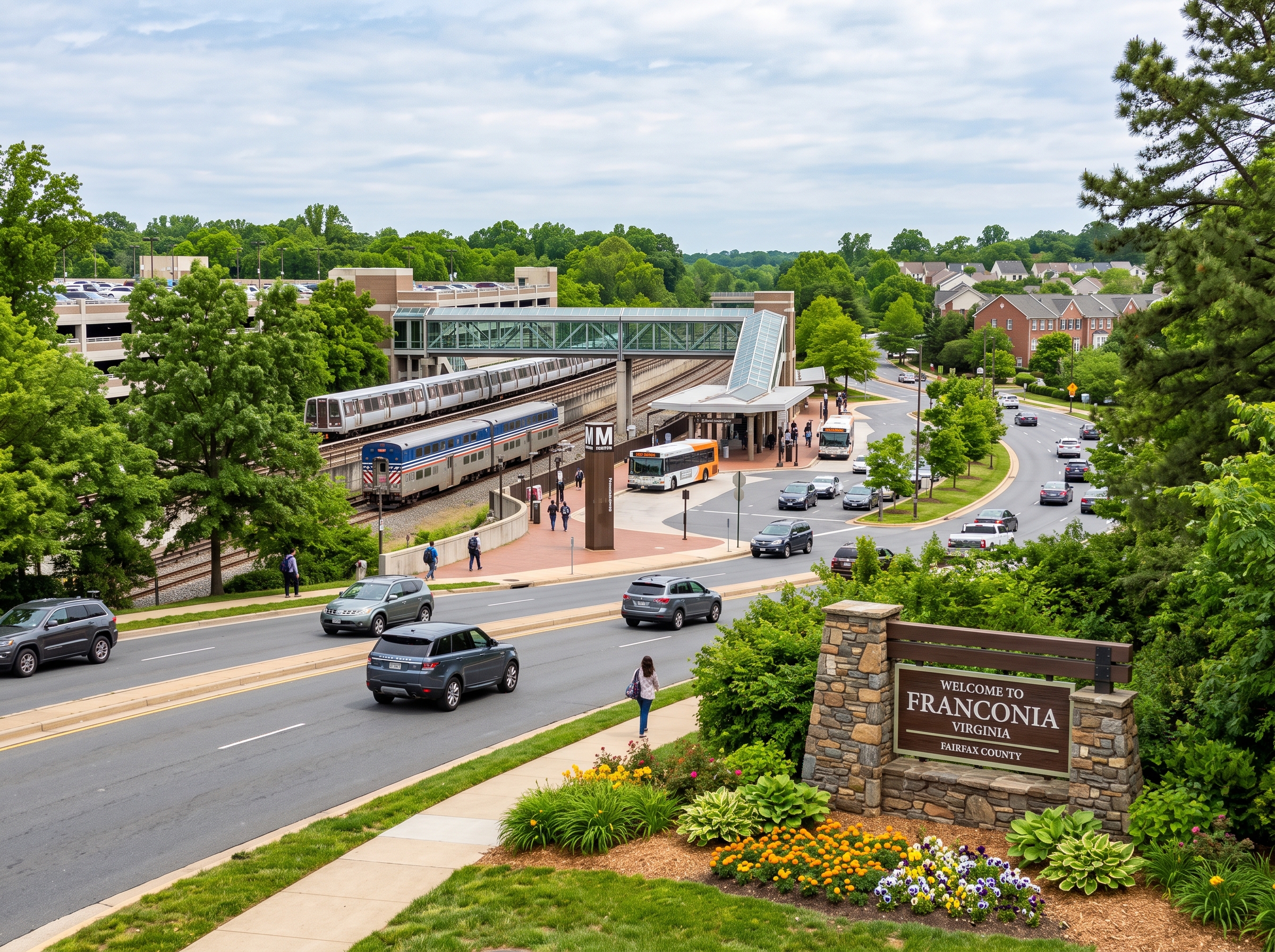
- Multimodal Regional Transportation Nexus: Franconia is anchored by the Franconia-Springfield Transportation Center—serving as the southern terminus of the Metrorail Blue Line and hosting the Virginia Railway Express (VRE Fredericksburg Line)—alongside the Springfield Interchange ("Mixing Bowl") linking I-95, I-395, and I-495.
- Historic Railroad Origins & Magisterial Renaming: Established in the early 1870s as a freight and passenger whistle-stop on the Richmond, Fredericksburg and Potomac (RF&P) Railroad, Franconia was officially commemorated when the Fairfax County Board of Supervisors renamed the magisterial jurisdiction the Franconia District.
- 193-Acre Franconia Park & RECenter Campus: Operated by the Fairfax County Park Authority, this regional recreation hub features an indoor 50-meter Olympic-sized competition pool, comprehensive fitness center, lighted ball diamonds, soccer turf, amphitheater, "Our Special Harbor" spray ground, and inclusive play facilities.
- Diverse Housing Continuum: Features quiet mid-century single-family neighborhoods (such as Bush Hill, Bush Hill Woods, and Windsor Park) with solid brick ramblers and split-levels, alongside established planned townhome communities (Franconia Commons, Franconia Forest) and custom infill estates.
- Top-Tier FCPS Academic Pyramids: Primary attendance feeds directly into the Thomas A. Edison High School International Baccalaureate (IB) World School pyramid (housing the specialized Edison Academy for technical sciences), Mark Twain Middle School (AAP Level IV Center), and Franconia Elementary School.
- Virginia Statutory Assessment Standards: Real property is evaluated under Virginia Code § 58.1-3201 at 100 percent of fair market value by the Fairfax County Department of Tax Administration (DTA) with semi-annual tax installments due on July 28 and December 5.
1. Spatial Morphology, Boundaries & Regional Geography
Franconia represents one of the most strategically connected residential and commercial submarkets in Fairfax County. Designated as an unincorporated census-designated place (CDP) situated within the Franconia Magisterial District (postal ZIP codes 22310 and 22315), the community occupies approximately 3.5 square miles in eastern Fairfax County, positioned immediately east of Springfield, north of Kingstowne, and southwest of the City of Alexandria.
The spatial perimeter of Franconia is delineated by major transportation arteries and historic roadway corridors:
- West Boundary: Interstate 95 and the CSX / RF&P railroad right-of-way, transitioning into the commercial hub of Springfield Town Center and the industrial corridors of Loisdale Road.
- North Boundary: The Capital Beltway (Interstate 495) and South Van Dorn Street, buffering Franconia from Lincolnia and the Landmark corridor of Alexandria.
- East Boundary: Telegraph Road (State Route 611) and the historic Bush Hill ridge, bordering the mature suburban neighborhoods of Rose Hill and Wilton Woods.
- South Boundary: Beulah Street (Route 613), Manchester Boulevard, and Kingstowne Boulevard, blending smoothly into the master-planned communities of Kingstowne and Island Creek.
2. Historical Evolution: 19th-Century RF&P Railroad Whistle-Stop to District Seat
The historical trajectory of Franconia illustrates Northern Virginia's transition from agrarian rail corridor into a dynamic, multimodal civic center.
The RF&P Railroad & Franconia Station (1870–1940)
In the early 1870s, the Richmond, Fredericksburg and Potomac (RF&P) Railroad established a rural passenger depot and freight whistle-stop named Franconia Station along its main north-south trunk line. Named either in honor of the historic German region of Franconia (Franken) or after an early local farmstead, the depot served as a vital shipping point for local dairy farmers, fruit orchardists, and timber mills dispatching products northward into the port city of Alexandria and the capital markets of Washington, D.C.
Surrounding the depot, a small hamlet developed along Franconia Road and Beulah Street, featuring a country general store, a blacksmith shop, a post office, and local churches that served rural farming families across southern Fairfax County.
Post-WWII Suburban Expansion (1950–1980)
With the post-World War II expansion of the federal government and the construction of the Shirley Highway (Interstate 395) and the Capital Beltway (I-495) in the early 1960s, Franconia's farms were acquired for suburban residential development. Subdivisions such as Bush Hill Woods, Windsor Park, and St. Louis were platted, delivering sturdy single-family brick ramblers and split-levels on quarter-to-third-acre parcels beneath mature oak and hickory canopies.
During the 1970s and 1980s, master-planned townhome communities—such as Franconia Forest and Franconia Commons—were introduced, providing high-density, low-maintenance housing options for the region's growing professional workforce.
The Metrorail Revolution & Magisterial District Renaming
In 1997, the opening of the Franconia-Springfield Metrorail Station as the southern terminus of the Blue Line transformed Franconia into one of Northern Virginia's preeminent multimodal transportation hubs. The station complex integrated heavy-rail Metrorail, commuter rail (VRE), express bus transit, and park-and-ride facilities directly connected to the regional highway system.
In recognition of Franconia's central geographic, economic, and civic significance, the Fairfax County Board of Supervisors officially voted in 2022 to rename the former Lee Magisterial District as the Franconia Magisterial District, cementing the community's identity as the institutional and administrative anchor of southeastern Fairfax County.
3. Residential Enclaves, Neighborhood Typologies & Architectural Morphology
Franconia features a mature, highly balanced housing continuum that spans mid-century brick single-family neighborhoods, established master-planned townhome clusters, modern infill estates, and transit-adjacent condominiums.
| Residential Subdivision / Enclave | Primary Architectural Style | Construction Era | Typical Lot Dimensions / Density | Fairfax County Zoning |
|---|---|---|---|---|
| Bush Hill & Bush Hill Woods | Brick Ramblers, Multi-Level Split-Levels | 1954 – 1968 | 0.25 to 0.40 Acre Parcels | R-3 / R-4 (Single-Family Residential) |
| Windsor Park & St. Louis | Mid-Century Ranchers & Split-Foyers | 1958 – 1972 | 0.22 to 0.35 Acre Lots | R-3 / R-4 (Suburban Residential) |
| Franconia Forest & Franconia Commons | Colonial Multi-Story Brick Townhomes | 1974 – 1985 | Townhome Platted Parcels | PDH-8 / PDH-12 (Planned Development) |
| Clermont & Wilton Woods Border | Stately Center-Hall Brick Colonials | 1965 – 1985 | 0.30 to 0.50 Acre Elevated Lots | R-2 / R-3 (Low Density Residential) |
| Island Creek Border Enclaves | Executive Single-Family & Luxury Townhomes | 1992 – 2004 | Master-Planned Community Parcels | PDH-4 / PDH-8 (Master-Planned Cluster) |
| Custom Infill Estates (Scattered) | Transitional Craftsman & Modern Farmhouses | 2010 – Present | 0.25 to 0.45 Acre Replacement Lots | R-3 (Single-Family Infill) |
Bush Hill & Bush Hill Woods
Situated between Franconia Road and Telegraph Road, Bush Hill and Bush Hill Woods are among Franconia's most cherished mid-century single-family communities. Properties feature generous front lawn setbacks, deep rear yards, and solid masonry construction utilizing authentic red-brick exteriors. The neighborhood is shaded by a mature canopy of native white oaks and flowering dogwoods, with quiet interior streets free from cut-through traffic.
Franconia Forest & Franconia Commons Townhomes
Developed during the mid-1970s and 1980s, communities like Franconia Forest and Franconia Commons set the standard for master-planned townhome living in eastern Fairfax County. These residences showcase traditional three-level brick colonial designs with fenced private rear patios, walk-out finished lower levels, dedicated assigned parking, and community recreation facilities including swimming pools, tennis courts, and tot lots.
Custom Modern Infill Construction
Driven by Franconia's exceptional commuter logistics, custom residential builders have systematically acquired older homes on select quarter-acre to half-acre lots to construct substantial transitional Craftsman and modern farmhouse residences. These modern homes feature open-concept floor plans, 10-foot ceilings, professional chef kitchens, attached two-car garages, and high-performance building envelopes.
4. Structural Anatomy, Building Eras & Property Maintenance
Purchasing and managing real estate in Franconia requires specialized technical understanding of both mid-century building assemblies and modern planned community construction:
Mid-Century Single-Family Masonry Homes (1950–1975)
- Foundations & Soil Mechanics: Typically constructed with concrete masonry unit (CMU) block or poured concrete crawl spaces and basements. Properties situated along the rolling stream ravines of Accotink tributaries require positive exterior grading slope (minimum 5 percent fall away from foundation walls for 10 feet) and functional downspout extensions to manage hydrostatic soil pressure.
- Plumbing Supply & Cast Iron DWV: Water supply is delivered through rigid copper piping (Type L). Original drain-waste-vent (DWV) stacks utilize heavy-duty cast iron. Homebuyers should commission a fiber-optic video camera sewer scope inspection of the sewer lateral from the cleanout to the street connection to evaluate for root penetration from mature oak trees and internal iron corrosion.
- Electrical Service Infrastructure: Original installations often featured 60-amp or 100-amp split-bus electrical panels. Modern living demands upgrading to 200-amp circuit breaker panels with AFCI and GFCI protection to safely support modern central heat pumps and electric vehicle charging equipment.
- Attic Ventilation & Roof Decks: Framed with dimensional 2x6 rafters or early pre-engineered trusses sheathed in 1x6 tongue-and-groove boards or plywood. Ensuring balanced attic airflow through continuous soffit intake vents and ridge exhaust vents prevents winter ice damming and extends asphalt shingle lifespan.
Modern Planned Community Construction (1990–Present)
- Engineered Assemblies: Feature engineered wood floor I-joists, laminated veneer lumber (LVL) load-bearing beams, and high-durability exterior cladding including fiber-cement and insulated vinyl siding.
- Energy Efficiency & Multi-Zone HVAC: Conditioned via multi-zone variable-speed heat pumps or high-efficiency gas furnaces paired with programmable smart thermostats, sealed ductwork, and Low-E argon-insulated windows.
5. Public Education Infrastructure: FCPS School Pyramids & Academic Profiles
Franconia is served exclusively by Fairfax County Public Schools (FCPS), recognized nationally for academic excellence and comprehensive student development. The community is anchored primarily by the Thomas A. Edison High School Pyramid.
| School Facility | Grade Levels | Pyramidal Feeder Alignment | Curriculum Programs & Academic Honors |
|---|---|---|---|
| Thomas A. Edison High School | Grades 9 – 12 | Edison High Pyramid | Authorized International Baccalaureate (IB) World School, Full IB Diploma, Edison Academy (STEM/Biotech) |
| Mark Twain Middle School | Grades 7 – 8 | Edison High Pyramid | Full-Time Advanced Academic Programs (AAP Level IV Center), Accelerated Math & World Languages |
| Franconia Elementary School | Pre-K – Grade 6 | Edison High Pyramid | STEAM Innovation Focus, Responsive Classroom Model, Comprehensive Modernization Campus |
| Bush Hill Elementary School | Pre-K – Grade 6 | Edison High Pyramid | Advanced Academic Programs (AAP), Eco-Schools USA Green Flag Award, Community Garden Labs |
| Hayfield Secondary School | Grades 7 – 12 | Hayfield Pyramid (South Border) | Comprehensive 7–12 Secondary Campus, Advanced Placement (AP) Capstone, STEM Initiatives |
The International Baccalaureate (IB) Diploma at Edison High
Thomas A. Edison High School is an authorized International Baccalaureate (IB) World School. Eleventh and twelfth graders can elect to pursue the prestigious full IB Diploma Programme. The rigorous two-year curriculum demands college-level coursework across six academic disciplines, an independent 4,000-word Extended Essay research thesis, the interdisciplinary Theory of Knowledge (TOK) capstone seminar, and 150 hours of Creativity, Activity, Service (CAS).
The Specialized Edison Academy
Edison High also houses the Edison Academy, an elite career and technical education center serving students from across southern Fairfax County. The academy offers advanced coursework in biomedical sciences, cyber security, veterinary science, architectural engineering, automotive technology, and electrical construction, providing students with industry credentials alongside standard academic diplomas.
Mark Twain Middle School & Advanced Academic Programs (AAP)
Franconia middle school students attend Mark Twain Middle School, an official Full-Time AAP Level IV Center. Twain delivers an accelerated curriculum in English, science, social studies, and accelerated mathematics (Geometry Honors and Algebra I Honors). Additionally, rising eighth graders in Franconia are eligible to apply through the competitive regional admissions process for Thomas Jefferson High School for Science and Technology (TJHSST) in nearby Lincolnia.
6. Transportation Logistics, Commuter Corridors & Dual-Rail Transit
Few residential submarkets in Northern Virginia match Franconia for comprehensive, multimodal transportation logistics.
The Franconia-Springfield Transportation Center
Located directly within the community, this multimodal transit facility provides:
- Metrorail Blue Line: Southern terminus offering a direct, one-seat heavy-rail ride to the Pentagon (18 min), Arlington National Cemetery, Rosslyn (24 min), and Metro Center in downtown Washington, D.C. (30 min).
- Virginia Railway Express (VRE): Fredericksburg Line commuter rail service providing weekday express transit to Alexandria, Crystal City, L'Enfant Plaza, and Washington Union Station.
- Park-and-Ride Capacity: A multi-level parking garage providing over 5,000 commuter parking spaces, electric vehicle charging stations, and covered bicycle lockers.
- Bus Transit Hub: Regional bus bays serving Fairfax Connector and Metrobus routes connecting to Fort Belvoir, Kingstowne, and Tysons.
Major Highway Arterials & The Springfield Interchange
- The Springfield Interchange ("Mixing Bowl"): Immediate access to the convergence of Interstate 95, Interstate 395, and the Capital Beltway (Interstate 495), offering unparalleled vehicular access in all directions.
- I-395 Express Lanes: Dedicated high-occupancy toll lanes providing rapid, congestion-free express commuting directly across the 14th Street Bridge into downtown Washington, D.C.
- Fairfax County Parkway (Route 286): High-capacity parkway transit connecting Franconia directly to Fort Belvoir, Burke, Fair Oaks, and Reston.
- Franconia Road (Route 644) & Telegraph Road: Primary local arterial corridors providing smooth east-west and north-south movement across eastern Fairfax County.
7. Environmental Topography, Stream Valleys & Protected Regional Parklands
Franconia sits across the rolling topography of the Atlantic Coastal Plain Fall Line transition, drained by natural headwater tributaries of Accotink Creek, Cameron Run, and Dogue Creek that feed into the tidal Potomac River basin.
Franconia Park: The 193-Acre Regional Recreation Hub
Operated by the Fairfax County Park Authority, Franconia Park (formerly Lee District Park) is one of the premier outdoor recreation campuses in the National Capital Region. Spanning 193 acres along Telegraph Road, amenities include:
- The Franconia RECenter: A 65,000-square-foot indoor facility featuring a 50-meter Olympic competition pool, diving well, multi-tier fitness center, dance studios, and racquetball courts.
- Athletic Complexes: Lighted baseball/softball diamonds, regulation soccer/lacrosse turf fields, and outdoor lighted tennis and pickleball courts.
- Inclusive Recreation: Home to the "Our Special Harbor" spray park, a fully accessible Chesapeake Bay-themed water play facility, and "Chessie's Big Backyard" universally accessible playground.
- Nature Trails & Amphitheater: Paved and natural walking trails traversing mature hardwood forests, alongside an outdoor amphitheater hosting community concerts.
Protected Stream Corridors & Historic Sites
- Accotink Stream Valley: An environmental quality corridor (EQC) preserving riparian buffers and providing connected off-street trails linking north toward Lake Accotink Park.
- Bush Hill Historic Grounds: Preserves the historic hilltop vantage point associated with Bushrod Washington, offering panoramic woodland vistas.
8. Real Estate Assessment Cycles & Virginia Statutory Tax Framework
Real estate taxation in Franconia operates strictly under the statutory framework of the Commonwealth of Virginia and the administrative authority of Fairfax County. Because Franconia is an unincorporated community within Fairfax County, property owners pay municipal real estate taxes solely to Fairfax County, with zero supplemental city-level property tax millages.
Virginia Code Title 58.1-3201: The 100% Fair Market Value Mandate
Under Virginia Code § 58.1-3201, all real property in Virginia must be assessed for tax purposes at one hundred percent (100%) of its true fair market value. The Fairfax County Department of Tax Administration (DTA) conducts comprehensive annual reassessments of every taxable parcel in Franconia. Valuations are determined through mass appraisal market equalization based on verified arm's-length sales of comparable properties within identical neighborhood submarket codes, accounting for lot size, topography, structural square footage, and property condition.
Annual Assessment Calendar & Payment Schedules
- January 1 (Statutory Effective Date): Property assessments are legally established as of January 1 of each calendar year, reflecting real estate market transactions occurring during the preceding twelve months.
- Late February (Mailing of Assessment Notices): The DTA mails official Notice of Real Estate Assessment cards to all property owners, itemizing land value, building value, and total equalized taxable assessment.
- Semi-Annual Payment Deadlines: Real estate tax payments in Fairfax County are billed in two equal installments:
- First Installment: Statutorily due on or before July 28.
- Second Installment: Statutorily due on or before December 5.
- Countywide Dedicated Levies: Properties in Franconia are subject to the Countywide Stormwater Management Service District Tax, dedicated to stream valley restoration, dam safety, and Chesapeake Bay runoff mitigation.
Statutory Assessment Appeals Mechanism
Property owners who believe their annual assessment exceeds fair market value, is non-uniform compared to contiguous properties, or contains clerical errors have the legal right to challenge the valuation through a formal two-tiered process:
- Administrative Review: An informal appeal submitted directly to the Department of Tax Administration, typically required by early April. An assigned county residential appraiser reviews structural data, square footage calculations, physical property condition, and relevant sales comps.
- Board of Equalization (BOE) Appeal: A formal evidentiary appeal submitted to the citizen-led Board of Equalization of Real Estate Assessments, typically requiring filing by June 1. If dissatisfied with the BOE ruling, property owners retain the statutory right to file a petition with the Circuit Court of Fairfax County under Virginia Code § 58.1-3984.
9. Frequently Asked Questions Regarding Franconia, VA Real Estate
Is Franconia an incorporated municipality or an unincorporated community in Fairfax County?
Franconia is an unincorporated census-designated place (CDP) governed directly by the Fairfax County Board of Supervisors within the Franconia Magisterial District (formerly known as the Lee District). It carries an Alexandria postal address for mailing purposes but is entirely located in Fairfax County. Municipal services, public education (FCPS), police protection, and land-use zoning are administered by Fairfax County.
What was the historical origin of Franconia?
Franconia developed in the early 1870s as a rural railroad hamlet and freight whistle-stop on the Richmond, Fredericksburg and Potomac (RF&P) Railroad. Named after the historic German region of Franconia (Franken) or an early local estate, the station served dairy farmers and timber operations shipping goods north into Alexandria and Washington, D.C.
What makes the Franconia-Springfield transit hub a major regional asset?
The Franconia-Springfield Transportation Center is one of Northern Virginia's premier multimodal hubs. It serves as the southern terminus of the Metrorail Blue Line (providing a direct one-seat ride to the Pentagon, Rosslyn, and downtown Washington, D.C.) and hosts a station on the Virginia Railway Express (VRE) Fredericksburg Line, alongside extensive commuter parking, regional bus bays, and express toll lane access.
What amenities are featured at the 193-acre Franconia Park and RECenter?
Operated by the Fairfax County Park Authority, Franconia Park (formerly Lee District Park) spans 193 acres. It houses the Franconia RECenter with a 50-meter Olympic-sized indoor competition pool, diving complex, fitness center, dance/aerobic studios, lighted baseball and soccer fields, outdoor tennis/pickleball courts, an outdoor amphitheater, the "Our Special Harbor" spray park, and Chessie's Big Backyard accessible playground.
What residential architectural typologies are found in Franconia?
Franconia features a diverse housing continuum: mid-century brick ramblers, split-levels, and split-foyers constructed between 1952 and 1975 on mature quarter-to-third-acre lots (such as Bush Hill Woods and Windsor Park); established multi-level brick townhome communities from the 1970s and 1980s (Franconia Forest, Franconia Commons); and modern custom craftsman infill homes.
Which public schools serve the Franconia community?
Franconia is served by Fairfax County Public Schools (FCPS), primarily within the Thomas A. Edison High School pyramid. Students attend Edison High School, an authorized International Baccalaureate (IB) World School offering the prestigious full IB Diploma Programme and the specialized Edison Academy for technical sciences. Middle school students attend Mark Twain Middle School (an AAP Level IV Center), and elementary students attend Franconia Elementary or Bush Hill Elementary.
How does commuter vehicular transit operate from Franconia?
Franconia sits at the convergence of Northern Virginia's primary highway arteries at the Springfield Interchange ("Mixing Bowl"), providing immediate access to Interstate 95, Interstate 395 (with express toll lanes to Washington, D.C.), Interstate 495 (Capital Beltway), the Fairfax County Parkway (Route 286), and Franconia Road (Route 644).
What structural maintenance considerations are essential for mid-century homes in Franconia?
Purchasers of mid-century single-family properties should conduct fiber-optic camera sewer scope inspections of underground cast iron lines to check for root penetration and internal scaling, upgrade original 60-amp or 100-amp electrical panels to modern 200-amp circuit breakers with AFCI/GFCI protection, and ensure positive drainage grading around foundation masonry walls.
What major regional retail and commercial destinations are adjacent to Franconia?
Residents enjoy immediate access to Springfield Town Center (a two-level premier shopping, dining, and entertainment destination featuring multi-screen cinema and major retailers), Kingstowne Towne Center (offering grocery centers, boutiques, and lakeside dining), and Manchester Lakes commercial centers.
How are real estate assessments and property taxes governed in Franconia?
Under Virginia Code § 58.1-3201, all real property in Franconia is assessed annually at 100 percent of fair market value by the Fairfax County Department of Tax Administration (DTA). Assessment notices are mailed every February based on verified arm's-length market sales, with taxes paid semi-annually on July 28 and December 5, and formal appeal rights through the county Board of Equalization.
10. Academic References, Municipal Archives & Statutory Legal Disclaimers
This architectural monograph, environmental assessment, and regional real estate reference treatise incorporates verified historical archives, public planning documents, and statutory legal frameworks:
- Fairfax County Comprehensive Plan: Area IV, Franconia Magisterial District Plan & Springfield-Franconia Transit Station Area Guidance, Fairfax County Department of Planning and Development, Fairfax, Virginia.
- Fairfax County Park Authority (FCPA): Franconia Park Master Plan, RECenter Facility Studies, and Accotink Stream Valley Environmental Corridor Surveys, Herrity Building, Fairfax, Virginia.
- Washington Metropolitan Area Transit Authority (WMATA): Franconia-Springfield Station Area Planning & Blue Line Capacity Studies, Washington, D.C.
- Fairfax County Public Schools (FCPS): Office of Facilities Planning, Thomas A. Edison High School Pyramid Boundary Alignment Directory, Gatehouse Administration Center, Falls Church, Virginia.
- Code of Virginia (Statutory Authority): Title 58.1 (Taxation), § 58.1-3201 (Fair Market Value Mandates) and § 58.1-3370 (Board of Equalization Procedures), Commonwealth of Virginia, Richmond, Virginia.
- United States Geological Survey (USGS): Annandale and Alexandria 7.5-Minute Topographic Quadrangles, Accotink and Cameron Run Hydrologic Basin Surveys, Reston, Virginia.
Statutory Research & Regulatory Notice: This architectural monograph, environmental review, and submarket treatise is published strictly for informational, educational, and spatial orientation purposes. Real estate boundaries, school attendance zones, park facilities, and tax assessment schedules are subject to ongoing administrative modifications by the Fairfax County Board of Supervisors, the Fairfax County School Board, and the Virginia Department of Transportation (VDOT). This publication does not constitute formal appraisal valuations, structural architectural inspections, or legal counsel. Prospective purchasers and property owners must verify official parcel-specific records directly with the Fairfax County Department of Tax Administration (DTA) and Land Development Services (LDS).