
George Mason, VA Real Estate: The Definitive Guide to Spatial Morphology, Country Club View, George Mason Forest, GMU Cultural Hub & Secondary Pyramids
Executive Summary & Essential Community Takeaways
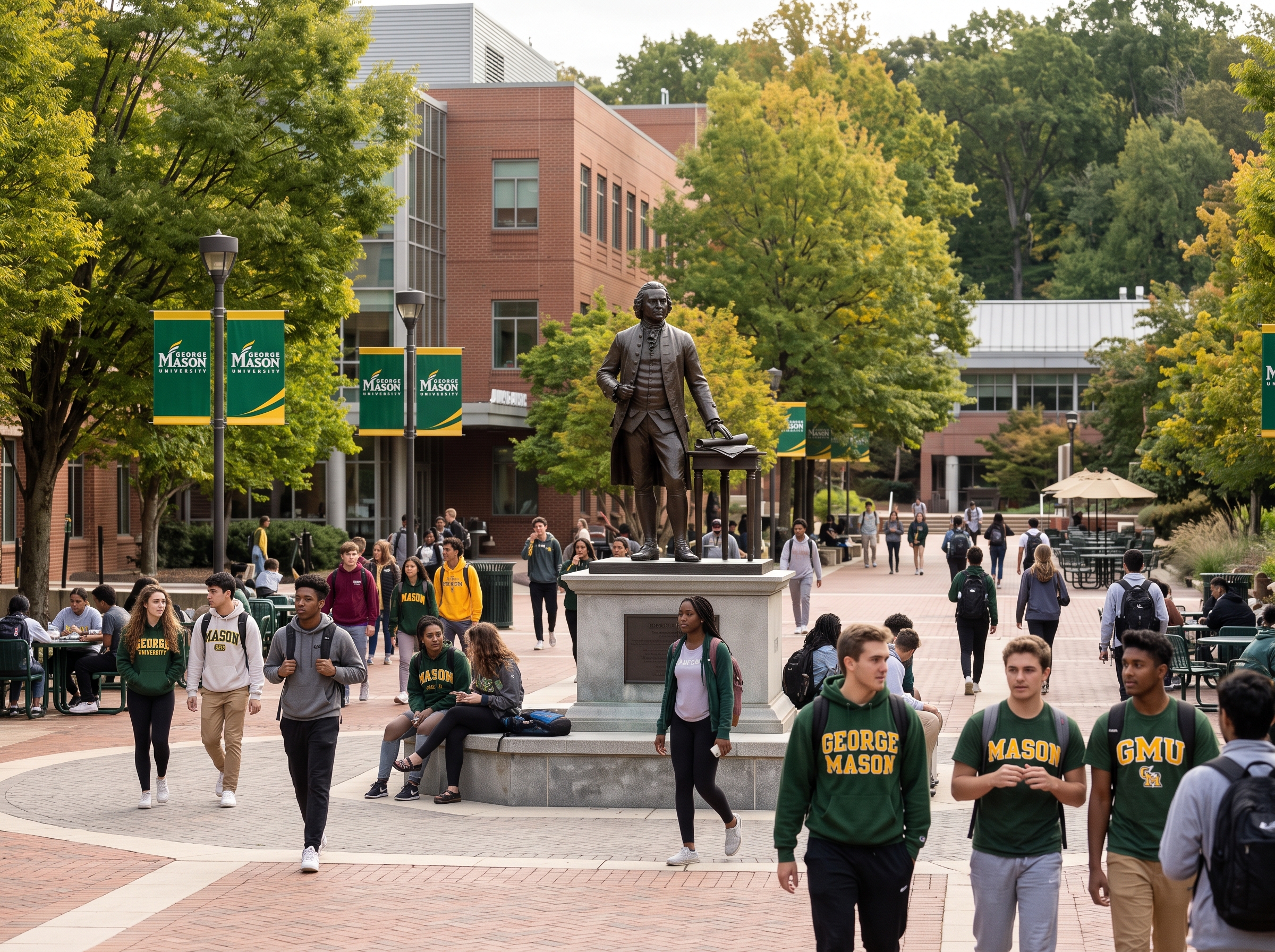
- Vibrant 2.53-Square-Mile Collegiate Residential Nexus: Located in central Fairfax County immediately southwest of the independent City of Fairfax (ZIP codes 22030 and 22032), the George Mason Census-Designated Place (CDP) encompasses approximately 2.53 square miles, blending peaceful, mature single-family subdivisions with the intellectual and cultural energy of Virginia's largest public research institution.
- Country Club View & George Mason Forest Enclaves: Anchored by prestigious single-family neighborhoods, including Country Club View (developed 1966–1972 with ~470 solid brick colonials and split-levels enjoying no mandatory HOA fees) and George Mason Forest (a collection of roughly 200 custom homes built amidst preserved woodland common grounds).
- World-Class Cultural & Athletic Infrastructure: Residents enjoy unmatched pedestrian proximity to George Mason University’s collegiate anchors, including the 10,000-seat EagleBank Arena (NCAA Division I Atlantic 10 basketball and national concerts), the Center for the Arts (symphonic concerts, ballet, and opera), and the community-accessible Aquatic and Fitness Center (AFC) with its 50-meter Olympic pool.
- Elite FCPS Dual Feeder Pyramids: Woodson & Robinson: Zoned for two of the most distinguished public secondary institutions in the Commonwealth of Virginia: W.T. Woodson High School (celebrated for the AP Capstone Diploma and STEM academies) and Robinson Secondary School (housing grades 7–12, offering both the International Baccalaureate IB Diploma and AP credentials), anchored by the on-site Oak View Elementary School.
- Multimodal Transit & CUE Bus Metrorail Connectivity: Served by the City of Fairfax CUE Bus system and university Mason Shuttles, offering direct, high-frequency transit to the Vienna/Fairfax-GMU Metrorail Station (Orange Line), while situated just two miles north of the Burke Centre VRE Station on the Manassas Line.
- Dynamic Commercial & Dining Proximity: Located across Braddock Road from University Mall (Giant Food, dining, cinemas) and one mile south of historic Old Town Fairfax, delivering a vibrant walkable lifestyle filled with craft breweries, artisanal dining, and seasonal festivals.
1. Spatial Morphology, Geographic Coordinates & Territorial Extents
The George Mason Census-Designated Place (CDP) encompasses approximately 2.53 square miles (6.55 square kilometers) of prime rolling piedmont terrain in central Fairfax County, Virginia. Situated at nominal geographic coordinates 38°49′54″ North latitude and 77°18′32″ West longitude (FIPS Code 51-30618; GNIS Feature ID 2584848), the CDP carries the postal ZIP codes of 22030 (Fairfax) and 22032 (George Mason/Burke) within the Braddock Magisterial District.
The community’s geographic borders are distinctly carved by municipal boundaries and regional arterial highways. To the north, the CDP abuts the corporate limits of the independent City of Fairfax along University Drive, Armstrong Street, and Chain Bridge Road (Route 123). To the east, the boundary follows Roberts Road and the Long Branch stream valley, connecting north toward Little River Turnpike (Route 236).
To the south, Braddock Road (State Route 620) forms a vital east-west perimeter, separating the university campus from the established residential neighborhoods of Country Club View and Kings Park West. To the west, the boundary is framed by Ox Road (State Route 123) and the Shirley Gate Road corridor. This strategic spatial positioning places residents within walking distance of high-level higher education, regional arts, and suburban shopping, while maintaining an insulated residential atmosphere surrounded by mature deciduous forests.
2. Historical Genesis: Agrarian Farmsteads & The Rise of George Mason University
Before the mid-20th century, the territory encompassing the George Mason community was characterized by peaceful dairy farms, apple and peach orchards, and dense stands of native oak and Virginia pine. The historic turnpikes of Little River (Route 236) and Ox Road (Route 123) served as primary trade routes connecting interior agricultural producers to the Potomac River docks at Alexandria.
The modern identity of the area began to crystallize in 1957, when the Commonwealth of Virginia established a northern branch of the University of Virginia known as University College. In 1958, the Town of Fairfax donated 150 acres of historic farmland to establish a permanent campus. The institution officially opened its doors on the present site in 1964 and gained full legislative independence in 1972 as George Mason University, named in honor of the Founding Father and author of the Virginia Declaration of Rights.
Over the subsequent decades, GMU underwent one of the most explosive and impressive institutional growths in American higher education. Transitioning from a small regional commuter college into the largest public research university in Virginia with an elite Carnegie R1 (Very High Research Activity) classification, the university catalyzed rapid residential development. Surrounding farmsteads were transformed into masterfully planned single-family enclaves designed to house university faculty, scientific researchers, corporate executives, and defense professionals.
3. Signature Residential Subdivisions: Country Club View & George Mason Forest
The residential neighborhoods within the George Mason CDP represent some of the most stable and coveted real estate in central Fairfax County:
Country Club View
Developed primarily between 1966 and 1972, Country Club View is an established community of approximately 470 substantial single-family detached residences located just south of Braddock Road. Characterized by wide, tree-canopied avenues and uniform setbacks, the neighborhood features classic Center-Hall Colonials, tri-level split-levels, and sprawling brick ramblers. Parcels are exceptionally generous, frequently exceeding one-third of an acre.
A major distinguishing attribute of Country Club View is that it operates with no mandatory Homeowners Association (HOA) fees. Community affairs, directories, and seasonal events are stewarded by the voluntary Country Club View Civic Association (CCVCA), granting homeowners complete architectural autonomy over their properties while maintaining high standards of property care.
George Mason Forest
Situated directly adjacent to the university campus, George Mason Forest is a slightly newer, upscale enclave developed from the early 1980s through the early 2000s. Comprising approximately 200 custom and semi-custom single-family homes, the neighborhood features multi-level traditional and transitional floor plans, attached two-car garages, and heavily wooded common grounds with pedestrian footbridges crossing natural stream channels. An active HOA preserves the cohesive aesthetic and natural woodland buffers.
4. Collegiate & Urban-Adjacent Neighborhoods: University Square, Commons & Courts
Complementing the large single-family subdivisions are several highly desirable townhome and cluster communities positioned along the university perimeter:
Enclaves such as University Square, University Commons, and University Courts provide sophisticated multi-level brick-front townhome residences. Featuring three- and four-bedroom floor plans, finished walk-out lower levels, and private fenced patios, these neighborhoods offer exceptional walkability to GMU lecture halls, research laboratories, and cultural venues.
Because of their immediate adjacency to Virginia's largest university—with over 40,000 enrolled undergraduate and graduate students, thousands of faculty members, and researchers at the nearby Inova Schar Cancer Institute—these properties enjoy consistently high occupancy, strong rental yields, and enduring long-term asset appreciation.
5. Architectural Typologies & Construction Anatomy
The structural character of the George Mason community reflects the premier building standards of post-war and late-20th-century Northern Virginia residential construction. Homes in Country Club View and surrounding sectors were constructed with dimensional timber framing, solid brick-and-masonry veneer exteriors, poured concrete foundations, and copper supply plumbing.
The principal single-family architectural styles include:
- Two-Story Center-Hall Colonials: Featuring formal dining rooms, formal front living parlors, central staircases, four to five upper-level bedrooms, and main-level family rooms anchored by wood-burning brick fireplaces.
- Tri-Level & Multi-Level Split-Levels: Staggered living designs that efficiently isolate upper sleeping quarters from lower-level recreation salons, perfectly adapted to rolling piedmont topographies.
- Sprawling Brick Ramblers: Generous single-level footprints featuring 1,800 to 2,400 square feet on the primary level plus matching full daylight basements, offering expansive living space for multi-generational households.
6. Contemporary Structural Renovations & Interior Transformations
Over the past two decades, properties in the George Mason area have undergone dramatic architectural modernizations. Homeowners and design-build firms routinely remove interior non-load-bearing partition walls to create sweeping open-concept great rooms that merge the kitchen, dining, and family living spaces into one cohesive entertaining pavilion.
Kitchens are expanded to feature 10-foot waterfall quartz prep islands, custom soft-close cabinetry, commercial gas ranges, and integrated dry bars with wine coolers. Primary bedroom suites are enlarged to accommodate walk-in dressing rooms and spa-inspired bathrooms featuring curbless frameless-glass showers, freestanding soaking tubs, and custom double vanities.
The presence of full daylight walk-out basements allows owners to finish lower levels into independent in-law suites, private home gyms, and remote executive offices with separate garden entrances. In the rear yards, owners construct expansive multi-tiered composite decks, covered screened porches, and flagstone patio terraces with built-in outdoor gas firepits, creating tranquil woodland retreats under mature hardwood canopies.
7. Cultural & Collegiate Anchors: EagleBank Arena & Center for the Arts
A singular advantage of living in the George Mason community is immediate access to collegiate cultural and entertainment venues that rival those of major metropolitan downtowns:
EagleBank Arena
Located directly on campus at 4500 Patriot Circle, EagleBank Arena (formerly the Patriot Center) is a premier 10,000-seat multi-purpose sports and entertainment arena. It serves as the home court for George Mason University’s NCAA Division I Men's and Women's basketball teams (competing in the Atlantic 10 Conference) and hosts national concert tours, family ice shows, circus performances, and high school and university commencements.
Center for the Arts (Concert Hall)
The university’s Center for the Arts (CFA) is Northern Virginia’s flagship performing arts complex. Its acoustically magnificent Concert Hall hosts world-renowned symphony orchestras, international ballet companies, touring Broadway productions, opera, and chamber music ensembles throughout the academic year.
Mason Pond & Campus Greenways
At the center of the academic core lies Mason Pond, a picturesque freshwater reservoir surrounded by manicured weeping willows, paved walking loops, and open-air seating where neighborhood residents frequently walk dogs, jog, and enjoy campus tranquility.
8. Athletic Facilities & Community Recreation: AFC & Country Club View Park
Recreational opportunities in the George Mason area span both municipal county parklands and elite university complexes open to community members:
Country Club View Park
Located at the southern terminus of the neighborhood along Sideburn Road, Country Club View Park is a 10-acre county park featuring lighted championship tennis courts, pickleball courts, full basketball courts, a modern playground, and scenic woodland trails following a tributary of Accotink Creek.
GMU Aquatic and Fitness Center (AFC) & RAC
Local residents can purchase community memberships to George Mason University’s state-of-the-art Aquatic and Fitness Center (AFC). The complex houses a 50-meter Olympic-sized competition pool, a 25-yard warm-water recreation pool with a whirlpool spa, cardiovascular fitness suites, and free-weight training rooms. Complementing the AFC is the Recreation and Athletic Complex (RAC), which features indoor basketball courts, racquetball courts, and fitness studios.
9. Fairfax County Public Schools (FCPS): The W.T. Woodson & Robinson Pyramids
The enduring desirability of the George Mason community is underpinned by its zoning within two of the highest-rated secondary pyramids in Fairfax County Public Schools (FCPS):
W.T. Woodson High School (AP Capstone)
Serving substantial portions of the George Mason community (including George Mason Forest), W.T. Woodson High School is internationally celebrated for academic rigor. Woodson offers the prestigious Advanced Placement (AP) Capstone Diploma, specialized STEM academies, elite choral and orchestral programs, and state-champion varsity athletics. Middle school students attend Robert Frost Middle School, renowned for its honors curricula and robotics labs.
Robinson Secondary School (IB Diploma & AP)
Other sectors (including Country Club View) feed into Robinson Secondary School, housing grades 7 through 12 under one roof in Burke. Robinson is globally accredited for both the International Baccalaureate (IB) Diploma Program and a comprehensive AP course catalog.
Oak View Elementary School
Elementary students attend the neighborhood anchor, Oak View Elementary School, situated on Sideburn Road. Oak View features Advanced Academic Programs (AAP), inclusive STEAM learning labs, and extensive community volunteer involvement.
10. Multimodal Commuter Logistics: CUE Bus, Mason Shuttles & Metro Transit
Transportation connectivity in the George Mason area is exceptionally robust, providing multiple alternatives to driving in highway traffic:
The City of Fairfax CUE Bus system operates high-frequency, clean-diesel transit throughout the university campus and surrounding residential thoroughfares. CUE buses connect riders directly to the Vienna/Fairfax-GMU Metrorail Station (Orange Line), allowing commuters to reach Tysons, Arlington, and downtown Washington, D.C. quickly and affordably.
Furthermore, the university operates Mason Shuttles, providing free scheduled transportation connecting the Fairfax campus directly to the Vienna Metro, MetroWest, and the GMU Science and Technology campus in Manassas.
For regional rail commuters, the Burke Centre VRE Station is located just two miles south on Roberts Parkway, offering daily passenger rail service on the Manassas Line into Alexandria, Crystal City (Amazon HQ2), and Washington Union Station, as well as daily Amtrak intercity service to New York City and Boston.
11. Commercial & Dining Vibrancy: Old Town Fairfax, University Mall & Fairfax Corner
Everyday retail convenience and culinary options are readily available across multiple neighborhood commercial centers:
- University Mall: Located directly across Braddock Road from the GMU campus, featuring a newly remodeled Giant Food supermarket, local and national dining, pharmacies, banking branches, and University Mall Theatres.
- Historic Old Town Fairfax: Situated just one mile north along Chain Bridge Road, offering an award-winning historic downtown streetscape filled with local craft breweries, independent bookstores, artisan coffee shops, farm-to-table bistros, and the Fairfax Old Town Square splash pad and concert stage.
- Fairfax Corner: Located minutes to the northwest via Route 123 and I-66, delivering a pedestrian-friendly open-air lifestyle center anchored by boutique fashion shops, an upscale cinema megaplex, and fine dining establishments.
12. Environmental Hydrology: Accotink & Pohick Watershed Tributaries
Geographically, the George Mason community straddles an important ecological drainage divide in central Fairfax County. The eastern portions of the CDP drain toward the Accotink Creek basin, feeding through Long Branch into Lake Accotink, while the western and southern sectors drain into the Pohick Creek watershed, eventually emptying into the Potomac River.
Fairfax County’s Department of Public Works and Environmental Services (DPWES), in partnership with the university’s Office of Sustainability, actively implements green stormwater infrastructure throughout the area. These initiatives include engineered bioretention rain gardens, permeable pavers, and native riparian buffer reforestation along stream corridors, protecting local waterways while preserving old-growth oak and tulip poplar canopies.
13. Virginia Statutory Assessment Framework Under Code § 58.1-3201
Real property taxation across the George Mason community is governed by the statutory framework established in the Code of Virginia § 58.1-3201, which strictly mandates that all real estate must be assessed for tax purposes at one hundred percent (100%) of its true fair market value.
The Fairfax County Department of Tax Administration (DTA) conducts comprehensive annual reassessments of every taxable parcel in the George Mason CDP. The DTA utilizes computerized mass appraisal market equalization techniques that analyze verified, arm's-length sales of comparable homes within specific neighborhood submarket codes (such as Country Club View and George Mason Forest). The appraisal models account for lot square footage, topography, structural improvements, effective age, and physical condition.
Because tax assessments in Fairfax County are equalized annually to reflect real-time market transactions, property owners benefit from transparent, predictable valuations without arbitrary administrative surprises. Homeowners also maintain the statutory right to appeal assessments annually to the DTA and the Fairfax County Board of Equalization (BOE) should physical discrepancies arise.
14. Comparative Analysis Matrix: George Mason vs. Peer Fairfax Enclaves
To evaluate George Mason within the broader central Fairfax County residential ecosystem, the following matrix compares the community against adjacent premier residential enclaves:
| Community | Primary Build Eras | Dominant Architectural Typologies | Mandatory HOA | Primary Cultural / Nature Asset | FCPS High School Feeder |
|---|---|---|---|---|---|
| George Mason | 1966–1988 | Brick Colonials, Split-Levels & Townhomes | None in Country Club View | EagleBank Arena & CFA (GMU) | Woodson & Robinson |
| City of Fairfax | 1950–Modern | Historic Colonials, Ramblers & Urban Condos | Varies by Subdivision | Old Town Square & Historic Courthouse | Fairfax High School |
| Long Branch | 1964–1972 | Mid-Century Split-Levels & Colonials | None (Voluntary Olde Creek) | Long Branch Stream Valley Park | W.T. Woodson High School |
| Mantua | 1952–1970 | Mid-Century Custom Ramblers & Colonials | None (Voluntary Civic Assn) | Accotink Stream Valley & Mantua Pool | Woodson High School |
| Burke Centre | 1977–1988 | Planned Colonials, Splits & Townhomes | Mandatory (Conservancy) | 30 Miles Trails & 5 Pools | Robinson & Lake Braddock |
| Oakton | 1970–Modern | Executive Colonials & Luxury Estates | Varies by Subdivision | Oakton Community Park & W&OD Trail | Oakton & Madison High |
15. Frequently Asked Questions Regarding George Mason, VA Real Estate
What are the precise geographic boundaries of George Mason, Virginia?
The George Mason Census-Designated Place (CDP) spans roughly 2.53 square miles in central Fairfax County (ZIP codes 22030 and 22032). It is bounded by the City of Fairfax to the north, Roberts Road to the east, Braddock Road (Route 620) to the south, and Ox Road (Route 123) and Shirley Gate Road to the west.
What residential subdivisions are located in the George Mason community?
Key neighborhoods include Country Club View (approximately 470 mid-century brick colonials and split-levels with no mandatory HOA), George Mason Forest (roughly 200 custom single-family homes built from the 1980s to early 2000s), University Square, University Commons, and University Courts.
How does George Mason University benefit surrounding residential homeowners?
GMU provides residents with immediate access to NCAA Division I Atlantic 10 basketball at EagleBank Arena, world-class symphonic and ballet performances at the Center for the Arts, community memberships to the Olympic 50m pool at the Aquatic and Fitness Center, scenic walking paths around Mason Pond, and sustained housing stability driven by faculty and staff demand.
Which public schools serve George Mason children?
Students are zoned into two of Fairfax County Public Schools' top-rated secondary pyramids: W.T. Woodson High School (AP Capstone Diploma and STEM) and Robinson Secondary School (grades 7–12; offering both the IB Diploma and AP courses). Elementary students attend Oak View Elementary on Sideburn Road.
Does Country Club View have a mandatory Homeowners Association (HOA)?
No. Country Club View operates with no mandatory HOA fees or restrictive covenants. Community affairs, directories, and seasonal events are managed on a voluntary basis by the Country Club View Civic Association (CCVCA).
What architectural styles predominate in George Mason neighborhoods?
Homes feature solid brick and masonry construction across Center-Hall Colonials, tri-level split-levels, and sprawling brick ramblers. Most homes offer 4 to 5 bedrooms, full daylight walk-out basements, two-car garages, and mature lots ranging from 0.25 to 0.40 acres.
What public transit options connect George Mason to the Metrorail?
Residents utilize the City of Fairfax CUE Bus system, which provides direct, high-frequency transit straight to the Vienna/Fairfax-GMU Metrorail Station (Orange Line). In addition, free Mason Shuttles serve the area, and the Burke Centre VRE Station is just two miles south.
What recreational parks and athletic amenities are located in George Mason?
Recreation is anchored by Country Club View Park (lighted tennis courts, basketball courts, and playground) and GMU's Olympic-sized Aquatic and Fitness Center, complemented by campus walking greenways around Mason Pond.
What shopping and dining options exist near George Mason?
Everyday convenience is anchored by University Mall across Braddock Road (Giant Food, dining, cinemas). Historic Old Town Fairfax is located just one mile north, offering craft breweries, artisan restaurants, and seasonal farmers markets, with Fairfax Corner minutes away.
How are real estate property taxes assessed in George Mason?
Under Code of Virginia § 58.1-3201, all real property is assessed annually at 100 percent of true fair market value. The Fairfax County Department of Tax Administration (DTA) conducts computerized mass appraisal equalizations annually based on verified arm's-length sales of comparable homes within specific neighborhood submarkets.
Navigating Real Estate in George Mason & Central Fairfax County
Whether you are preparing to market an established brick colonial in Country Club View, considering a home in George Mason Forest, or evaluating investment townhomes near George Mason University zoned for the Woodson and Robinson pyramids, partner with trusted Northern Virginia real estate authority Elena Gorbounova for private, data-driven representation.