
Hayfield, VA Real Estate: The Definitive Guide to Spatial Morphology, Historic Washington Heritage, Hayfield Secondary Campus & Residential Enclaves
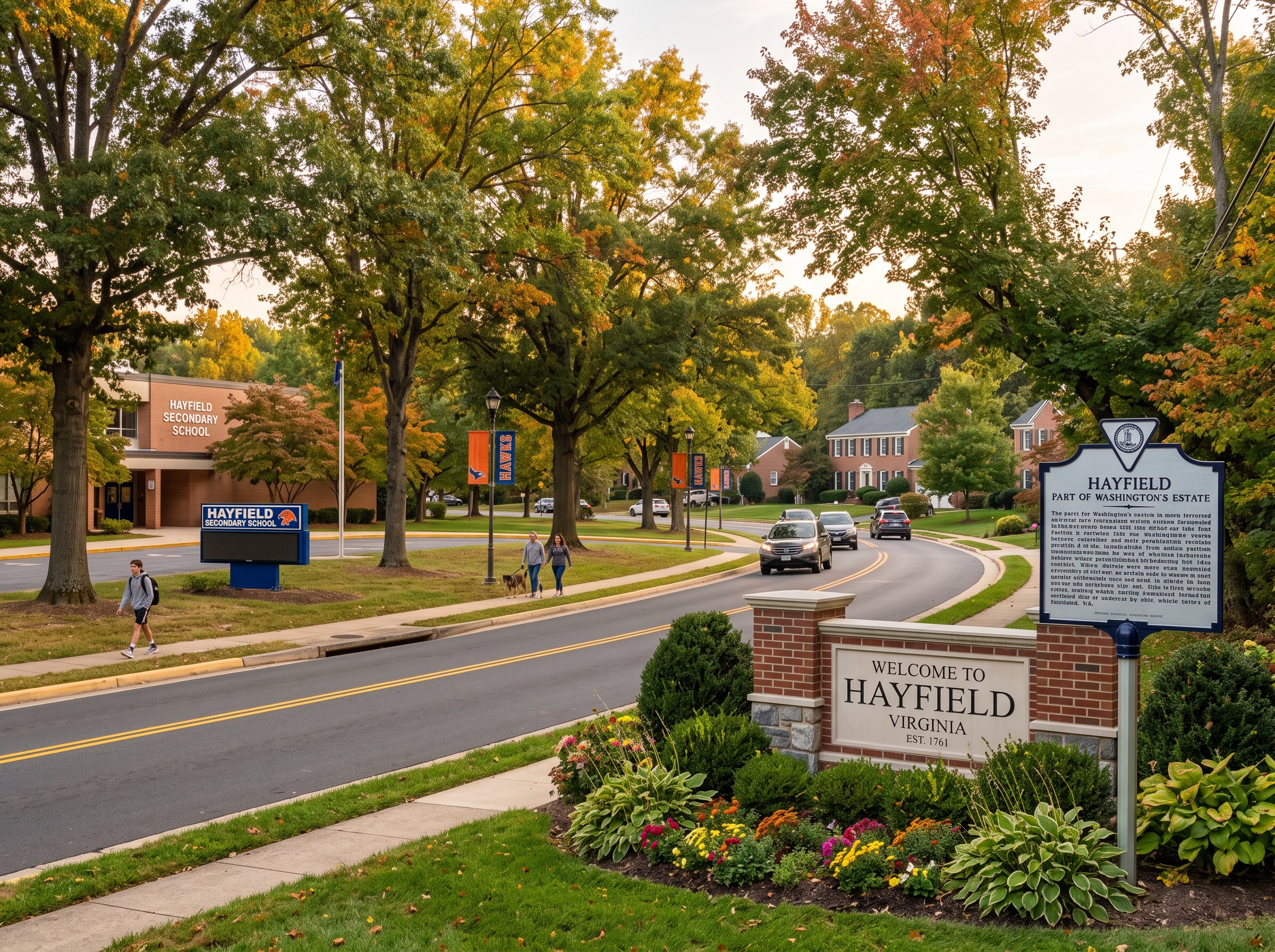
Executive Summary & Essential Community Takeaways
- Historic Washington Plantation Legacy: Originates from the 18th-century agricultural holdings of George Washington, purchased in 1785 by Lund Washington (George Washington's second cousin and wartime manager of Mount Vernon), who constructed the historic Hayfield mansion and the famous Hayfield 16-sided barn.
- Comprehensive 7–12 Secondary Academic Campus: Home to the prominent Hayfield Secondary School campus, housing both middle school (grades 7–8) and high school (grades 9–12) on an expansive 80-acre site alongside Hayfield Elementary School.
- Cohesive Master-Planned Enclaves: Defined by the foundational neighborhood of Hayfield Farm (platted in the late 1960s and 1970s with classic brick Colonials and split-levels) and the townhome enclave of Hayfield View.
- Direct Border to Huntley Meadows Park: Directly borders the 1,500-acre Huntley Meadows Park to the east, providing immediate neighborhood access to protected freshwater wetlands, wildlife observation towers, and nature boardwalks.
- Strategic Transit & Defense Proximity: Positioned along the Telegraph Road and Beulah Street corridors, located less than two miles north of Fort Belvoir and Fort Belvoir North Area (NGA), and 3.5 miles from the Franconia-Springfield Metro/VRE hub.
- Virginia Statutory Assessment Standards: Evaluated under Virginia Code § 58.1-3201 at 100 percent of fair market value by the Fairfax County Department of Tax Administration (DTA) with semi-annual tax installments due on July 28 and December 5.
1. Spatial Morphology, Boundaries & Regional Geography
Hayfield represents an established, master-planned residential community situated in the southeastern portion of Fairfax County within the Franconia Magisterial District (postal ZIP code 22315). Occupying approximately two square miles, Hayfield is strategically positioned between the Kingstowne commercial center to the north and the military cantonment of Fort Belvoir to the south.
The spatial perimeter of Hayfield is defined by historic roadway alignments, military reservations, and regional parklands:
- East Boundary: The protected forested perimeter and wetland drainage basins of Huntley Meadows Park, insulating Hayfield from eastern commercial corridors.
- West Boundary: Beulah Street (State Route 613), separating Hayfield from the planned lake communities of Island Creek and Manchester Lakes.
- North Boundary: Kingstowne Boulevard and Manchester Boulevard, providing seamless connection into the vibrant shopping, dining, and cinema district of Kingstowne Towne Center.
- South Boundary: Telegraph Road (State Route 611) and the northern boundary of Fort Belvoir and Woodlawn, offering rapid access southward to Route 1 and the Potomac River basin.
2. Historical Evolution: George Washington's Holdings, Lund Washington & The 16-Sided Barn
The historical pedigree of Hayfield is intimately connected with the personal life and agricultural operations of General George Washington and his extended family.
George Washington & Lund Washington (1761–1796)
In 1761, George Washington acquired a 460-acre parcel of land near Dogue Run from John West, incorporating it into his extensive agricultural holdings surrounding Mount Vernon. In 1785, following the conclusion of the Revolutionary War, Washington sold the tract to his second cousin and lifelong confidant, Lund Washington.
Lund Washington had managed the entire Mount Vernon estate throughout the seven long years of the Revolutionary War while George Washington led the Continental Army. Upon purchasing the land, Lund christened the estate Hayfield Plantation and constructed an elegant Georgian brick manor house along with extensive agricultural outbuildings.
The Famous Hayfield 16-Sided Barn
Inspired by George Washington's revolutionary sixteen-sided threshing and treading barn at nearby Dogue Run Farm, Lund Washington constructed a massive, circular 16-sided brick and timber barn on the Hayfield property. The barn featured an ingenious circular inner track where horses trod out grain on an upper slatted floor, allowing clean grain to fall through to a granary below, shielded from inclement weather.
The Hayfield 16-sided barn stood as a celebrated regional architectural landmark for nearly two centuries, surviving the Civil War and the transition into the twentieth century before being tragically destroyed by an accidental fire in 1967. Today, the barn's pioneering agricultural engineering is commemorated through historical roadside markers and neighborhood street nomenclature.
The Master-Planned Suburban Era (1968–Present)
In the late 1960s, the historic Hayfield tract was assembled for master-planned suburban development. Planners designed Hayfield Farm with wide, curvilinear residential streets, continuous pedestrian sidewalks, dedicated green park belts, and an underground utility grid. Uniquely, the master plan allocated over 80 contiguous acres for a unified public educational campus, establishing Hayfield Elementary and Hayfield Secondary directly within the neighborhood core.
3. Residential Enclaves, Neighborhood Typologies & Architectural Morphology
Hayfield features an established, cohesive residential fabric that balances classic single-family suburban homes with low-maintenance planned townhome communities.
| Residential Subdivision / Enclave | Primary Architectural Style | Construction Era | Typical Lot Dimensions | Fairfax County Zoning |
|---|---|---|---|---|
| Hayfield Farm | Brick Colonials, Split-Levels, Ramblers | 1968 – 1976 | 0.22 to 0.35 Acre Parcels | R-3 (Single-Family Residential) |
| Hayfield View | Colonial Multi-Level Brick & Siding Townhomes | 1978 – 1985 | Townhome Platted Parcels | PDH-8 / PDH-12 (Planned Development) |
| Wickford Enclave | Center-Hall Brick Colonials & Split-Foyers | 1972 – 1982 | 0.25 to 0.38 Acre Lots | R-3 (Suburban Single-Family) |
| Broad Run & Beulah Fringe | Traditional Single-Family & Executive Homes | 1985 – 1998 | 0.20 to 0.30 Acre Lots | PDH-4 / R-4 (Suburban Cluster) |
| Hilltop & Kingstowne Border | Contemporary Townhomes & Carriage Homes | 1995 – 2015 | Master-Planned Parcels | PDH-8 (Master-Planned Community) |
Hayfield Farm: Classic Post-War Single-Family Living
Platted between 1968 and 1976, Hayfield Farm represents the residential heart of the community. Homes are characterized by solid red-brick and partial-masonry facades, two-story center-hall colonial layouts, multi-tier split-levels, and daylight basements. Properties feature generous 0.22 to 0.35-acre lots, private rear yards, concrete driveways, and an absence of commercial through-traffic. The neighborhood is anchored by the member-owned Hayfield Farm Community Pool and park grounds.
Hayfield View & Townhome Enclaves
Constructed in the late 1970s and 1980s, Hayfield View offers low-maintenance townhome living in a parklike setting. These three-level residences feature traditional brick and beaded-siding elevations, private fenced rear brick patios, finished walk-out lower-level recreation rooms, and dedicated assigned parking spaces, appealing to busy professionals and military officers stationed at nearby defense facilities.
4. Structural Anatomy, Building Eras & Technical Due Diligence
Evaluating residential properties in Hayfield requires specialized technical familiarity with late-1960s and 1970s suburban construction practices:
Late-1960s & 1970s Residential Assemblies
- Foundations & Soil Mechanics: Typically constructed with poured concrete or concrete masonry unit (CMU) block foundations over continuous spread footings. Properties bordering the natural drainage swales leading into Huntley Meadows must maintain a positive grading slope (a minimum 5 percent fall away from foundation walls for 10 feet) and functional gutter downspout extensions to manage hydrostatic soil pressure.
- Plumbing Supply & Drainage Systems: Water supply is delivered via Type L copper piping. Drain-waste-vent (DWV) piping utilized heavy cast iron stacks transitioning into ductile iron or early PVC building drains. Homebuyers should commission a fiber-optic video camera sewer scope inspection of the sewer lateral from the cleanout to the street main to check for internal rust scaling, pipe settlement, or tree root penetration from mature oak and maple trees.
- Electrical Service Infrastructure: Original installations often featured 100-amp or 150-amp electrical panels. Modern living demands upgrading to a 200-amp circuit breaker panel with arc-fault (AFCI) and ground-fault (GFCI) protection to safely support modern central heat pumps and level-2 electric vehicle charging equipment.
- Attic Ventilation & Roof Decks: Framed with pre-engineered roof trusses sheathed in 1/2-inch exterior-grade plywood. Ensuring balanced attic airflow through continuous soffit intake vents and ridge exhaust vents prevents winter ice damming and extends asphalt shingle lifespan.
5. Public Education Infrastructure: The Unified Hayfield Secondary 7–12 Pyramid
Hayfield is served exclusively by Fairfax County Public Schools (FCPS), recognized nationally for academic rigor and student achievement. The community features a uniquely unified educational structure centered around the 80-acre Hayfield educational campus.
| School Facility | Grade Levels | Feeder Alignment | Curriculum Programs & Academic Distinctions |
|---|---|---|---|
| Hayfield Secondary School (High School) | Grades 9 – 12 | Hayfield Pyramid | AP Capstone Diploma, STEM Pathways, Championship Athletics (Hawks), Performing Arts |
| Hayfield Secondary School (Middle School) | Grades 7 – 8 | Hayfield Pyramid | Accelerated Honors Curriculum, Algebra & Geometry Honors, World Languages, STEM Labs |
| Hayfield Elementary School | Pre-K – Grade 6 | Hayfield Pyramid | Advanced Academic Programs (AAP), STEAM Innovation Focus, Responsive Classroom Model |
Hayfield Secondary School: A Comprehensive 7–12 Campus
Hayfield Secondary School is one of Fairfax County's few comprehensive secondary schools, accommodating students from seventh grade through twelfth grade on a single unified campus. The high school program offers the prestigious AP Capstone Diploma, advanced STEM laboratories, computer science academies, and collegiate dual-enrollment coursework. Hayfield is also widely celebrated for its championship athletics program (the Hayfield Hawks) and award-winning bands, orchestras, and choral ensembles.
Hayfield Elementary School
Situated directly adjacent to the secondary campus, Hayfield Elementary School serves children from Pre-Kindergarten through sixth grade. The school offers an Advanced Academic Programs (AAP) curriculum, STEAM innovation labs, and extensive community garden learning programs. Additionally, rising eighth graders in Hayfield are eligible to participate in the competitive regional admissions process for Thomas Jefferson High School for Science and Technology (TJHSST) in Lincolnia.
6. Transportation Logistics, Highway Arterials & Commuter Connectivity
Hayfield benefits from a central location in southeastern Fairfax County, offering convenient multimodal access to regional highway corridors, defense installations, and mass transit.
Major Highway Arterials
- Telegraph Road (State Route 611): The primary eastern arterial, providing a direct route north to the Capital Beltway (I-495) and Old Town Alexandria, and south directly into Fort Belvoir.
- Beulah Street (State Route 613): Connects Hayfield northwest directly into Franconia Road and the Franconia-Springfield Metrorail interchange.
- Interstate 95 / 395 Corridor: Accessible within five to seven minutes, offering dedicated I-395 Express Lanes for rapid, toll-free high-occupancy transit into the Pentagon and downtown Washington, D.C.
- Fairfax County Parkway (Route 286): Accessible just south along Telegraph Road, delivering express parkway transit across western Fairfax County to Burke, Fair Oaks, and Reston.
Public Mass Transit & Metrorail Access
- Franconia-Springfield Metrorail & VRE Station: Located 3.5 miles northwest, providing Blue Line Metrorail transit (direct to the Pentagon, Rosslyn, and Metro Center) and Virginia Railway Express (VRE) Fredericksburg Line commuter rail.
- Huntington Metrorail Station: Located approximately five miles northeast, providing direct Yellow Line access into Old Town Alexandria and downtown Washington, D.C.
- Fairfax Connector Bus Routes: Multiple neighborhood bus lines traverse Telegraph Road and Beulah Street, offering scheduled peak-hour feeder service to regional Metrorail stations.
7. Environmental Topography, Stream Valleys & Protected Parklands
Situated within the Atlantic Coastal Plain, Hayfield features gently rolling topography bordered by protected natural stream valleys and wildlife preserves.
Huntley Meadows Park: 1,500+ Acres of Protected Wetland
Forming the entire eastern border of Hayfield, Huntley Meadows Park is the largest and most ecologically significant park in the Fairfax County Park Authority system. The 1,500-acre sanctuary includes:
- A famous half-mile raised wooden wetland boardwalk traversing pristine freshwater marshes.
- A multi-level wildlife observation tower overlooking active beaver lodges, river otters, and nesting territories for bald eagles, osprey, and great blue herons.
- Miles of forested hiking and nature trails connecting directly into neighborhood spur paths.
Community Parks & Golf Facilities
- Hayfield Farm Community Pool: A private, member-owned recreation facility featuring a 25-meter competition pool, diving well, baby pool, picnic pavilion, and the active Hayfield Farm Dolphins swim team.
- Hayfield Park: A county-maintained community park featuring youth baseball diamonds, basketball courts, and playground structures.
- Greendale Golf Course: Located just one mile north along Telegraph Road, this 18-hole championship public golf facility is operated by the Fairfax County Park Authority.
8. Real Estate Assessment Cycles & Virginia Statutory Tax Framework
Real estate taxation in Hayfield operates strictly under the legal framework established by the General Assembly of the Commonwealth of Virginia and the administrative authority of Fairfax County. Because Hayfield is an unincorporated census-designated place within Fairfax County, property owners pay real estate taxes solely to Fairfax County, with zero supplemental town or city tax millages.
Virginia Code Title 58.1-3201: The 100% Fair Market Value Mandate
Under Virginia Code § 58.1-3201, all real property in Virginia must be assessed for tax purposes at one hundred percent (100%) of its true fair market value. The Fairfax County Department of Tax Administration (DTA) conducts comprehensive annual reassessments of every taxable parcel in Hayfield. Valuations are determined through annual mass appraisal market equalization based on verified arm's-length sales of comparable properties within identical neighborhood submarket codes, accounting for lot size, topography, structural improvements, and physical condition.
Annual Assessment Calendar & Payment Schedules
- January 1 (Statutory Effective Date): Property assessments are legally established as of January 1 of each calendar year, reflecting real estate market transactions occurring during the preceding twelve months.
- Late February (Assessment Notice Distribution): The DTA mails official Notice of Real Estate Assessment cards to all property owners, itemizing land value, structural improvement value, and total equalized taxable valuation.
- Semi-Annual Payment Deadlines: Real estate tax payments in Fairfax County are billed in two equal installments:
- First Installment: Statutorily due on or before July 28.
- Second Installment: Statutorily due on or before December 5.
- Countywide Dedicated Levies: Properties in Hayfield are subject to the Countywide Stormwater Management Service District Tax, dedicated to stream valley restoration, dam safety, and Chesapeake Bay runoff mitigation.
Statutory Assessment Appeals Mechanism
Property owners who believe their annual assessment exceeds fair market value, is non-uniform compared to contiguous properties, or contains clerical errors have the legal right to challenge the valuation through a formal two-tiered process:
- Administrative Review: An informal appeal submitted directly to the Department of Tax Administration, typically required by early April. An assigned county residential appraiser reviews structural data, square footage calculations, physical property condition, and relevant sales comps.
- Board of Equalization (BOE) Appeal: A formal evidentiary appeal submitted to the citizen-led Board of Equalization of Real Estate Assessments, typically requiring filing by June 1. If dissatisfied with the BOE ruling, property owners retain the statutory right to file a petition with the Circuit Court of Fairfax County under Virginia Code § 58.1-3984.
9. Frequently Asked Questions Regarding Hayfield, VA Real Estate
Is Hayfield an incorporated municipality or an unincorporated community in Fairfax County?
Hayfield is an unincorporated census-designated place (CDP) governed directly by the Fairfax County Board of Supervisors within the Franconia Magisterial District. It carries an Alexandria postal address (ZIP code 22315) for postal routing purposes, but it is entirely located within Fairfax County. Public safety, road maintenance, public education (FCPS), and land-use zoning are administered by Fairfax County.
What was the historical origin of Hayfield?
The land comprising Hayfield was originally owned by George Washington as part of his Mount Vernon estate holdings. In 1785, Lund Washington (George Washington's second cousin and wartime manager of Mount Vernon) acquired the 460-acre tract and established Hayfield Plantation. Lund Washington constructed a prominent mansion and a famous 16-sided barn, modeled after George Washington's innovative circular treading barn at Dogue Run Farm.
What makes the Hayfield Secondary School campus unique in Fairfax County?
Hayfield Secondary School is one of Fairfax County Public Schools' signature comprehensive secondary campuses, housing both a middle school (grades 7–8) and a high school (grades 9–12) on an expansive 80-acre site. It features the AP Capstone Diploma program, STEM pathways, championship athletic facilities, and nationally recognized music and performing arts programs.
What architectural typologies define residential neighborhoods in Hayfield?
Hayfield is distinguished primarily by mid-to-late 20th-century residential architecture: classic two-story brick Colonials, split-levels, and ramblers platted in the late 1960s and 1970s in Hayfield Farm on mature quarter-to-third-acre lots; traditional multi-level brick townhomes in Hayfield View; and newer planned single-family enclaves along the Kingstowne and Beulah Street borders.
Which public schools serve the Hayfield community?
Hayfield is served by Fairfax County Public Schools (FCPS) within the Hayfield Secondary School pyramid. Students attend Hayfield Elementary School (located within the neighborhood) for grades Pre-K through 6, and advance seamlessly to Hayfield Secondary School for middle school (grades 7–8) and high school (grades 9–12).
What recreational facilities and parklands are located in and around Hayfield?
Recreational amenities include the private, member-owned Hayfield Farm Community Pool and tennis courts, Hayfield Park athletic grounds, the Greendale Golf Course (an 18-hole public course operated by FCPA just north on Telegraph Road), and direct trail connectivity to the 1,500-acre Huntley Meadows Park wetland sanctuary.
How is commuter transit structured from Hayfield to major employment hubs?
Commuters benefit from immediate access to Telegraph Road (Route 611) and Beulah Street (Route 613). The Franconia-Springfield Metrorail (Blue Line) and VRE commuter rail station is located approximately 3.5 miles northwest, while the Huntington Metrorail Station (Yellow Line) is approximately 5 miles northeast. Fort Belvoir and the NGA campus are situated less than 2 miles south.
What structural maintenance considerations are essential for homes in Hayfield Farm?
Buyers of late 1960s and 1970s homes should conduct fiber-optic camera sewer scope inspections of underground cast iron lines to check for root penetration and internal scaling, verify that electrical panels have been upgraded to modern 200-amp service with AFCI/GFCI protection, and maintain proper perimeter foundation drainage slopes to manage coastal plain soil moisture.
What commercial and retail amenities serve the Hayfield area?
Residents enjoy convenient shopping at the Hayfield Shopping Center (anchored by neighborhood restaurants, banking, and convenience retail), the adjacent Hilltop Village Center (featuring Wegmans, dining, and specialty services), and the comprehensive retail, cinema, and dining options at Kingstowne Towne Center and Springfield Town Center.
How are real estate property assessments and taxes governed in Hayfield?
Under Virginia Code § 58.1-3201, all real property in Hayfield is assessed annually at 100 percent of fair market value by the Fairfax County Department of Tax Administration (DTA). Assessment notices are mailed every February based on verified arm's-length market sales, with taxes paid semi-annually on July 28 and December 5, and formal administrative appeal rights through the county Board of Equalization.
10. Academic References, Historic Archives & Statutory Legal Disclaimers
This architectural monograph, environmental assessment, and regional real estate reference treatise incorporates verified historical archives, public planning documents, and statutory legal frameworks:
- Fairfax County Comprehensive Plan: Area IV, Franconia Magisterial District Plan & Telegraph Road / Hayfield Community Planning Guidance, Fairfax County Department of Planning and Development, Fairfax, Virginia.
- Fairfax County Park Authority (FCPA): Huntley Meadows Park Resource Management Plan & Historic Hayfield 16-Sided Barn Archaeological Records, Herrity Building, Fairfax, Virginia.
- Mount Vernon Ladies' Association Historical Archives: George Washington Farm Ledgers, Lund Washington Plantation Accounts, and Dogue Run Land Deeds, Mount Vernon, Virginia.
- Fairfax County Public Schools (FCPS): Office of Facilities Planning, Hayfield Secondary School and Elementary School Feeder Boundary Alignment Directory, Gatehouse Administration Center, Falls Church, Virginia.
- Code of Virginia (Statutory Authority): Title 58.1 (Taxation), § 58.1-3201 (Fair Market Value Mandates) and § 58.1-3370 (Board of Equalization Procedures), Commonwealth of Virginia, Richmond, Virginia.
- United States Geological Survey (USGS): Alexandria and Fort Belvoir 7.5-Minute Topographic Quadrangles, Dogue Creek Hydrologic Basin Surveys, Reston, Virginia.
Statutory Research & Regulatory Notice: This architectural monograph, environmental review, and submarket treatise is published strictly for informational, educational, and spatial orientation purposes. Real estate boundaries, school attendance zones, community pool memberships, and tax assessment schedules are subject to ongoing administrative modifications by the Fairfax County Board of Supervisors, the Fairfax County School Board, and the Virginia Department of Transportation (VDOT). This publication does not constitute formal appraisal valuations, structural architectural inspections, or legal counsel. Prospective purchasers and property owners must verify official parcel-specific records directly with the Fairfax County Department of Tax Administration (DTA) and Land Development Services (LDS).