Hybla Valley, VA Real Estate: The Definitive Guide to Richmond Highway Revitalization, Historic Huntley & Huntley Meadows Park
1. Executive Summary & Foundational Takeaways
Hybla Valley, Virginia, represents one of the most strategically positioned, ecologically buffered, and transit-transformative suburban enclaves in eastern Fairfax County. Centered primarily within postal ZIP code 22306 across the Mount Vernon and Lee Magisterial Districts, Hybla Valley is defined by its pivotal position along the historic Route 1 (Richmond Highway) corridor, immediately bordered to the west by the pristine 1,500-acre expanse of Huntley Meadows Park.
As an unincorporated census-designated place (CDP) governed directly by the Fairfax County Board of Supervisors, Hybla Valley operates free of municipal town boundaries. Residential homeowners benefit from a single, unified county tax framework without secondary town levies, backed by the comprehensive public safety, school system, and capital investments of Fairfax County.
Historically celebrated for its nineteenth-century agricultural dairy heritage and early twentieth-century aviation history at the former Hybla Valley Airport, the community is currently at the nexus of the county's landmark Embark Richmond Highway initiative. This transformative multimodal project is introducing dedicated median-running Bus Rapid Transit (BRT)—branded as The One—linking Hybla Valley directly to the Huntington Metrorail Station (Yellow Line) and Fort Belvoir, establishing the corridor as a modern mixed-use residential and commercial frontier.
The Six Structural Pillars of Hybla Valley Real Estate
- Huntley Meadows Ecological Sanctuary. Over 1,500 contiguous acres of protected non-tidal freshwater wetlands, forest canopies, and elevated boardwalks that form an immutable western green buffer protecting community tranquility.
- Historic Huntley Heritage. Thomson Francis Mason's circa-1825 Federal-style villa perched on a commanding hilltop ridge, preserved on the National Register of Historic Places and anchoring local cultural identity.
- Embark Richmond Highway Multimodal BRT. Direct alignment along the dedicated median-running BRT transit spine, connecting residents swiftly to Huntington Metrorail and the regional transit grid.
- Fort Belvoir Defense Employment Nexus. Proximity to the military garrison, Defense Logistics Agency (DLA), Defense Threat Reduction Agency, and Belvoir Community Hospital, generating non-cyclical defense and federal contractor housing demand.
- Diverse Housing Morphology. A balanced spectrum encompassing mid-century brick ramblers and split-levels on quarter-acre parcels, multi-level townhome enclaves with private garages, and entry-level condominium residences.
- Dual Academic Pyramids. Served by Fairfax County Public Schools through the celebrated West Potomac High School and Mount Vernon High School International Baccalaureate (IB) World School pyramids.
2. Comprehensive Historical Evolution
Hybla Valley's historical progression spans agricultural prominence, nineteenth-century architectural achievement, early twentieth-century aviation development, and post-war suburban maturation.
Agrarian Origins & Mount Hybla Nomenclature
In the eighteenth and early nineteenth centuries, the fertile lowlands drained by Little Hunting Creek were part of expansive agrarian holdings owned by prominent Virginia families, including the Mason and Fitzhugh lineages. The area took its distinctive name from the Hybla Valley Dairy Farm, named in romantic tribute to Mount Hybla in ancient Sicily, renowned in classical Greek and Roman literature for its rich flora, wild thyme, and honey.
Historic Huntley (c. 1825)
Dominating the high northern ridge overlooking the valley stands Historic Huntley. Constructed circa 1825 for Thomson Francis Mason—grandson of George Mason of Gunston Hall and mayor of Alexandria from 1827 to 1830—the Federal-style villa served as a rural retreat and agricultural center. Designed with an unusual three-part tiered elevation, a detached dairy, tenant quarters, and terraced orchards, Historic Huntley represents one of the finest surviving examples of early nineteenth-century domestic architecture in Fairfax County. Today, meticulously restored by the Fairfax County Park Authority, it operates as an educational museum and research center.
The Aviation Era: Hybla Valley Airport (1925–1954)
Few modern residents realize that for three decades, Hybla Valley served as a vibrant hub of early American civil aviation. Established in 1925 along the western side of Richmond Highway, Hybla Valley Airport (also operating under the name Alexandria Airport) was among the earliest airfields in the National Capital Region. The airfield featured sod runways, hangars, and flight schools, training hundreds of civil and military pilots during the interwar and World War II eras. By 1954, as regional real estate pressures surged and larger commercial facilities opened, the airfield was decommissioned. Its expansive acreage was systematically replatted into commercial shopping centers and suburban residential neighborhoods.
3. Huntley Meadows Park & Ecological Conservation
Hybla Valley is blessed with the most ecologically significant parkland in Northern Virginia: Huntley Meadows Park. Spanning more than 1,500 contiguous acres, it is the largest park managed by the Fairfax County Park Authority.
Originally part of George Mason's expansive colonial land holdings, the wetland basin was acquired by the federal government in the mid-twentieth century and utilized as an auxiliary classified research facility before being deeded to Fairfax County under the Federal Surplus Property program in 1975.
Today, Huntley Meadows encompasses a nationally recognized non-tidal freshwater wetland complex, mature oak-hickory forests, and extensive wildflower meadows situated along the Atlantic Flyway. A half-mile elevated wooden boardwalk leads visitors through the central wetland marsh to a multi-story observation tower. The park serves as a critical nesting habitat and sanctuary for over 200 species of migratory waterfowl, herons, egrets, river otters, and beavers. For adjacent residential neighborhoods, Huntley Meadows provides an immutable, permanent green buffer that eliminates the risk of future western industrial encroachments and preserves environmental serenity.
4. Richmond Highway Corridor & The Embark BRT Transformation
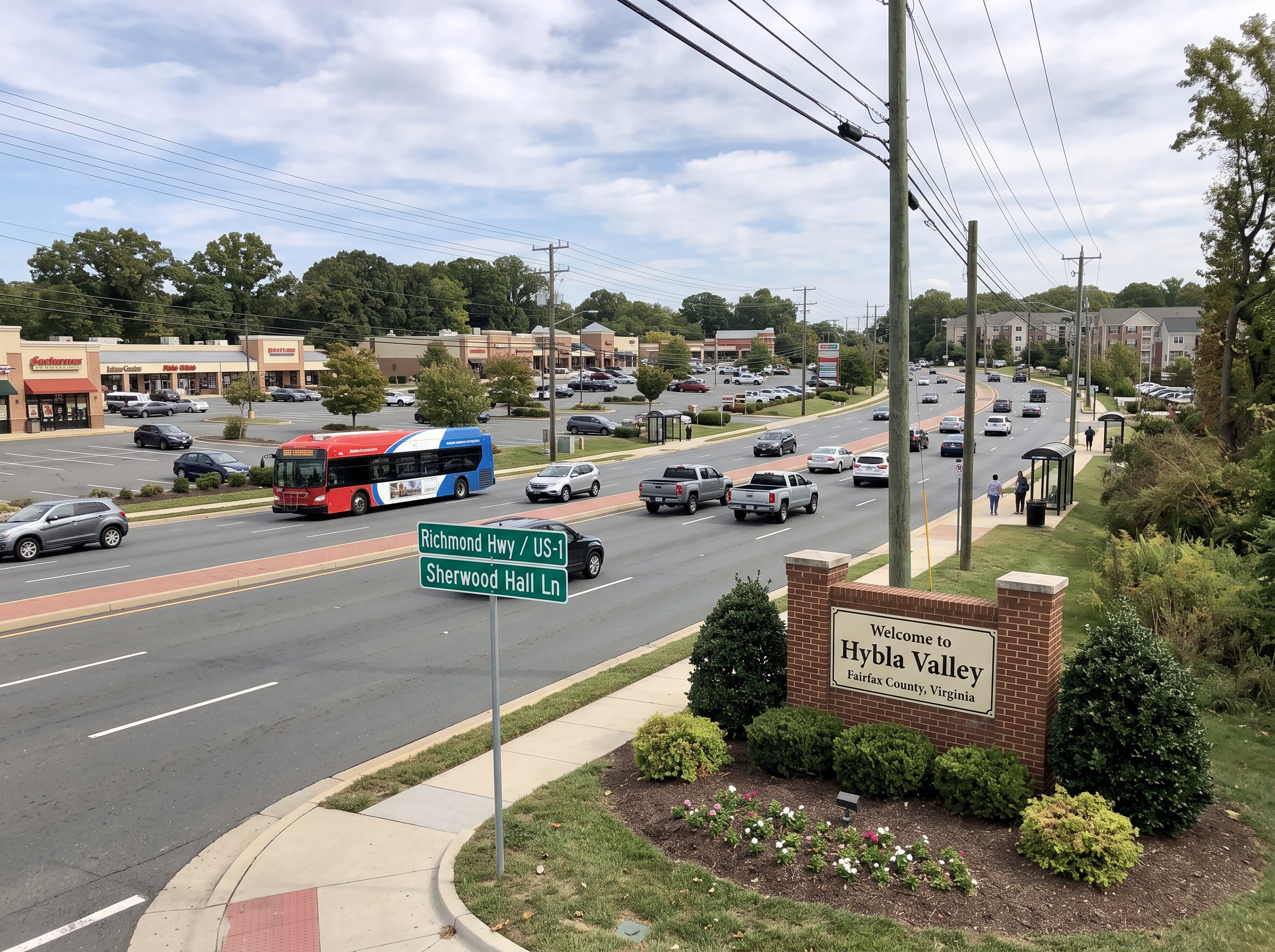
The civic and commercial backbone of Hybla Valley is Route 1 (Richmond Highway), a historic regional transportation artery that is undergoing one of the most comprehensive urban renewal and transit initiatives in the Commonwealth of Virginia.
The "Embark Richmond Highway" Initiative
Led by the Fairfax County Department of Transportation (FCDOT) in collaboration with the Virginia Department of Rail and Public Transportation (DRPT), Embark Richmond Highway is reimagining the corridor into a multimodal, pedestrian-friendly boulevard. The cornerstone of the plan is a dedicated, median-running Bus Rapid Transit (BRT) system known as The One.
Featuring dedicated travel lanes that bypass general vehicular traffic, modern level-boarding stations, transit signal priority, and frequent headways, the BRT line connects directly from Fort Belvoir through Hybla Valley to the Huntington Metrorail Station on the WMATA Yellow Line. This infrastructure upgrade is catalyzing the phased transition of conventional strip commercial plazas into dense, mixed-use town center developments with ground-floor retail, wide landscaped sidewalks, and protected cycling tracks.
5. Housing Stock Typologies & Architectural Stratification
Hybla Valley provides an accessible and varied housing stock that accommodates diverse buyer lifestyles across several structural eras:
1. Mid-Century Single-Family Enclaves
Constructed primarily between 1952 and 1972, single-family neighborhoods throughout Hybla Valley feature solid brick ramblers, split-levels, and traditional two-story colonial homes. Situated on generous quarter- to third-acre parcels with mature shade trees, these properties appeal to purchasers seeking substantial private yard space, fee-simple non-HOA ownership, and opportunity for interior modern renovations or additions.
2. Multi-Level Fee-Simple Townhomes
Developed in several deliberate phases from the early 1980s through the 2000s, Hybla Valley's townhome developments provide multi-story living with brick and siding facades, private rear sundecks, and one- to two-car attached garages. These communities operate under professionally managed home owner associations (HOAs) that maintain common turf areas, parking reserves, and neighborhood playgrounds.
3. Low-Maintenance Condominium Communities
Positioned with direct access to Richmond Highway bus transit, garden-style and mid-rise condominium residences provide entry-level homeownership opportunities and resilient rental investment options. Common amenities frequently include community swimming pools, fitness centers, and assigned parking.
4. Emerging Custom Infill Properties
In response to regional land scarcity and transit expansion, custom residential builders are increasingly acquiring older single-family parcels to construct modern craftsman and transitional style residences featuring open floor plans, 9-foot ceilings, and energy-efficient building envelopes.
6. Institutional, Military & Defense Economic Anchors
The Hybla Valley residential market is deeply anchored by major federal, defense, and healthcare institutions that provide robust, non-cyclical employment:
- Fort Belvoir Military Installation: Situated mere minutes south of Hybla Valley along Route 1, Fort Belvoir is one of the premier command centers of the National Capital Region. The installation houses the headquarters of the Defense Logistics Agency (DLA), Defense Threat Reduction Agency (DTRA), and the Alexander T. Augusta Military Medical Center, generating continuous demand for both purchase and rental housing among military personnel and federal civilians.
- National Geospatial-Intelligence Agency (NGA): Located at Fort Belvoir North Area (New Campus East), this primary combat support agency employs thousands of intelligence officers, cartographers, and defense contractors who reside throughout Hybla Valley.
- Inova Mount Vernon Hospital: Located nearby on Parkers Lane, this comprehensive healthcare campus features specialized acute rehabilitation and orthopedic surgery centers, supporting a stable local medical workforce.
- South County Governmental Center: Positioned directly on Richmond Highway in Hybla Valley, this major administrative complex houses Fairfax County police, human services, and judicial satellite offices.
7. Zoning, Land-Use Governance & Revitalization Districts
Land use across Hybla Valley is regulated under the modernized Fairfax County Zoning Ordinance (zMOD):
Single-Family & Planned Residential Zoning
Single-family subdivisions are predominantly zoned R-2, R-3, and R-4 (Residential 2 to 4 units per acre), which mandate minimum lot sizes ranging from 8,400 to 15,000 square feet, established front setbacks, and strict building height maximums (typically 35 feet) to preserve suburban neighborhood character.
Commercial Revitalization District (CRD) Overlay
Portions of the Richmond Highway frontage in Hybla Valley are designated within a Fairfax County Commercial Revitalization District (CRD). The CRD overlay provides regulatory flexibility, reduced parking minimums, and density bonuses to incentivize high-quality mixed-use redevelopment, underground utilities, and pedestrian-oriented street frontages that support the Embark BRT system.
8. Environmental Regulation: Chesapeake Bay Act & Stream Valleys
Because Hybla Valley lies within the watersheds of Little Hunting Creek and Dogue Creek—both vital tributaries of the tidal Potomac River—environmental protections are rigorous. Under the Chesapeake Bay Preservation Act and Fairfax County's Chesapeake Bay Preservation Ordinance, statutory 100-foot Resource Protection Areas (RPAs) flank stream corridors and perennial wetlands.
Within these RPA zones, development is strictly curtailed to prevent water runoff pollution, maintain native forest buffers, and protect critical downstream aquatic habitats. Property owners seeking to perform exterior alterations near RPA boundaries must obtain formal county environmental approvals and implement modern stormwater retention facilities.
9. Multimodal Transportation & Commuter Arteries
Hybla Valley provides multi-faceted transportation connectivity to the greater Washington metropolitan region:
- Richmond Highway (Route 1): Primary north-south arterial providing a direct drive north into Old Town Alexandria, Reagan National Airport, Crystal City (National Landing), and the Capital Beltway (I-495/I-95), and south to Fort Belvoir and Prince William County.
- Huntington Metrorail Station: The southern terminus of the WMATA Yellow Line is located approximately four miles north of Hybla Valley, offering rapid rail transit into downtown Washington, D.C., and the Pentagon.
- Fairfax Connector & Metrobus: Frequent bus routes traverse Richmond Highway, Lockheed Boulevard, and Sherwood Hall Lane, offering seamless feeder connections to the rail network.
- Fort Hunt Road & GW Parkway Proximity: Quick access east allows drivers to utilize Fort Hunt Road and the scenic George Washington Memorial Parkway for peaceful commutes along the Potomac River.
10. Public Education & Dual Academic Pyramids
Hybla Valley is served by the prestigious Fairfax County Public Schools (FCPS) system. Depending on precise street-level boundaries, residential neighborhoods feed into two distinguished high school pyramids:
West Potomac High School Pyramid
West Potomac High School is celebrated for its extensive Advanced Placement (AP) course offerings, competitive STEM and career academy pathways, and acclaimed performing arts and athletics programs. It is fed by Carl Sandburg Middle School (which hosts an Advanced Academic Program / AAP center) and neighborhood elementary schools including Hollin Meadows Elementary School (renowned for its innovative Outdoor Math and Science learning gardens) and Groveton Elementary School.
Mount Vernon High School Pyramid
Portions of southern Hybla Valley feed into Mount Vernon High School, an authorized International Baccalaureate (IB) World School providing the internationally recognized IB Diploma Programme. The high school is fed by Walt Whitman Middle School and neighborhood elementary facilities including Hybla Valley Elementary School.
11. Parks, Recreation & Community Infrastructure
Beyond the sprawling natural sanctuary of Huntley Meadows Park, Hybla Valley offers rich civic and recreational amenities:
- Mount Vernon Plaza: A major regional retail and dining center on Richmond Highway featuring anchor grocery stores, national retailers, fitness studios, and casual dining.
- South County Teen & Senior Center: Integrated civic facility providing community athletic rooms, youth mentorship programs, and senior activity spaces.
- Little Hunting Creek Greenway: Paved nature paths and forested stream valley trails offering serene walking and biking corridors through residential neighborhoods.
12. Comprehensive Submarket Matrix Table
The matrix below outlines the primary residential sectors of Hybla Valley, evaluating architectural typologies, lot configurations, transit access, and governance frameworks:
| Submarket / Sector | Primary Architectural Typology | Dominant Construction Era | Density & Lot Size Profile | Transit & Arterial Access | Governance & HOA Structure |
|---|---|---|---|---|---|
| Huntley Meadows Western Periphery | Brick Ramblers, Split-Levels, Custom Renovations | 1955 – 1975 (with Modern Infill) | Low-Medium; 0.25 to 0.40 Acres | Lockheed Blvd, Telegraph Rd Proximity | Predominantly Non-HOA Fee-Simple Ownership |
| Central Route 1 Corridor Townhomes | Multi-Story Brick & Siding Townhomes, 1-2 Car Garages | 1980s – 2005 | Medium-High Density Clustered Sites | Direct Walking Distance to Route 1 & Future BRT | Mandatory HOA (POAA Regulatory Oversight) |
| Garden & Mid-Rise Condominium Enclaves | 1-to-3 Bedroom Garden Flats, Mid-Rise Elevator Units | 1965 – 1990s | High Density Multi-Family Complexes | Direct Route 1 & Express Bus Access | Mandatory Condominium Association Oversight |
| Sherwood Hall & Little Hunting Creek | Traditional 2-Story Colonials, Expanded Split-Levels | 1960s – 1980s | Medium Density; 0.20 to 0.35 Acres | Sherwood Hall Lane, Fort Hunt Road Access | Voluntary Civic Associations / Non-HOA |
13. Taxation & Civic Governance
As an unincorporated community within Fairfax County, Hybla Valley is governed under the statutory authority of the Fairfax County Board of Supervisors:
Ad Valorem Real Estate Assessments
All real property in Hybla Valley is assessed annually at 100% fair market value by the Fairfax County Department of Tax Administration (DTA) in strict adherence to Virginia Code Title 58.1. Real estate taxes are billed semi-annually. Because Hybla Valley is not an incorporated municipality, homeowners are exempt from secondary town real estate taxes, paying solely the unified county tax levy and standard countywide service assessments.
Homeowner Associations vs. Non-HOA Enclaves
A key attraction for many single-family homeowners in Hybla Valley is the absence of mandatory HOA restrictions, affording property owners maximum autonomy over exterior remodeling, landscaping, and outbuilding construction within county zoning guidelines. Conversely, townhome and condominium residents enjoy maintenance-free common areas governed under the Virginia Property Owners' Association Act (POAA) and the Virginia Condominium Act, which mandate reserve fund studies and professional management.
14. 10 Comprehensive Evergreen FAQs
1. Is Hybla Valley an incorporated town or an unincorporated community?
Hybla Valley is an unincorporated census-designated place (CDP) situated in the Mount Vernon and Lee Magisterial Districts of Fairfax County. It possesses no separate municipal town council or town mayor. All public safety, road maintenance, public schooling, and property tax administration are managed directly by Fairfax County government, meaning residents pay only standard county real estate levies without separate town surcharges.
2. Where did the name "Hybla Valley" originate?
The name originates from the historic nineteenth-century Hybla Valley Dairy Farm, which occupied the fertile lowlands along Little Hunting Creek. The farm was named in tribute to ancient Mount Hybla in Sicily, renowned in classical antiquity for its rich flora and wild honey production.
3. What is Historic Huntley and how is it connected to Hybla Valley?
Historic Huntley is a Federal-style villa constructed circa 1825 for Thomson Francis Mason, grandson of founding father George Mason and former mayor of Alexandria. Perched on a high ridge overlooking Hybla Valley and Huntley Meadows Park, the historic property is listed on the National Register of Historic Places and operates as a preserved historic site and educational center under the Fairfax County Park Authority.
4. What role does Huntley Meadows Park play in the local community?
Huntley Meadows Park is Fairfax County's largest park and premier ecological sanctuary, encompassing over 1,500 contiguous acres of freshwater non-tidal wetlands, mature hardwood forests, and wildflower meadows. It features an elevated boardwalk trail network, wildlife observation platforms, and the Norma Hoffman Visitor Center, serving as an irreplaceable natural buffer on Hybla Valley's western boundary.
5. How does the Embark Richmond Highway project influence Hybla Valley?
Embark Richmond Highway is Fairfax County's comprehensive multi-modal infrastructure and land-use initiative revitalizing the Route 1 corridor through Hybla Valley. It introduces dedicated median-running Bus Rapid Transit (BRT)—branded as The One—connecting Hybla Valley directly to the Huntington Metrorail Station (Yellow Line) and Fort Belvoir, accompanied by wide multi-use pathways, pedestrian safety upgrades, and planned mixed-use town center redevelopment.
6. What architectural home styles are found in Hybla Valley?
Hybla Valley presents a diverse residential tapestry: mid-century solid brick ramblers and split-level single-family homes on generous quarter-acre lots, multi-level fee-simple brick townhomes with private garages built from the 1980s through 2000s, low-maintenance garden-style condominium residences, and contemporary custom infill homes.
7. How does proximity to Fort Belvoir affect residential demand in Hybla Valley?
Fort Belvoir borders Hybla Valley immediately to the south, serving as one of Northern Virginia's primary military command complexes housing the Defense Logistics Agency (DLA), the Defense Threat Reduction Agency, and Belvoir Community Hospital, alongside the nearby National Geospatial-Intelligence Agency (NGA). This institutional concentration creates resilient, non-cyclical rental and homeownership demand from military officers, federal civilian personnel, and defense contractors.
8. Which public schools serve Hybla Valley residents?
Hybla Valley is served by Fairfax County Public Schools (FCPS) across two primary high school pyramids: the West Potomac High School pyramid (celebrated for its Advanced Placement curricula and fine arts) and the Mount Vernon High School pyramid (an authorized International Baccalaureate / IB World School). Middle schools include Carl Sandburg and Walt Whitman, fed by elementary schools such as Hybla Valley, Hollin Meadows, and Groveton.
9. What is the history of Hybla Valley Airport?
From 1925 until 1954, Hybla Valley Airport (also known as Alexandria Airport) operated along Richmond Highway as one of the region's earliest civilian airfields and flight training facilities. Following its closure in the mid-1950s, the airfield's expansive acreage was redeveloped to support post-WWII commercial retail centers, business parks, and residential neighborhoods.
10. Do Hybla Valley neighborhoods have mandatory HOA dues?
Established single-family subdivisions in Hybla Valley generally operate as fee-simple properties with no mandatory HOA dues, providing homeowners autonomy over property usage within county zoning guidelines. Conversely, townhome and condominium communities are governed by formal associations pursuant to the Virginia Property Owners' Association Act or Virginia Condominium Act, covering exterior maintenance, landscaping, and reserved parking.
15. Legal & Fair Housing Disclaimer
This real estate and community monograph is published strictly for informational, educational, and demographic research purposes. All municipal boundaries, zoning districts, school attendance zones, tax assessments, and transit plans are derived from official Fairfax County public records, the Virginia Department of Transportation (VDOT), the Washington Metropolitan Area Transit Authority (WMATA), and the Code of Virginia, and are subject to periodic administrative modification. Prospective purchasers, sellers, and investors must independently examine official property disclosures, deed encumbrances, and zoning regulations through licensed legal and real estate professionals prior to executing contractual agreements. This publication strictly adheres to Title VIII of the Civil Rights Act of 1968 (The Federal Fair Housing Act) and the Virginia Fair Housing Law, prohibiting discrimination on the basis of race, color, religion, sex, handicap, familial status, elderliness, or national origin.