
Laurel Hill, VA Real Estate: The Definitive Guide to Master-Planned Living, Workhouse Arts Center, Championship Golf & South County Schools
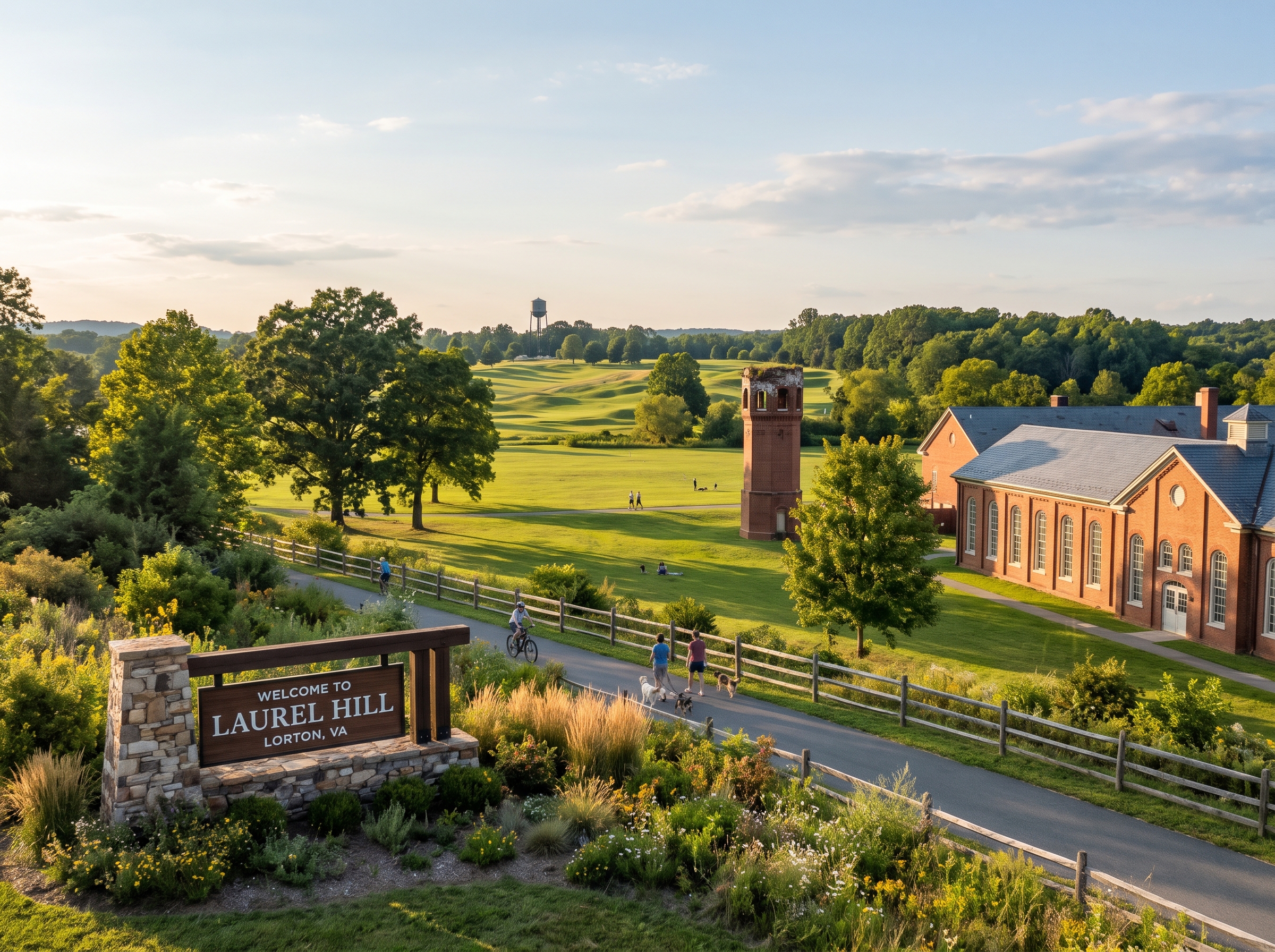
Executive Summary & Essential Community Takeaways
- Visionary 2,300-Acre Master-Planned Adaptive Redevelopment: Formerly the historic District of Columbia Lorton Reformatory complex, Laurel Hill was acquired by Fairfax County in 2002 and transformed into a nationally celebrated mixed-use community blending thousands of acres of dedicated parkland with modern residential villages.
- Cultural Heart: Workhouse Arts Center & Lucy Burns Museum: Anchored by the 55-acre historic Workhouse Arts Center, offering 85+ resident artist studios, art galleries, community performing arts, and the Lucy Burns Museum honoring American suffragists imprisoned on the site in 1917.
- Championship Golf & Outdoor Recreation: Home to the award-winning, municipal 18-hole Laurel Hill Golf Club designed by Bill Love, adjacent to hundreds of acres in Laurel Hill Park, the Giles Run Disc Golf Course, equestrian loops, and Occoquan Regional Park.
- Neo-Traditional Architectural Elegance: Built primarily from 2003 onwards, featuring executive detached residences with welcoming double-deck front porches, alley-loaded rear garages, 9- to 10-foot ceilings, and luxury townhomes with rooftop sky terraces, alongside historic brick loft residences at Liberty.
- Top-Tier Educational Continuity: Anchored by Laurel Hill Elementary School on Laurel Crest Drive, feeding into South County Middle School and the acclaimed South County High School campus in Lorton.
- Multimodal Commuter Nexus: Immediate connectivity to Interstate 95 (Exits 160 and 163), the Lorton VRE commuter rail station (direct trains to Alexandria and D.C. Union Station), Route 123 (Ox Road), and under-ten-minute access to Fort Belvoir.
1. Spatial Morphology, Geographic Coordinates & Territorial Extents
Laurel Hill, Virginia, is a distinguished master-planned community and formal Census-Designated Place (CDP) situated in the southernmost tier of Fairfax County. Cataloged under Federal Information Processing Standard (FIPS) code 51-44672 and Geographic Names Information System (GNIS) identifier 2583849, Laurel Hill spans a substantial land area of approximately 4.6 square miles. Centered at geographical coordinates 38°42′40″ N latitude and 77°14′45″ W longitude, the community rests at an average elevation of 180 to 200 feet above sea level, occupying a rolling, upland plateau overlooking the historic Occoquan River basin.
The perimeter of Laurel Hill is framed by distinctive natural topography and arterial roadways. To the north, the territorial boundary follows Silverbrook Road, bordering the established master-planned neighborhoods of Newington Forest and Hooes Road. To the east, the community connects with the traditional residential and commercial core of Lorton along Interstate 95, Lorton Road, and the Richmond, Fredericksburg and Potomac (RF&P) rail line. To the south, the boundary drops gracefully toward the Occoquan River, bordering Occoquan Regional Park, the historic Town of Occoquan, and Prince William County. To the west, the boundary is framed by Ox Road (Route 123), Giles Run, and the executive residential enclaves of Crosspointe and South Run.
Administratively, Laurel Hill is positioned within the Mount Vernon Magisterial District of Fairfax County. Residential mailing addresses within the community bear the Lorton postal designation under ZIP code 22079. Unlike conventional suburban sprawl, the spatial layout of Laurel Hill was designed under a unified master plan that permanently set aside more than half of its total acreage for public parks, golf courses, equestrian trails, and cultural facilities, ensuring an enduring sense of openness and natural serenity.
2. Historical Transformation: From the 1910 Lorton Reformatory to the Visionary Laurel Hill Master Plan
The narrative of Laurel Hill is one of the most remarkable stories of civic and architectural adaptive reuse in American history. In 1910, following an investigation commissioned by President Theodore Roosevelt into overcrowded and inhumane penal facilities in Washington, D.C., the federal government acquired approximately 2,300 acres of rural woodland and farmland in southern Fairfax County to create the District of Columbia Lorton Reformatory.
Conceived as a progressive experiment in correctional theory, the reformatory was designed not as an imposing stone fortress, but as an open-air agricultural and industrial community. Inmates lived in low-rise brick dormitories organized around open courtyards, operated dairy farms, orchards, and timber mills, and constructed their own neoclassical colonial buildings using clay extracted and kilned on-site along the Occoquan River.
During the women's suffrage movement of 1917, the Occoquan Workhouse on the property became a pivotal site in American civil rights history. Members of the National Woman's Party—including suffragist leaders Alice Paul and Lucy Burns—were arrested for peacefully picketing outside the White House for the right to vote and imprisoned at Occoquan. Their brutal mistreatment, hunger strikes, and forced feedings galvanized public outcry and played an essential role in compelling President Woodrow Wilson to support the passage of the Nineteenth Amendment.
Following decades of suburban encroachment and evolving correctional standards, the Lorton Reformatory complex was permanently decommissioned in late 2001. In 2002, the federal government conveyed the entire 2,300-acre property to the Fairfax County Government. Over the ensuing two decades, Fairfax County executed the visionary Laurel Hill Master Plan, collaborating with historic preservationists, environmentalists, and master builders to transform the former correctional tract into an award-winning residential community, cultural arts center, and regional recreational destination.
3. The Workhouse Arts Center: Historic Preservation, Adaptive Reuse & Cultural Anchor
The cultural jewel of Laurel Hill is the Workhouse Arts Center, a 55-acre multidisciplinary cultural campus that occupies the meticulously preserved and restored brick dormitories of the historic Occoquan Workhouse along Ox Road. Opened in 2008, the Workhouse has grown into one of Northern Virginia's premier destinations for visual arts, performing arts, and community cultural engagement.
Key facets of the Workhouse Arts Center include:
- Working Visual Artist Studios: Over 85 juried resident artists work, create, and display their art in open studios spanning ceramics, sculpture, glassblowing, photography, painting, fiber arts, and jewelry making, allowing visitors to interact directly with artists in their creative spaces.
- Lucy Burns Museum: A nationally recognized historical museum detailing both the 91-year operational history of the Lorton correctional complex and the harrowing story of the 1917 suffragist prisoners who fought for American women's right to vote.
- Performing Arts & Theatrical Venues: Hosting year-round professional theatrical productions, dance performances, live musical concerts, film screenings, and comedy showcases in its intimate indoor theater and open-air event pavilions.
- Community Arts Education: Offering comprehensive art instruction, ceramics workshops, youth summer art camps, and adult continuing education programs led by master craftsmen.
- Signature Community Festivals: Serving as the gathering site for annual regional celebrations, including the Fourth of July fireworks display, seasonal Oktoberfest, craft beer festivals, and holiday light extravaganzas.
4. Architectural Typologies: 21st-Century Neo-Traditional Homes & Historic Liberty Lofts
Unlike older mid-century subdivisions in central Fairfax County, the residential architecture of Laurel Hill was conceived in the early-to-mid 2000s under neo-traditional town planning principles (often termed the New Urbanism). The community emphasizes pedestrian-friendly streetscapes, welcoming front porches, and concealed garage loading.
The distinctive architectural typologies across Laurel Hill include:
- Neo-Traditional Executive Single-Family Residences: Built by premier national homebuilders such as Pulte, Centex, and Richmond American, these four- to six-bedroom homes feature striking two-story elevations with full-width front porches or dramatic double-deck covered porticos. Exterior walls feature fiber-cement lap siding (HardiePlank), natural brick water-tables, architectural shingle roofs, and decorative trim. Inside, homes boast 9-foot to 10-foot main-level ceilings, sweeping two-story family rooms, open gourmet kitchens, and fully finished daylight walkout basements.
- Rear-Alley-Loaded Carriage Residences: A signature design element of Laurel Hill's master plan, these single-family and townhome residences feature two-car garages positioned at the rear of the home, accessed via private paved alleyways. This design eliminates front driveway curb cuts, creating uninterrupted, tree-lined front lawns and welcoming sidewalks where neighbors naturally interact.
- Luxury Multi-Story Townhomes: Ranging from three to four finished levels, these spacious townhomes feature open-concept main levels, chef's kitchens with oversized center islands, expansive primary bedroom suites, and private fourth-floor rooftop sky terraces that provide sweeping panoramic views of the surrounding forest canopy and sunsets.
- Historic Adaptive-Reuse Lofts at Liberty: Located within the central former reformatory core, the Liberty community represents a celebrated historic preservation initiative. Master builders restored the original early-20th-century brick structures into distinctive loft-style residences featuring soaring 12-foot exposed timber ceilings, authentic exposed masonry brick interior walls, oversized multi-pane industrial windows, and contemporary luxury finishes.
5. Distinct Master-Planned Enclaves: Spring Hill, Laurel Hill South & Overlook
Laurel Hill is partitioned into several thoughtfully articulated residential villages, each designed with its own neighborhood character, private amenities, and architectural harmony:
The Village at Laurel Hill: Positioned around Laurel Crest Drive and Laurel Hill Elementary School, The Village serves as the vibrant family heart of the community. Characterized by wide sidewalks, tree-lined streets, and pocket parks, it features an appealing mix of large neo-traditional single-family homes and elegant brick townhomes within easy walking distance of classrooms and neighborhood playgrounds.
Spring Hill: A premier active-adult (55+) community within the Laurel Hill master plan, Spring Hill offers single-family homes and luxury condominium residences designed for main-level living. The enclave features its own exclusive 9,000-square-foot clubhouse, indoor swimming pool, fitness center, tennis and bocce ball courts, and a busy calendar of resident social programming.
Laurel Hill South & Overlook: Situated adjacent to the championship fairways of the Laurel Hill Golf Club, these enclaves feature some of the most expansive executive estate homes in southern Fairfax County. Properties here boast premium golf course views, generous lot setbacks, multi-car side-loading garages, and custom outdoor living installations.
Liberty: The newest residential quadrant, Liberty occupies the historic penitentiary campus. Combining historic adaptive-reuse lofts with newly constructed modern townhomes and single-family residences, Liberty features a dedicated community clubhouse, outdoor swimming pool, and direct access to the Cross County Trail.
6. Modern Structural Standards, High Ceilings & Energy Efficiency
Because the overwhelming majority of homes in Laurel Hill were constructed after 2003, homebuyers enjoy significant architectural and structural advantages compared to older mid-century housing stock elsewhere in Northern Virginia. Construction incorporates modern building codes, advanced structural engineering, and sophisticated residential technology:
- Engineered Floor Joists & High-Volume Ceilings: Poured concrete foundations paired with engineered I-joist floor systems eliminate settling and squeaking floors. Main levels standardly incorporate 9-foot to 10-foot ceiling heights, with upper bedroom levels featuring 9-foot ceilings and primary suites boasting vaulted or tray architectural volume.
- Gourmet Kitchen Architecture: Built-in double wall ovens, 36-inch or 48-inch gas cooktops, external ventilation hoods, walk-in food storage pantries, and central islands measuring eight to ten feet in length accommodate modern family culinary life and grand-scale entertaining.
- Advanced Energy & Thermal Envelopes: High-efficiency dual-zone natural gas heating and electric central air conditioning systems, programmable multi-zone thermostats, house-wrap moisture barriers, and double-pane low-emissivity argon-filled windows provide exceptional climate control and reduced utility bills.
- Fire Suppression & Electrical Capacity: Modern 200-amp to 400-amp electrical service panels easily accommodate electric vehicle (EV) level-2 charging stations, while integrated interior residential fire sprinkler systems provide unparalleled life safety.
7. Championship Golf & Civic Recreation: The 18-Hole Laurel Hill Golf Club
A crowning centerpiece of the community is the Laurel Hill Golf Club, a premier 18-hole municipal championship golf course owned and operated by the Fairfax County Park Authority. Spanning 300 acres of rolling Piedmont hills on the former reformatory grounds, the course was masterfully designed by renowned golf course architect Bill Love and opened to widespread acclaim in 2005.
Laurel Hill Golf Club is consistently ranked among the top public golf courses in Virginia by Golf Digest and Golf Magazine. The course plays from 5,000 to over 7,100 yards across five sets of tees, offering a challenging yet accessible test for golfers of all skill levels. The layout seamlessly incorporates the property's natural topography, meandering through mature hardwood forests, open grasslands, and wetlands, while passing historic stone structures and preserved silo landmarks.
The facility is anchored by a stately 9,400-square-foot clubhouse featuring a fully stocked pro shop, full-service bar and grille dining room, outdoor covered veranda overlooking the 18th green, and comprehensive practice facilities, including a full-length driving range and manicured short-game putting greens.
8. Parks, Greenways & Stream Valleys: Laurel Hill Park, Giles Run & Occoquan River
With more than 1,200 acres of dedicated open parkland within its borders, Laurel Hill offers an unmatched outdoor recreation infrastructure in southern Fairfax County:
- Laurel Hill Park: Encompassing extensive meadows, rolling uplands, and stream valleys, this regional park features multiple regulation athletic fields, picnic pavilions, and an extensive network of multi-use natural surface and crushed-stone trails favored by equestrian riders, mountain bikers, and trail runners.
- Giles Run Disc Golf Course: A championship-caliber 18-hole disc golf course traversing rolling hills, wooded tunnels, and open fields, attracting disc golf enthusiasts from throughout the mid-Atlantic region.
- Gerry Connolly Cross County Trail (CCT): The southern terminus of the 40-mile Cross County Trail traverses directly through Laurel Hill, providing continuous off-road hiking and cycling connectivity north along Pohick and Accotink Creeks to Great Falls on the Potomac River.
- Occoquan Regional Park: Located immediately south of Laurel Hill on the banks of the Occoquan River, this 400-acre regional park offers boat launch ramps, kayak and stand-up paddleboard rentals, a 5K loop trail, the 1619 Memorial Garden, and the waterside Brickmakers Cafe.
9. Environmental Hydrology: Occoquan Watershed Conservation & Wildlife Habitats
Laurel Hill is an integral component of the Occoquan River watershed, which feeds the Occoquan Reservoir—a vital source of drinking water for hundreds of thousands of Northern Virginia residents. Because of this critical ecological role, Fairfax County implemented strict environmental planning controls throughout the community's master planning and construction phases.
Giles Run and its associated tributary streams form natural stormwater filtration channels that are permanently shielded by extensive Environmental Quality Corridors (EQCs) and Resource Protection Areas (RPAs). Broad riparian forest buffers filter runoff, mitigate stream-bank erosion, and stabilize local water tables.
These protected natural corridors create an expansive wildlife sanctuary. Residents regularly observe white-tailed deer, red-tailed hawks, bald eagles nesting near the Occoquan River, wild turkeys, great blue herons, and migratory waterfowl throughout neighborhood open spaces.
10. Fairfax County Public Schools (FCPS): Laurel Hill Elementary, South County Middle & High
Fairfax County Public Schools (FCPS) consistently ranks among the premier public school systems in the United States, and Laurel Hill is served by an exceptional, modern educational pyramid that delivers rigorous academics, robust STEAM programs, and competitive athletics:
- Laurel Hill Elementary School: Located centrally on Laurel Crest Drive within the community, Laurel Hill Elementary opened in 2009 as a state-of-the-art facility. The school is renowned for its academic rigor, innovative outdoor learning courtyard, interactive technology labs, and strong parent-teacher partnership. Many neighborhood students walk or bike to school along dedicated community pathways.
- South County Middle School: Serving grades 7 and 8, South County Middle provides comprehensive pre-AP academic tracks, world language offerings in Spanish, French, and German, award-winning musical ensembles, and supportive transitional advisory programs.
- South County High School: Located nearby on Silverbrook Road in Lorton, South County High School is celebrated for its cutting-edge campus facilities, diverse Advanced Placement (AP) courses, dual-enrollment college partnerships, championship athletic teams, and nationally recognized fine arts and musical theatre departments.
11. Strategic Military Proximity: The Fort Belvoir Gateway & Defense Community Ties
Laurel Hill offers an exceptionally convenient home base for active-duty military service members, Department of Defense civilian personnel, and federal contractors. Positioned just five to ten minutes west of the Fort Belvoir Military Reservation, residents enjoy a swift, stress-free daily commute:
- Fort Belvoir Main Post & Tulley Gate: Direct vehicular access via Silverbrook Road, Backlick Road, and the Fairfax County Parkway allows service members to reach Fort Belvoir's primary entry gates in under ten minutes without traveling on major congested interstates.
- Alexander T. Augusta Military Medical Center: The flagship 120-bed tertiary hospital at Fort Belvoir is located just minutes away, providing world-class medical, dental, and emergency care to military families and retirees.
- Defense Logistics Agency (DLA) Headquarters: Operating as the Department of Defense's primary combat logistics agency, located right within Fort Belvoir.
- National Geospatial-Intelligence Agency (NGA) Springfield Campus: Located approximately six miles northeast, employing thousands of geospatial intelligence analysts and defense technology specialists.
12. Multimodal Commuter Infrastructure: I-95 Corridors, Lorton VRE Station & Route 123
Commuters residing in Laurel Hill benefit from a well-rounded multimodal transit network that provides multiple alternative routes into regional employment centers:
- Interstate 95 & Express Lanes: Immediate vehicular access via Exit 163 (Lorton Road) and Exit 160 (Route 123). The 95 Express Lanes provide smooth, dynamically tolled transit (free for HOV-3+ carpools) directly north to the Pentagon, Crystal City, and Washington, D.C.
- Lorton VRE Station: Located less than five minutes east on Lorton Station Boulevard, the Virginia Railway Express (VRE) Fredericksburg Line provides comfortable, stress-free passenger rail service north into Alexandria, Crystal City, L'Enfant Plaza, and Washington Union Station.
- Saratoga Park-and-Ride Hub: Situated approximately five minutes away on Barta Road, offering hundreds of free parking spaces and dedicated Fairfax Connector express commuter buses directly to the Pentagon Transit Center.
- Route 123 (Ox Road) & Fairfax County Parkway (Route 286): Providing high-speed northwest corridors connecting Laurel Hill directly to George Mason University, the City of Fairfax, Burke, and Reston without utilizing the Capital Beltway.
- Amtrak Auto Train Terminal: Located in Lorton, this unique rail facility provides the exclusive northern terminus for the nonstop Auto Train to Sanford, Florida, allowing families to transport their personal vehicles directly to the south.
13. Virginia Statutory Assessment Framework Under Code § 58.1-3201 & Fairfax County Mass Appraisal Equalization
Real property taxation across Laurel Hill is governed strictly by the statutory mandates of the Code of Virginia § 58.1-3201, which requires that all real estate subject to taxation must be assessed at one hundred percent (100%) of its true fair market value. The Commonwealth of Virginia enforces this uniform standard across all jurisdictions, ensuring equitable tax distribution without arbitrary fractional adjustments or speculative assessments.
To establish fair market value, the Fairfax County Department of Tax Administration (DTA) conducts an annual computerized mass appraisal equalization. Certified appraisal specialists evaluate closed arm's-length sales of comparable single-family homes and townhomes within Laurel Hill over the prior calendar year, adjusting for specific physical and location variables:
- Finished Living Area & Above-Grade Volume: Accurate measurement of gross above-grade living square footage, accounting for 9-foot and 10-foot ceiling configurations and open floor plan volume.
- Basement Finish & Walkout Attributes: Differentiated valuation of fully finished lower-level recreation suites, full bathrooms, and direct walkout ground-level access.
- Lot Topography & Premium Views: Valuation adjustments reflecting cul-de-sac positioning, direct frontage onto Laurel Hill Golf Club fairways, and rear borders backing onto protected parkland.
- Documented Capital Improvements: Verified property enhancements recorded through Fairfax County building permits, including custom screened porches, composite outdoor living decks, finished basements, and smart home electrical installations.
Fairfax County mails annual assessment notices to property owners in late February. Homeowners retain the statutory right to request an administrative review with the Department of Tax Administration, with subsequent appeal avenues available through the independent Fairfax County Board of Equalization (BOE) and the Circuit Court.
14. Comparative Analysis Matrix: Laurel Hill vs. Surrounding Communities
Prospective homebuyers exploring southern Fairfax County frequently compare Laurel Hill with neighboring communities. The comparative matrix below details key structural, governance, and lifestyle distinctions:
| Community | Primary Eras | Dominant Architecture | HOA Governance | Signature Parks & Amenities | High School Pyramids |
|---|---|---|---|---|---|
| Laurel Hill | 2003–Present | Neo-Traditional Colonials, Townhomes & Lofts | Mandatory Community HOAs | Workhouse Arts, Golf Club & Laurel Hill Park | South County High School |
| Newington Forest | 1978–1990 | Contemporary Colonials, Splits & Townhomes | Mandatory Community HOA (NFCA) | Pohick Stream Valley & 7+ Mi Trails | South County High School |
| Crosspointe | 1985–2000 | Large Executive Colonials & Townhomes | Mandatory Master Association | Two Community Pools & Silverbrook Lake | South County High School |
| South Run | 1980–1995 | Custom Executive Colonials on Large Lots | Mandatory Community HOA | South Run RECenter & Burke Lake Access | Lake Braddock Secondary |
| Lorton Station | 1998–2010 | Transit-Oriented Townhomes & Condominiums | Mandatory Master Association | Lorton VRE Station & Town Center Retail | South County High School |
| Kingstowne | 1985–2005 | Master-Planned Townhomes & Colonials | Mandatory Master Association | Kingstowne Lake & Town Center | Hayfield & Edison High School |
15. Frequently Asked Questions Regarding Laurel Hill, VA Real Estate
What are the precise geographic boundaries and spatial dimensions of Laurel Hill, Virginia?
The Laurel Hill Census-Designated Place (CDP) encompasses approximately 4.6 square miles in southern Fairfax County (ZIP code 22079, Mount Vernon District). It is bounded by Silverbrook Road and Newington Forest to the north, Interstate 95 and Lorton to the east, the Occoquan River and Occoquan Regional Park to the south, and Ox Road (Route 123) and Crosspointe to the west.
What is the historical background of the Laurel Hill property?
Laurel Hill was originally part of an expansive colonial estate before being acquired by the federal government in 1910 under President Theodore Roosevelt's commission to establish the District of Columbia Lorton Reformatory—a progressive, open-air agricultural correctional institution. Following the prison complex closure in late 2001, Fairfax County acquired the 2,300-acre property in 2002 and executed a master plan converting it into parkland, arts facilities, and modern residential neighborhoods.
What is the Workhouse Arts Center and what role does it play in the community?
The Workhouse Arts Center is a 55-acre cultural arts complex occupying the historic, repurposed brick dormitories of the former Occoquan Workhouse. It houses over 85 resident visual artist studios, art galleries, performing arts venues, music programs, the Lucy Burns Museum honoring the American women's suffrage movement, and host sites for community festivals and seasonal outdoor markets.
What architectural styles predominate throughout Laurel Hill?
Laurel Hill is characterized by 21st-century neo-traditional architecture, featuring executive single-family detached homes with double-deck front porches, fiber-cement and brick exteriors, rear-alley-loaded two-car garages, and open floor plans. The community also offers luxury multi-level townhomes with rooftop sky terraces and the Liberty adaptive-reuse enclave featuring historic exposed-brick loft designs.
What golf and recreational amenities are located in Laurel Hill?
Laurel Hill is home to the acclaimed Laurel Hill Golf Club, an 18-hole championship municipal course designed by Bill Love spanning 300 scenic acres of rolling Piedmont hills. Residents also enjoy hundreds of acres of parkland in Laurel Hill Park, the Giles Run Disc Golf Course, equestrian and mountain biking trails, and direct access to Occoquan Regional Park.
Which Fairfax County Public Schools serve Laurel Hill?
The community is anchored by Laurel Hill Elementary School, located on Laurel Crest Drive directly within the neighborhood. Middle school students attend South County Middle School, and high school students graduate from South County High School in Lorton, known for exceptional STEAM academies, Advanced Placement programs, and championship athletic facilities.
What is Laurel Hill's proximity to Fort Belvoir and defense facilities?
Laurel Hill is located just five to ten minutes from Fort Belvoir's primary gates, Fort Belvoir Community Hospital, Defense Logistics Agency (DLA) headquarters, and the National Geospatial-Intelligence Agency (NGA) campus in Springfield, making it an exceptionally popular residential community for military leaders and defense civilian personnel.
What commuter transit and highway corridors serve Laurel Hill?
Laurel Hill provides direct access to Interstate 95 via Exit 163 (Lorton Road) and Exit 160 (Route 123), the Fairfax County Parkway (Route 286), and the Lorton VRE Station (Virginia Railway Express Fredericksburg Line), offering direct rail transit to Alexandria and Washington Union Station. The Saratoga Park-and-Ride facility is also minutes away for express bus transit to the Pentagon.
Does Laurel Hill have Homeowners Associations (HOAs)?
Yes. Laurel Hill's residential subdivisions are governed by professional Homeowners Associations that maintain common neighborhood open spaces, private community swimming pools, clubhouse facilities, fitness centers, tot lots, and multi-use trail connectors, while enforcing architectural guidelines to protect long-term property values.
How does Fairfax County assess real property values across Laurel Hill?
Under Code of Virginia § 58.1-3201, all real property is assessed annually at 100 percent of true fair market value. The Fairfax County Department of Tax Administration (DTA) conducts computerized mass appraisal equalizations annually based on verified arm's-length sales of comparable homes within specific neighborhood submarket codes.
Navigating Real Estate in Laurel Hill & South Fairfax County
Whether you are preparing to list a neo-traditional single-family home with golf course views in Laurel Hill, seeking a luxury townhome near the Workhouse Arts Center, or evaluating residences near the Lorton VRE Station and South County High School, partner with trusted Northern Virginia real estate authority Elena Gorbounova for discreet, data-driven representation.