Lorton, VA Real Estate: The Definitive Guide to Laurel Hill, Liberty Adaptive Reuse, VRE Commuter Rail & Mason Neck
1. Executive Summary & Foundational Takeaways
Lorton, Virginia, stands as the premier model of large-scale municipal land reclamation, historic adaptive reuse, and environmental stewardship in southern Fairfax County. Encompassing postal ZIP code 22079 across the Mount Vernon and Springfield Magisterial Districts, Lorton is bounded by the historic Occoquan River to the south, the sprawling Mason Neck peninsula to the southeast, and the high-growth I-95 commuter corridor to the west.
As an unincorporated census-designated place (CDP) administered directly by the Fairfax County Board of Supervisors, Lorton is not an incorporated municipality. Property owners operate under a single, unified Fairfax County tax framework, avoiding secondary municipal town taxes while benefiting from county public safety, library networks, and public school infrastructure within the celebrated South County High School pyramid.
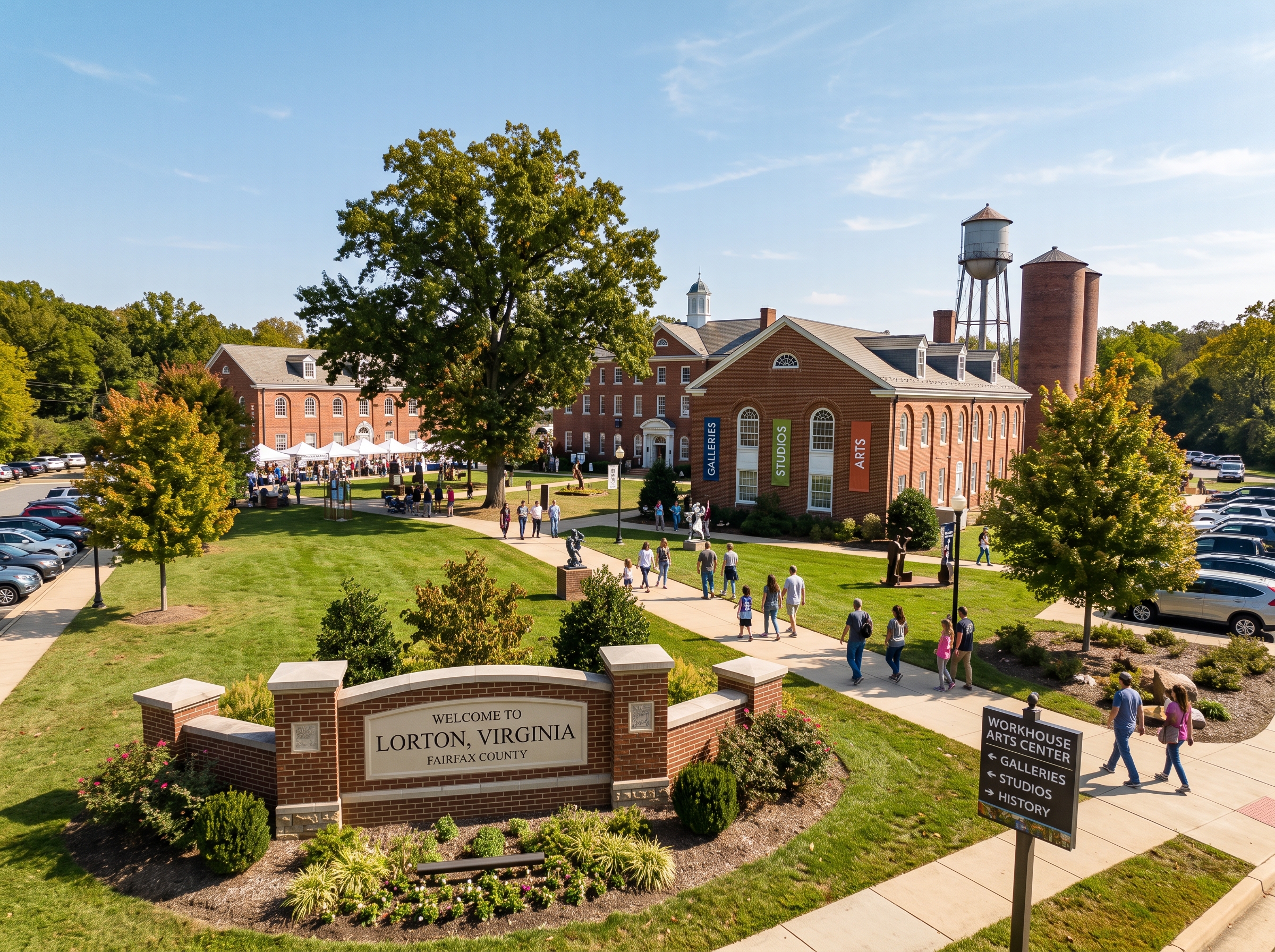
Once known primarily for institutional government facilities, Lorton has undergone a historic master-planned renaissance over the past three decades. Key developments include Laurel Hill—a vibrant community centered around the 18-hole Laurel Hill Golf Club—and Liberty Lorton, a nationally celebrated adaptive reuse of the historic 1910 D.C. Reformatory complex that created modern luxury housing and the 55-acre Workhouse Arts Center. Supported by the Virginia Railway Express (VRE) Lorton Station, I-95 Express Lanes, and thousands of acres of protected parkland on Mason Neck, Lorton offers an unparalleled synthesis of suburban luxury, cultural heritage, and commuter mobility.
The Six Structural Pillars of Lorton Real Estate
- Master-Planned Living at Laurel Hill & Liberty. Award-winning master developments offering architectural variety from expansive single-family estates and modern brownstones to historic loft apartments set amid conserved green space.
- Heavy Commuter Rail & Regional Arterials. Direct, relaxed heavy-rail service into Crystal City, L'Enfant Plaza, and Washington Union Station via the VRE Fredericksburg Line, alongside immediate access to the I-95 Express Lanes and Route 123 (Ox Road).
- The Workhouse Arts Center Cultural Hub. A 55-acre multidisciplinary cultural arts campus featuring artist studios, galleries, performing arts venues, and the Lucy Burns Museum honoring American suffragist history.
- The Mason Neck Wildlife & Riverfront Sanctuary. Thousands of acres of permanently conserved coastal terrain, including Mason Neck State Park and the nation's first federal bald eagle refuge, shielding southern Lorton from overdevelopment.
- South County Academic Pyramid. Seamless public education provided by Fairfax County Public Schools through South County High School, South County Middle School, and modern feeder elementary campuses.
- Amtrak Auto Train National Gateway. Host to the unique national northern terminal of the Amtrak Auto Train, offering non-stop vehicle-and-passenger rail transit directly to Sanford, Florida.
2. Comprehensive Historical Evolution
Lorton's rich historical trajectory spans colonial ecclesiastical governance, nineteenth-century commerce, pivotal twentieth-century civil rights milestones, and visionary twenty-first-century adaptive reuse.
Colonial Foundations & Historic Pohick Church
In the eighteenth century, the area was an agrarian crossroads centered near the colonial port of Colchester on the Occoquan River. In 1732, Truro Parish established Pohick Church as the spiritual center of southern Fairfax County. Between 1769 and 1774, the present two-story Georgian brick sanctuary was constructed on a high ridge along Route 1. George Washington, George Mason of Gunston Hall, and George William Fairfax served on the church vestry, personally surveying the location and overseeing its architectural construction. The historic structure remains an active parish and a revered national monument.
In 1875, merchant Joseph Plaskett opened a general store and post office at the crossroads, naming the postal station Lorton after his ancestral village in Cumbria, England.
The D.C. Workhouse & Suffragist History (1910–1917)
In 1910, under a penal reform commission appointed by President Theodore Roosevelt, the federal government established the District of Columbia Workhouse and Reformatory on several thousand acres of rolling countryside in Lorton. Designed around a progressive "open-air" architectural concept without conventional perimeter walls, inmates constructed the complex using bricks fired from local clay beds.
In 1917, Lorton became a focal point of American constitutional history. Members of the National Woman's Party—known as the "Silent Sentinels"—who picketed the White House demanding the right to vote were arrested and incarcerated at the Occoquan Workhouse. During the infamous "Night of Terror" in November 1917, suffragists led by Alice Paul and Lucy Burns endured brutal beatings and forced feedings. The public outrage that followed their courageous sacrifice galvanized national sentiment and directly catalyzed the passage and ratification of the Nineteenth Amendment to the U.S. Constitution.
Historic Land Reclamation & Adaptive Reuse
Following the closure of the correctional facility in late 2001, Fairfax County purchased the expansive 2,400-acre property from the federal government. Rather than allowing piecemeal commercial development, the county enacted a visionary master plan. The former prison complex was transformed into the Workhouse Arts Center and the Liberty Lorton master-planned residential community, preserving the historic brick colonnades, guard towers, and open quadrangles in an internationally acclaimed example of historic preservation.
3. Master-Planned Communities: Laurel Hill & Liberty Lorton
Lorton's real estate renaissance is anchored by two transformative master developments that redefine modern suburban living:
Laurel Hill
Encompassing several square miles of former public land, Laurel Hill is a master-planned residential tapestry harmoniously woven into rolling hills and preserved woodland. Built by premier national homebuilders, the community features spacious colonial revival and craftsman-style single-family homes, elegant executive townhomes, and pedestrian-oriented streetscapes. It is centered around the municipal 18-hole Laurel Hill Golf Club, extensive shared-use trail networks, neighborhood swimming pavilions, and newly constructed Fairfax County public schools.
Liberty Lorton
Developed by a public-private partnership, Liberty Lorton stands as a benchmark for historical adaptive reuse. The community integrates newly constructed luxury single-family homes, contemporary multi-story brick townhomes, and unique historic loft apartments housed within the original 1910 colonial revival brick dormitory buildings. Residents enjoy tree-lined pedestrian mews, a restored central green quadrangle, a state-of-the-art community clubhouse with swimming facilities, and seamless footbridge connectivity to the adjacent Workhouse Arts Center.
4. Natural Reserves & The Mason Neck Peninsula
To the south and east of Lorton's suburban core lies the Mason Neck peninsula, one of the most ecologically protected coastal landscapes in the mid-Atlantic region:
- Mason Neck National Wildlife Refuge: Established in 1969, this was the first federal national wildlife refuge created specifically to protect the nesting grounds of the American bald eagle. Spanning over 2,200 acres of mature hardwood forest and tidal freshwater marshes on Belmont Bay and the Potomac River, it remains a pristine nature sanctuary.
- Mason Neck State Park: An adjacent 1,800-acre Commonwealth park offering miles of coastal hiking and biking trails, canoe and kayak launches on Kane's Creek, and elevated wildlife observation decks.
- Pohick Bay Regional Park: A 1,000-acre regional park operated by NOVA Parks, featuring an 18-hole championship public golf course, full-service marina with boat launch ramps for powerboats and sailboats, waterfront camping facilities, and an aquatic waterpark.
- Meadowood Special Recreation Management Area: Over 800 acres of preserved public land managed by the Bureau of Land Management (BLM), providing 13 miles of equestrian and hiking trails and one of Northern Virginia's premier mountain biking single-track networks.
5. Housing Stock Typologies & Architectural Stratification
Lorton provides a diverse architectural landscape that accommodates varied buyer preferences across four prominent tiers:
1. Executive Single-Family Residences
Concentrated in neighborhoods like Laurel Hill, Lorton Valley, and Gunston Corner, these homes were constructed primarily between 2000 and the present. Featuring brick, stone, and architectural siding facades, these residences offer 3,500 to 6,000+ square feet of living space, two- to three-car garages, finished lower-level walkouts, grand primary bedroom suites, and chef-inspired kitchens.
2. Adaptive Reuse Lofts & Brownstones at Liberty
A boutique tier defined by historic character and urban aesthetic: exposed historic brick interior walls, soaring 12- to 14-foot ceilings, oversized industrial-style windows, and sleek quartz and stainless-steel designer finishes set within preserved century-old architectural shells.
3. Transit-Oriented Townhomes & Condominiums
Positioned within walking distance or brief shuttle access to the VRE Lorton Station and Lorton Station Town Center, these multi-level brick townhomes and garden-style condominiums appeal to commuters seeking low-maintenance living with neighborhood retail and rapid heavy-rail access.
4. Mason Neck Waterfront & Equestrian Acreage
On the rural fringes of the Mason Neck peninsula, custom estate residences occupy multi-acre wooded parcels. Many boast deeded riparian rights, private boat docks on Belmont Bay, Gunston Cove, or the Potomac River, and private equestrian barns and pastures.
6. Institutional, Healthcare & Commercial Anchors
Lorton's economic stability is reinforced by significant institutional infrastructure:
- Inova HealthPlex – Lorton: A modern healthcare facility located on Route 123, providing 24/7 full-service emergency medical care, advanced diagnostic imaging, outpatient surgical services, and physician offices.
- Fort Belvoir Proximity: Lorton borders the western garrison gates of Fort Belvoir, home to the Defense Logistics Agency (DLA) and the National Geospatial-Intelligence Agency (NGA) New Campus East, sustaining steady demand from defense personnel and contractors.
- Workhouse Arts Center: A major regional cultural institution home to over 100 working studio artists, art galleries, youth art education programs, and the Lucy Burns Museum.
- Lorton Station Town Center: A walkable commercial enclave adjacent to the VRE station featuring neighborhood restaurants, medical clinics, daycares, and convenience retail.
7. Zoning, Land-Use Governance & Planned Development Districts
Land use in Lorton is strictly regulated under the Fairfax County Zoning Ordinance (zMOD):
Planned Development Housing (PDH) & PRC Districts
Much of Lorton's modern residential acreage is governed by Planned Development Housing (PDH) and Planned Residential Community (PRC) zoning overlays. These sophisticated designations establish comprehensive master plans that dictate precise architectural guidelines, open-space ratios, trail connections, and public amenity contributions, preventing haphazard sprawl.
Conservation & Low-Density Rural Zoning
Conversely, the southern and eastern sectors on Mason Neck are protected under R-E (Residential Estate, 1 unit per 2 acres) and R-C (Residential Conservation, 1 unit per 5 acres) zoning. These strict limits preserve environmental buffers, protect aquifer recharge zones, and maintain the low-density pastoral character of the peninsula.
8. Environmental Regulation: Chesapeake Bay Act & Watersheds
Lorton lies within the sensitive watersheds of Pohick Creek, Accotink Creek, and the tidal Occoquan River, triggering comprehensive environmental protections under the Chesapeake Bay Preservation Act.
Statutory 100-foot Resource Protection Areas (RPAs) border all perennial streams, wetlands, and shorelines. In these zones, development, tree clearing, and ground disturbance are tightly restricted to prevent sediment runoff into the Occoquan reservoir and Belmont Bay. Regional stormwater retention ponds and bioretention swales are integrated throughout communities like Laurel Hill and Liberty to manage runoff and protect downstream wildlife.
9. Multimodal Transportation & Commuter Arteries
Lorton offers exceptional transit options connecting residents to employment hubs across the National Capital Region:
Virginia Railway Express (VRE) Commuter Rail
The Lorton VRE Station on the Fredericksburg Line provides a comfortable, seated heavy-rail commuter experience. Trains travel north through Franconia-Springfield, Alexandria, Crystal City (National Landing), L'Enfant Plaza, and terminate at Washington Union Station, providing a traffic-free journey for downtown professionals.
Amtrak Auto Train Terminal
Lorton is home to the northern passenger terminal for Amtrak's unique Auto Train. This specialized service transports travelers and their personal automobiles, motorcycles, and vans non-stop along an 855-mile rail corridor directly to Sanford, Florida, avoiding congested East Coast highway travel.
Arterial Highway Network & Express Lanes
Vehicular commuters benefit from immediate access to Interstate 95, including direct entry and exit ramps to the dynamically tolled I-95 Express Lanes. Additional major routes include Route 123 (Ox Road) connecting northwest to George Mason University and the City of Fairfax, Route 1 (Richmond Highway), and Lorton Road.
10. Public Education & The South County Academic Pyramid
Lorton is served by the acclaimed Fairfax County Public Schools (FCPS) system, organized within the cohesive South County High School pyramid:
South County High School
Constructed in 2005 to serve the growing southern Fairfax County population, South County High School is a modern academic and athletic powerhouse. The school offers extensive Advanced Placement (AP) courses, the AP Capstone Diploma program, competitive STEM pathways, award-winning marching band and fine arts programs, and championship athletic facilities.
Middle & Elementary Feeder Schools
The high school is fed by South County Middle School, located on an adjoining campus. Feeder elementary schools include modern, highly regarded neighborhood institutions such as Laurel Hill Elementary School, Silverbrook Elementary School, William Halley Elementary School, and Lorton Station Elementary School.
11. Parks, Culture & Recreation
Recreational opportunities in Lorton are among the most diverse and expansive in Northern Virginia:
- Workhouse Arts Center: Over 100 artist studios, galleries, ceramics facilities, and the Lucy Burns Museum, hosting year-round exhibitions, theater, and cultural festivals.
- Laurel Hill Golf Club: An award-winning 18-hole municipal championship golf course featuring rolling terrain, immaculate fairways, and a full-service clubhouse.
- Occoquan Regional Park: Situated directly on the Occoquan River, featuring the River View event center, Brickmakers Cafe, kayak launches, 5K loop trails, and batting cages.
- Cross County Trail (CCT): The 40-mile Fairfax County trail system connects directly through Laurel Hill and Occoquan Regional Park, linking Lorton to Great Falls on the Potomac.
12. Comprehensive Submarket Matrix Table
The table below contrasts the primary residential micro-markets across Lorton, highlighting architectural typologies, lot profiles, transit connectivity, and governance models:
| Submarket / Enclave | Primary Architectural Typology | Dominant Construction Era | Density & Lot Size Profile | Transit & Arterial Profile | Governance & HOA Structure |
|---|---|---|---|---|---|
| Laurel Hill Master Plan | Colonial Revival, Craftsman Single-Family, Executive Townhomes | 2003 – Present | Medium-Low Density; 0.2 to 0.4 Acres | Route 123, Silverbrook Rd, I-95 Access | Mandatory HOA (POAA Oversight); Pools, Trails |
| Liberty Lorton Adaptive Reuse | Historic Dormitory Lofts, Contemporary Brick Townhomes & Estates | 2016 – Present (1910 Historic Shells) | Medium-High Density; Clustered Mews | Route 123 & Lorton Road; Direct Trail to Arts Center | Mandatory Master Association; Historic Guidelines |
| Lorton Station Transit Core | Multi-Level Brick Townhomes, Garden Condominiums | 2000 – 2012 | High Density Urban Clustered Sites | Walking Distance to VRE Lorton Station & Town Center | Mandatory HOA & Condominium Associations |
| Lorton Valley Community | Single-Family Colonials, Craftsman Townhomes | 2004 – 2010 | Medium Density; 0.18 to 0.30 Acres | Direct Access to I-95 & Route 1 | Mandatory HOA; Clubhouses, Pools, Fitness Center |
| Mason Neck Waterfront & Estates | Custom Waterfront Manors, Equestrian Properties, Acreage | 1970s – Contemporary Custom | Very Low Density; 2.0 to 10.0+ Acres | Gunston Road; River & Belmont Bay Riparian Piers | Predominantly Non-HOA Fee-Simple; R-E & R-C Zoning |
13. Taxation & Civic Governance
As an unincorporated community governed directly by Fairfax County, Lorton provides clear, predictable tax and administrative structures:
Ad Valorem Real Estate Assessments
Real estate in Lorton is assessed annually at 100% fair market value by the Fairfax County Department of Tax Administration (DTA) in strict accordance with Virginia Code Title 58.1. Real property taxes are billed semi-annually. Because Lorton is not an incorporated town, property owners pay only the single unified county real estate tax and standard countywide service assessments (such as stormwater management), avoiding separate town tax levies.
Master Homeowner Associations (HOAs) vs. Rural Acreage
The vast majority of residential homes in Laurel Hill, Liberty, Lorton Valley, and Lorton Station are governed under the Virginia Property Owners' Association Act (POAA). These professional associations maintain private neighborhood swimming pools, community clubhouses, fitness centers, multi-sport courts, and extensive trail networks, ensuring high aesthetic and maintenance standards through architectural review committees. Conversely, rural properties on Mason Neck operate as fee-simple non-HOA holdings, giving owners maximum autonomy.
14. 10 Comprehensive Evergreen FAQs
1. Is Lorton an incorporated municipality or an unincorporated part of Fairfax County?
Lorton is an unincorporated census-designated place (CDP) governed directly by the Fairfax County Board of Supervisors within the Mount Vernon and Springfield Magisterial Districts. It is not an incorporated city or town. Homeowners in Lorton pay solely the unified Fairfax County real estate tax without separate municipal town tax surcharges.
2. What is the Liberty Lorton development and its historic significance?
Liberty Lorton is an acclaimed master-planned adaptive reuse community located on the former grounds of the historic D.C. Workhouse and Reformatory (established in 1910). Renowned historically as the site where suffragists from the National Woman's Party were imprisoned in 1917, the complex has been meticulously transformed into an architectural community featuring luxury single-family homes, multi-story townhomes, and historic loft apartments integrated with the adjacent 55-acre Workhouse Arts Center.
3. What commuter rail transit serves Lorton?
Lorton is served directly by the Virginia Railway Express (VRE) Lorton Station on the Fredericksburg Line. The commuter rail line provides a direct, stress-free commute northward to Franconia-Springfield, Crystal City, L'Enfant Plaza, and Washington Union Station. Additionally, Lorton hosts the national northern terminal of the Amtrak Auto Train.
4. What is the Laurel Hill master-planned community?
Laurel Hill is one of southern Fairfax County's largest master-planned residential environments, encompassing thousands of acres of former public lands. It integrates neighborhoods of executive single-family homes and spacious townhomes centered around the public 18-hole Laurel Hill Golf Club, extensive equestrian and mountain bike trails, and modern public school campuses.
5. Which public schools serve Lorton residents?
The majority of Lorton is served by Fairfax County Public Schools (FCPS) within the South County High School academic pyramid. South County High School features modern academic and athletic facilities, extensive Advanced Placement (AP) coursework, and competitive career/STEM pathways. It is fed by South County Middle School and elementary schools including Laurel Hill, Silverbrook, Halley, and Lorton Station Elementary.
6. What recreational and ecological resources surround Lorton?
Lorton is surrounded by exceptional open space and parkland, including the Mason Neck peninsula (housing Mason Neck State Park and the Mason Neck National Wildlife Refuge, the first federal refuge dedicated to bald eagles), Pohick Bay Regional Park with golf and marina facilities, Meadowood Special Recreation Management Area (800 BLM acres of trails), and Occoquan Regional Park.
7. What architectural home styles predominate in Lorton?
Lorton features a contemporary and diverse housing mix: large colonial and craftsman executive single-family residences in Laurel Hill and Lorton Valley, historic adaptive reuse lofts and brick brownstones at Liberty, transit-oriented multi-level townhomes near Lorton Station, and private multi-acre waterfront and equestrian estates on the Mason Neck peninsula.
8. What is the historical significance of Pohick Church in Lorton?
Established in 1732, Pohick Church is a historic colonial parish whose present brick sanctuary was constructed between 1769 and 1774. George Washington, George Mason of Gunston Hall, and George William Fairfax served on its vestry and were directly involved in its site selection and architectural planning, making it one of the foundational historical landmarks of Fairfax County.
9. What major highways provide access to Lorton?
Lorton provides immediate access to Interstate 95 (including direct access ramps to the 95 Express Lanes), Route 1 (Richmond Highway), Route 123 (Ox Road), and Lorton Road, offering rapid vehicular connectivity north to Springfield, Tysons, and Washington, D.C., and south across the Occoquan River to Prince William County.
10. Do residential communities in Lorton have mandatory HOAs?
Most master-planned communities in Lorton (such as Laurel Hill, Liberty, Lorton Valley, and Lorton Station) operate with mandatory community associations governed by the Virginia Property Owners' Association Act (POAA). These associations maintain extensive amenities including neighborhood swimming pools, community clubhouses, fitness centers, sports courts, and common landscaping. Older outlying parcels and Mason Neck acreage operate as fee-simple non-HOA properties.
15. Legal & Fair Housing Disclaimer
This real estate and community monograph is published strictly for informational, educational, and demographic research purposes. All municipal boundaries, zoning districts, school attendance zones, tax assessments, and transit plans are derived from official Fairfax County public records, the Virginia Department of Transportation (VDOT), the Virginia Railway Express (VRE), and the Code of Virginia, and are subject to periodic administrative modification. Prospective purchasers, sellers, and investors must independently examine official property disclosures, deed encumbrances, and zoning regulations through licensed legal and real estate professionals prior to executing contractual agreements. This publication strictly adheres to Title VIII of the Civil Rights Act of 1968 (The Federal Fair Housing Act) and the Virginia Fair Housing Law, prohibiting discrimination on the basis of race, color, religion, sex, handicap, familial status, elderliness, or national origin.