
Mantua, VA Real Estate: The Definitive Guide to Spatial Morphology, Wooded Half-Acre Parcels, Mid-Century Modern Architecture, Mantua Elementary AAP & Woodson High Pyramid
Executive Summary & Essential Community Takeaways
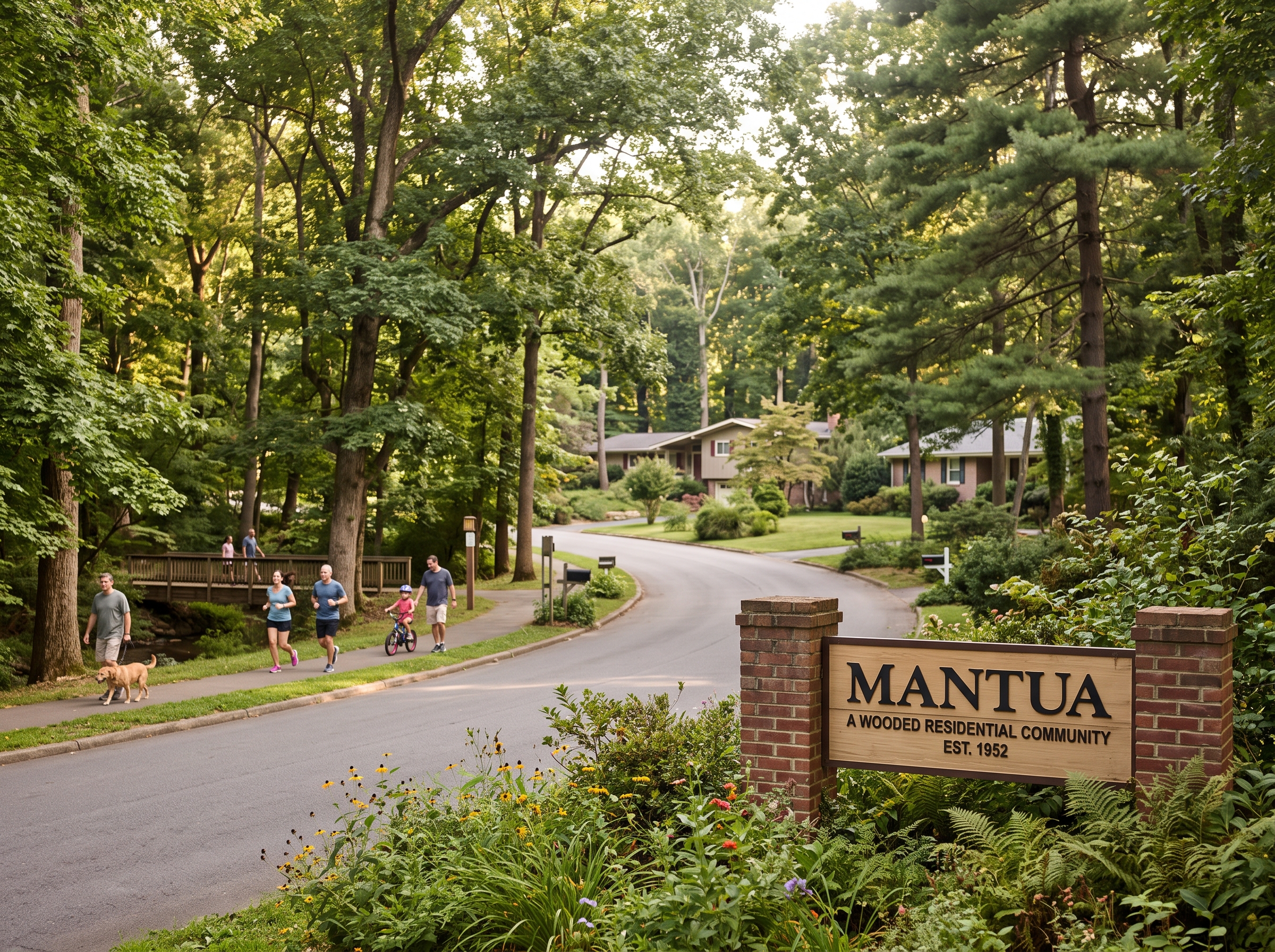
- Idyllic Wooded Conservation Sanctuary: Platted starting in 1952 across rolling Virginia piedmont terrain, Mantua is an unincorporated enclave in Fairfax County's Providence Magisterial District, characterized by generous parcel configurations ranging from one-third to over an acre, mature native hardwood canopies, and a distinct absence of sidewalks that preserves an authentic country-like woodland atmosphere just 15 miles from the nation's capital.
- Celebrated Mid-Century Modern & Custom Architecture: Unlike mass-produced post-war tract housing, Mantua features an extraordinary portfolio of authentic 1950s and 1960s Mid-Century Modern post-and-beam contemporary residences with floor-to-ceiling glass clerestories, exposed tongue-and-groove cedar decking, expansive Virginia fieldstone fireplaces, sprawling brick ramblers with walkout daylight lower levels, stately center-hall Colonials, and modern multi-level luxury custom craftsman estates.
- Elite FCPS Academic Pedigree: Feeds directly into the renowned W.T. Woodson High School pyramid, universally acclaimed for its Advanced Placement (AP) Capstone Diploma program, elite STEM academies, and championship athletics. The neighborhood is anchored by Mantua Elementary School, home to a dedicated Full-Time Advanced Academic Programs (AAP) Level IV Center and a nationally recognized Total Communication Program for Deaf and Hard of Hearing students.
- Vibrant Civic Identity & Mantua Swim & Tennis Club: Supported by the historic Mantua Citizens Association (MCA)—established in 1954—and centered socially around the member-owned Mantua Swim & Tennis Club (MSTC) on Glenbrook Road, featuring a 25-meter competition pool, diving well, lit tennis and pickleball courts, and the storied Mantua Marlins Northern Virginia Swimming League (NVSL) team.
- Direct Access to Stream Valleys & Regional Trails: Flanked by the Accotink Creek and Crook Branch stream corridors, offering direct neighborhood access to the 40-mile Gerry Connolly Cross County Trail (CCT), wooded parkland buffers, and protected wildlife corridors harboring native white-tailed deer, red foxes, and diverse migratory birds.
- Unrivaled Central Fairfax Commuter Orientation: Positioned conveniently between Route 50 (Arlington Boulevard) and Route 236 (Little River Turnpike), just two miles east of historic Old Town Fairfax and minutes from the Vienna/Fairfax-GMU Metrorail Station (Orange Line), I-66, the Capital Beltway (I-495), Inova Fairfax Hospital Medical Campus, and the bustling Mosaic District.
1. Spatial Morphology, Topography & Environmental Geography
Mantua occupies a distinctive geographic territory in central Fairfax County, Virginia, situated within the Providence Magisterial District and utilizing the Fairfax postal designation (ZIP code 22031). Encompassing approximately two square miles of deeply contoured terrain, the community is bordered by Route 50 (Arlington Boulevard) to the north, Route 236 (Little River Turnpike) to the south, the independent City of Fairfax corporate boundary to the west, and the Annandale/I-495 corridor to the east.
What fundamentally differentiates Mantua from the surrounding Northern Virginia suburban fabric is its pronounced geological and topographic character. The land forms part of the Piedmont Upland subprovince, characterized by rolling hills, ridgelines, and dramatic ravines carved over millennia by the drainage network of Accotink Creek and its principal local tributary, Crook Branch. Rather than leveling this complex topography with heavy earthmovers—as became standard practice in later suburban subdivisions—the original developers preserved the natural contours of the hillsides.
Streets throughout Mantua were platted along natural topographic ridges and contour lines. Roadways curve organically through deep ravines and ascend gentle wooded crests, deliberately avoiding standard rectilinear grid layouts. The intentional exclusion of concrete sidewalks and streetlights across most interior residential lanes was a deliberate mid-century planning choice, conceived to maintain a rustic, secluded countryside aesthetic that seamlessly integrates residential architecture into the natural woodland ecosystem.
The environmental canopy of Mantua constitutes one of Fairfax County's most mature and contiguous urban forests. Stately stands of native white oak (Quercus alba), northern red oak (Quercus rubra), tulip poplar (Liriodendron tulipifera), American beech (Fagus grandifolia), sweetgum, and flowering dogwoods dominate the landscape. These towering trees form a dense, protective canopy that provides substantial summertime cooling, natural windbreaks during winter months, and critical ecological corridors connecting directly into the Accotink Stream Valley parklands.
2. Historical Evolution: Agrarian Roots to Conservation Master Plan
The historical lineage of Mantua dates back to eighteenth- and nineteenth-century Virginia land patents. During the colonial era, the territory formed part of the vast Northern Neck Proprietary granted by the English Crown. Throughout the eighteenth and nineteenth centuries, the fertile rolling terrain was cultivated for tobacco, winter wheat, orchards, and dairy farming, with historic timber tracts harvested to support the growth of the nearby crossroad towns of Fairfax Court House and Alexandria.
The community draws its historic name from the celebrated Mantua estate in Virginia, which itself referenced the ancient Italian city of Mantua, renowned for classical poetry and rural tranquility. Following the Civil War and the reconstruction of regional turnpikes—notably the Little River Turnpike (Route 236), one of America's earliest private paved toll roads, and the Alexandria-Winchester Turnpike (Route 50)—the rural crossroad maintained a pastoral identity dotted with family farmsteads and dense hardwood groves.
The transformative chapter in Mantua's modern history began in 1952. As post-war suburban decentralization gained momentum around Washington, D.C., visionary developers recognized the unique potential of the large rural parcels situated between Fairfax City and Falls Church. However, instead of subdividing the land into uniform quarter-acre tract parcels, the planners instituted an ambitious conservation-oriented master plan. They platted generous parcels—typically measuring from 15,000 square feet (over one-third acre) to upwards of 40,000 square feet (nearly a full acre)—and invited leading regional architects and custom builders to craft individual homes tailored to the natural slope of each homesite.
In 1954, as the first waves of residents moved into their woodland homes, the community formally chartered the Mantua Citizens Association (MCA). One of the oldest continuously active civic organizations in Fairfax County, the MCA was formed to protect the community's natural tree canopy, advocate for municipal infrastructure improvements, establish architectural design guidelines, and foster civic unity. Over the ensuing decades, the MCA played an instrumental role in advocating for the construction of Mantua Elementary School, securing county parkland along Accotink Creek, and maintaining the neighborhood's unique character.
In 1990, an underground petroleum leak occurred at the nearby Pickett Road tank farm storage facility along the western perimeter of the neighborhood. The event prompted an immediate, comprehensive joint response from the Mantua community, Fairfax County, the Commonwealth of Virginia, and the United States Environmental Protection Agency (EPA). Through rigorous civic advocacy, the oil companies executed an exhaustive, multi-million-dollar remediation program, installing state-of-the-art hydraulic containment systems, bioremediation vapor extraction systems, and an extensive network of continuous water quality monitoring wells. Today, the Pickett Road remediation is studied nationwide as a textbook model of environmental restoration, with all affected soils and groundwater thoroughly reclaimed, monitored, and confirmed completely safe by environmental regulatory authorities.
3. Architectural Typologies & Residential Micro-Enclaves
Mantua boasts an architectural diversity rarely found in modern suburban communities. Because homes were platted over several decades by various premier custom builders, the neighborhood exhibits an authentic architectural continuum rather than uniform construction. Key typologies and micro-enclaves include:
Mid-Century Modern Custom Contemporary Masterworks (1954–1968)
Among the most historically significant residential collections in Fairfax County are Mantua's authentic Mid-Century Modern post-and-beam contemporary residences. Inspired by Frank Lloyd Wright's organic architectural philosophy and the California contemporary movement, these homes were designed to integrate with the topography. They feature low-pitch gabled or flat rooflines with wide overhanging eaves, exposed tongue-and-groove structural cedar plank ceilings, massive structural timber beams, and floor-to-ceiling glass clerestory window assemblies that blur the boundary between indoor living spaces and the surrounding forest.
These residences incorporate native Virginia fieldstone chimneys, open-concept living and dining pavilions centered on dual-sided hearths, cantilevered cedar decks overlooking wooded ravines, and daylight walkout lower levels that take full advantage of sloping lots. Over recent years, many of these mid-century gems have undergone multi-level architectural restorations, preserving their authentic post-war lines while integrating designer Scandinavian kitchens, spa-inspired bathrooms, and commercial-grade high-efficiency thermal window assemblies.
Sprawling Brick & Stone Ramblers with Walkout Basements (1953–1965)
Representing the quintessential American ranch form, Mantua's single-story brick and stone ramblers offer extensive main-level footprints spanning 1,800 to 2,600 square feet on the primary floor, doubled by full finished subterranean or walkout daylight basements. These residences feature solid masonry exteriors, oak hardwood strip flooring, formal living rooms with natural wood-burning fireplaces, wide picture windows, and integrated two-car carports or attached side-load garages. The expansive floorplans lend themselves effortlessly to modern open-concept reconfigurations and main-level primary suite expansions.
Traditional Center-Hall Colonials, Dutch Colonials & Split-Levels (1960–1978)
As Mantua expanded eastward and southward through the late 1960s and 1970s into sub-sections such as Mantua Hills, Pine Ridge, and Ridgelea Hills, traditional two-story colonial architecture gained prominence. These dignified residences showcase red brick facades, classic multi-pane double-hung windows with architectural shutters, formal central entry halls flanked by formal living and dining salons, rear wood-paneled family dens with masonry fireplaces, and four to five second-story bedrooms.
Multi-level split-foyer and split-level residences built during this era provide innovative vertical zoning, separating formal entertainment spaces from casual ground-level recreation rooms and private upper-tier sleeping wings. Situated on sweeping, elevated lots with mature hardwood trees, these homes offer generous interior square footages and private backyard sanctuaries.
Modern Luxury Custom Infill & Transitional Estates (2000–Present)
Owing to Mantua's expansive lot sizes, mature wooded privacy, and top-tier school pyramid, the community has experienced a dramatic custom infill renaissance over the past two decades. Discerning homeowners and bespoke custom builders have sensitively transformed select properties through massive additions or full architectural rebuilds. These modern custom estates span 5,000 to over 8,500 finished square feet, executed in transitional European craftsman, modern farmhouse, and classical colonial revival styles.
They boast ten-foot main-level ceilings, architectural coffered and timber-truss detailing, commercial chef's kitchens with double islands and walk-in butler's pantries, main-level multi-generational guest suites, luxurious primary retreats with heated marble spa baths, finished lower levels with home theaters, fitness studios, and wine cellars, and resort-style outdoor living loggias with integrated stone fireplaces, outdoor kitchens, and private in-ground swimming pools.
4. Comprehensive Architectural Typologies Comparison Table
The following analytical matrix summarizes the primary residential typologies represented throughout Mantua, illustrating historical eras, spatial dimensions, structural materials, and micro-enclave distributions:
| Architectural Typology | Primary Eras Platted | Finished Living Area | Structural & Facade Materials | Lot Profiles & Primary Enclaves |
|---|---|---|---|---|
| Mid-Century Contemporary Ranches | 1954 – 1968 | 2,200 – 3,800 sq ft (including walkout level) | Post-and-beam timber framing, tongue-and-groove cedar, glass curtain walls, fieldstone | 0.45 to 0.75-acre ravine and hillside parcels; Glenbrook Rd, 맞 Hathaway Dr, Toll House Rd |
| Sprawling Masonry Ramblers | 1953 – 1965 | 2,400 – 4,200 sq ft (with finished lower level) | Solid brick masonry, poured concrete foundations, slate/asphalt gables, wide bay windows | 0.40 to 0.65-acre level and rolling lots; 맞 Barkwood Dr, 맞 Beechwood Dr, 맞 맞 Kirkwood area |
| Classic Center-Hall Colonials | 1962 – 1978 | 2,800 – 4,800 sq ft (across 3 finished levels) | Brick veneer, architectural siding, copper accents, double-hung divided-lite windows | 0.50 to 0.85-acre elevated parcels; Mantua Hills, Pine Ridge, Ridgelea Hills |
| Multi-Level Split-Level Homes | 1958 – 1972 | 2,200 – 3,400 sq ft (tri-level & quad-level) | Brick and cedar exterior, dual-level foundations, multi-tier roofs | 0.35 to 0.55-acre terraced parcels; 맞 맞 맞 맞 Barkley Dr, 맞 맞 Pickett border lanes |
| Modern Luxury Custom Estates | 2000 – Present | 5,000 – 8,500+ sq ft (3 to 4 finished levels) | Natural stone water tables, hardiplank, engineered roof trusses, 3-car side-load garages | 0.50 to 1.10-acre estate parcels; bespoke redevelopments on prominent original homesites |
5. The Renowned Public Education Feeder Network
Academic excellence is a defining cornerstone of Mantua's enduring desirability. The community is served by the nationally celebrated W.T. Woodson High School pyramid within Fairfax County Public Schools (FCPS), widely regarded as one of the premier public school feeder networks in the United States:
Mantua Elementary School (Located Within the Neighborhood)
Situated directly within the community on Horner Court, Mantua Elementary School serves as an intellectual and civic anchor for kindergarten through sixth grade. Mantua Elementary is renowned across Virginia for its comprehensive dual academic programs:
- Full-Time Advanced Academic Programs (AAP) Level IV Center: A highly selective, full-time curriculum serving intellectually gifted students from Mantua and surrounding elementary boundary zones, delivering accelerated coursework in mathematics, literature, conceptual science, and critical thinking.
- Deaf and Hard of Hearing (DHH) Total Communication Center: A pioneering, countywide specialized program integrating deaf and hard-of-hearing students with general education peers. This celebrated program has fostered a uniquely inclusive, empathetic school culture where American Sign Language (ASL) is embraced throughout the student body.
- STEAM Laboratories & Outdoor Classrooms: Comprehensive science, technology, engineering, arts, and mathematics labs, augmented by courtyard gardens and nature trails that utilize Mantua's natural woodlands for ecological study.
Robert Frost Middle School
For grades seven and eight, Mantua students advance to Robert Frost Middle School, located on Pickett Road. Frost Middle School recently completed a comprehensive, state-of-the-art multi-million-dollar modernization and expansion. The school delivers an exceptionally rigorous transitional curriculum, including Honors coursework across all academic subjects, Algebra and Geometry pathways for high school credit, World Languages (Spanish, French), an award-winning robotics and STEM engineering curriculum, and distinguished band, orchestra, and choral music departments.
W.T. Woodson High School
Secondary education culminates at W.T. Woodson High School, an institution with a storied tradition of academic, artistic, and athletic excellence:
- Advanced Placement (AP) Capstone Diploma: Woodson provides an extensive catalog of AP courses spanning AP Calculus BC, AP Physics C, AP Chemistry, AP Literature, and AP European History, paired with the specialized AP Seminar and AP Research thesis requirements.
- Collegiate Matriculation: Woodson graduates consistently matriculate to America's leading universities, including the University of Virginia, William & Mary, Virginia Tech, Johns Hopkins, Harvard, Princeton, MIT, and Duke.
- Championship Extracurriculars: Home to Virginia High School League (VHSL) championship athletic teams, nationally acclaimed marching bands, wind ensembles, and a celebrated fine arts and theatrical program.
6. Community Culture, Civic Life & The Mantua Swim & Tennis Club
The vibrant social fabric of Mantua is anchored by two cherished community institutions: the Mantua Swim & Tennis Club and the Mantua Citizens Association:
Mantua Swim & Tennis Club (MSTC)
Nestled within a private, wooded glen off Glenbrook Road, the member-owned Mantua Swim & Tennis Club (MSTC) serves as the social epicenter of summer life in Mantua. The facility features:
- Competition Aquatic Complex: A heated 25-meter six-lane competition swimming pool, dedicated deep-water diving well with springboard diving towers, a zero-entry heated wading pool for toddlers, and expansive shade pavilions.
- The Mantua Marlins Swim & Dive Team: A competitive powerhouse within the Northern Virginia Swimming League (NVSL), fostering athletic discipline, sportsmanship, and inter-neighborhood camaraderie among hundreds of youth swimmers and divers every summer.
- Racquet Facilities: Four championship hard-surface tennis courts lit for evening play, dedicated pickleball courts, professional tennis coaching clinics, adult round-robins, and youth junior leagues.
- Social Clubhouse: Host to community food truck nights, Friday evening raft nights, adult socials, Fourth of July barbecues, and live acoustic music gatherings.
The Mantua Citizens Association (MCA) & Cherished Traditions
Governed by an elected board of neighborhood volunteers, the MCA coordinates civic engagement and organizes time-honored annual events that unite generations of residents:
- Annual Memorial Day Parade & Picnic: A cherished community tradition spanning over six decades, featuring marching bands, antique cars, decorated children's bicycles, and a commemorative ceremony honoring veterans, followed by a community-wide picnic at Mantua Elementary.
- Halloween Pet & Costume Parade: An annual autumn celebration winding through the neighborhood parklands.
- The Mantua Directory & Woodland Preservation Committee: The MCA publishes an exclusive annual community directory and administers a dedicated Woodland Preservation Committee focused on invasive species removal, native tree replanting, and stream valley conservation.
7. Parks, Trails & Outdoor Recreation Infrastructure
Recreational opportunities in Mantua are woven directly into the surrounding natural landscape, providing residents with immediate access to pristine Northern Virginia parklands:
Accotink Stream Valley Park & The Gerry Connolly Cross County Trail (CCT)
Mantua is traversed by the Accotink Creek and Crook Branch stream corridors, forming part of the extensive Fairfax County Park Authority (FCPA) stream valley protection system. Neighborhood trailheads offer direct access to the Gerry Connolly Cross County Trail (CCT), an extraordinary 40-mile continuous multi-use trail connecting Great Falls on the Potomac River in the north to Occoquan Regional Park in the south. Residents can hike, mountain bike, or jog along natural and crushed-stone paths traversing dense forest canopies, wooden footbridges, and quiet wetlands.
Local Neighborhood Parks & Playgrounds
- Mantua Community Park: A wooded passive park providing serene natural walking paths, benches, and preserved forest habitat.
- Thaiss Memorial Park: Located immediately along the western perimeter, offering lighted baseball and softball diamonds, soccer fields, and playground amenities.
- Eakin Community Park & Lake Accotink: Situated just downstream along Accotink Creek, providing extensive picnic pavilions, youth athletic complexes, and direct trail linkages south to the 493-acre Lake Accotink Park, celebrated for canoe/kayak rentals, fishing piers, and waterfront loop trails.
8. Commuter Logistics & Strategic Transit Orientation
Despite its tranquil, woodland seclusion, Mantua occupies one of the most geographically strategic transit positions in Northern Virginia, offering effortless access to the region's principal arterial corridors:
Metrorail Connectivity (WMATA Orange Line)
Mantua is located equidistant from two prominent stations on the WMATA Orange Line:
- Vienna/Fairfax-GMU Metrorail Station: Located approximately 2.5 miles northwest, featuring extensive multi-story commuter parking garages, bicycle lockers, and express bus connections, providing direct transit into Arlington (Ballston, Rosslyn) and downtown Washington, D.C.
- Dunn Loring-Merrifield Metrorail Station: Located approximately 3.5 miles northeast adjacent to the Mosaic District, offering additional rapid transit options into the regional core.
Arterial Highway Infrastructure
- Route 50 (Arlington Boulevard): Borders Mantua to the north, providing an uninterrupted east-west artery leading directly east through Falls Church and Arlington to Roosevelt Bridge and downtown Washington, D.C., and west into the Route 28 technology corridor.
- Route 236 (Little River Turnpike / Main Street): Forms the southern perimeter, connecting directly to George Mason University and the City of Fairfax to the west, and Annandale and Alexandria to the east.
- Interstate 66 (I-66): Accessible within three miles via the Route 50 or Route 123 interchanges, providing express lanes connecting to Washington, D.C., and western employment hubs in Dulles and Reston.
- Interstate 495 (Capital Beltway): Exit 50 (Route 50) and Exit 52 (Little River Turnpike) are both reachable within five to seven minutes, enabling rapid transit to Tysons Corner, Bethesda, Maryland, and National Harbor.
Proximity to Major Employment Centers
- Inova Fairfax Medical Campus: Located just three miles east, Northern Virginia's premier Level 1 Trauma Center, flagship research hospital, and largest healthcare employer.
- Tysons Corner (Virginia's Economic Engine): Situated six miles north via the Beltway, home to Fortune 500 corporate headquarters, defense contractors, and premier shopping centers.
- George Mason University (GMU): Located two miles southwest, Virginia's largest public research university, offering Division I athletics, cultural concert halls, and academic research partnerships.
9. Commercial Centers, Dining & Cultural Hubs
Mantua residents enjoy exceptional proximity to several of Northern Virginia's most dynamic culinary and retail hubs:
The Mosaic District (Merrifield)
Located just two miles northeast, the Mosaic District is Northern Virginia's flagship urban lifestyle center. Mosaic features an upscale, pedestrian-friendly open-air streetscape anchored by the Angelika Film Center & Cafe (presenting independent and blockbuster cinema), boutique retailers including Anthropologie, West Elm, and Kendra Scott, and an acclaimed culinary scene featuring artisan bakeries, award-winning chef-driven restaurants, outdoor cocktail lounges, and weekly farmers markets surrounding an expansive public community green.
Historic Old Town Fairfax (City of Fairfax)
Situated just three minutes west, historic downtown Fairfax blends eighteenth-century colonial heritage with contemporary urban amenities. Centered around Old Town Square and the historic Fairfax County Courthouse (circa 1800), the district offers independent coffee shops, historic taverns, craft breweries, boutique shopping, outdoor summer concert series, and the celebrated Fairfax City Fall Festival and Chocolate Lovers Festival.
Neighborhood Retail Corridors & Gourmet Groceries
Everyday shopping conveniences are located immediately around Mantua's perimeter:
- Pickett Shopping Center: Located on the western border, anchored by Trader Joe's, Home Depot, Total Wine & More, and local dining options.
- Fairfax Circle Shopping District: Home to specialized international grocers, pharmacies, hardware retailers, and daily service businesses.
- Vienna & Falls Church Boutiques: Just ten minutes away, providing additional access to Whole Foods Market, Fresh Market, and independent specialty grocers.
10. Structural Maintenance, Mechanical Systems & Woodland Stewardship
Homeownership within a mature, heavily forested conservation community like Mantua involves unique property management and building mechanics considerations:
Arboricultural Management & Forest Canopy Care
The majestic white oaks, red oaks, and tulip poplars that grace Mantua's half-acre lots represent significant aesthetic and environmental assets. However, mature trees require ongoing care by certified arborists. Regular deadwood pruning, crown thinning to reduce wind resistance during severe storms, and diagnostic assessments for bacterial leaf scorch or root compaction are essential to preserve tree health and safeguard structural building envelopes.
Subsurface Drainage & Walkout Foundation Waterproofing
Because Mantua's topography features natural hillsides, homes with walkout lower levels and daylight basements must manage natural groundwater migration toward the Accotink stream valley. Best maintenance practices include maintaining clean, oversized seamless gutters and downspout extensions that discharge stormwater at least ten feet away from foundations, installing exterior French drain systems, and equipping basement sump pits with dual submersible pumps supported by secondary battery-powered backup systems.
Municipal Sanitary Sewer & Plumbing Modernization
While Mantua was originally established with private septic drainfields in the early 1950s, the entire community has long since been connected to the modern Fairfax County public municipal sanitary sewer system. For homes built between 1954 and 1975, pre-acquisition home inspections should always incorporate a fiber-optic video scope of the underground lateral sewer line to evaluate pipe condition, check for root penetration from mature oak trees, and verify structural slope toward the county street main.
Electrical Service Upgrades & Modern HVAC Systems
Original mid-century electrical services configured for 100 amps should be upgraded to modern 200-amp or 400-amp breaker panels with Arc-Fault Circuit Interrupter (AFCI) protection to accommodate modern lifestyle demands, including Level 2 electric vehicle (EV) charging stations, high-efficiency dual-fuel heat pumps, and modern kitchen appliances. Given the large wooded lots and substantial building envelopes, many Mantua homeowners have successfully installed multi-zone high-SEER variable-speed heat pump systems or high-efficiency geothermal heating and cooling systems.
11. Real Property Tax Equalization & Fairfax County DTA Assessment Framework
Real estate taxation in Mantua is governed strictly under the statutory framework of the Commonwealth of Virginia and the administrative authority of Fairfax County. Because Mantua is an unincorporated census-designated place within Fairfax County, property owners are subject exclusively to Fairfax County real property levies, with zero municipal city or town taxes.
Virginia Code Title 58.1-3201: The 100% Fair Market Value Mandate
Under Virginia Code § 58.1-3201, all real property in Virginia must be assessed for tax purposes at one hundred percent (100%) of its true fair market value. The Fairfax County Department of Tax Administration (DTA) conducts comprehensive annual reassessments of every taxable parcel in Mantua. Valuations are established through computerized mass appraisal market equalization based on verified arm's-length sales of comparable properties within identical neighborhood submarket codes, accounting for lot size, topography, tree cover, structural improvements, and physical condition.
Annual Assessment Calendar & Payment Schedules
- January 1 (Statutory Effective Date): Property assessments are legally established as of January 1 of each calendar year, reflecting real estate market transactions occurring during the preceding twelve months.
- Late February (Assessment Notice Distribution): The DTA mails official Notice of Real Estate Assessment cards to all property owners, itemizing land value, structural improvement value, and total equalized taxable valuation.
- Semi-Annual Payment Deadlines: Real estate tax payments in Fairfax County are billed in two equal installments:
- First Installment: Statutorily due on or before July 28.
- Second Installment: Statutorily due on or before December 5.
- Countywide Dedicated Levies: Properties in Mantua are subject to the Countywide Stormwater Management Service District Tax, dedicated to maintaining stream valley restoration, dam safety, and Accotink Creek watershed protection.
Statutory Assessment Appeals Mechanism
Property owners who believe their annual assessment exceeds fair market value, is non-uniform compared to contiguous properties, or contains clerical errors have the legal right to challenge the valuation through a formal two-tiered process:
- Administrative Review: An informal appeal submitted directly to the Department of Tax Administration, typically required by early April. An assigned county residential appraiser reviews structural data, square footage calculations, physical property condition, and relevant sales comps.
- Board of Equalization (BOE) Appeal: A formal evidentiary appeal submitted to the citizen-led Board of Equalization of Real Estate Assessments, typically requiring filing by June 1. If dissatisfied with the BOE ruling, property owners retain the statutory right to file a petition with the Circuit Court of Fairfax County under Virginia Code § 58.1-3984.
12. Frequently Asked Questions Regarding Mantua, VA Real Estate
Is Mantua an incorporated town or an unincorporated community in Fairfax County?
Mantua is an unincorporated census-designated place (CDP) governed directly by the Fairfax County Board of Supervisors within the Providence Magisterial District. Although it carries a Fairfax postal address (ZIP code 22031), it is not part of the independent City of Fairfax. All public services, road maintenance, zoning enforcement, emergency rescue, and public education are administered by Fairfax County.
What was the founding vision and historical development of Mantua?
Developed beginning in 1952–1954, Mantua was conceived as a conservation-oriented woodland residential sanctuary. Unlike typical grid subdivisions of the post-war era, developers established rolling curvilinear streets without sidewalks, preserving towering native oak and beech canopies on generous parcels typically spanning one-third to three-quarters of an acre, creating a tranquil retreat just minutes from the nation's capital.
What architectural styles characterize the residential fabric of Mantua?
Mantua is celebrated for its diverse architectural collection: authentic 1950s and 1960s Mid-Century Modern contemporary homes with post-and-beam construction and floor-to-ceiling glass walls; sprawling brick ramblers with walkout lower levels; stately center-hall Colonials and split-levels; and modern luxury custom architectural craftsman and transitional estates built on original oversized parcels.
Which public schools serve the Mantua community?
Mantua is served by the prestigious W.T. Woodson High School pyramid within Fairfax County Public Schools (FCPS). Students attend the neighborhood Mantua Elementary School (nationally recognized for its Full-Time Advanced Academic Programs AAP Level IV Center and Deaf and Hard of Hearing Total Communication Program), Robert Frost Middle School, and W.T. Woodson High School (famed for AP Capstone, STEM academies, and championship athletics).
What community amenities and recreational facilities are located in Mantua?
The social epicenter of the neighborhood is the member-owned Mantua Swim & Tennis Club (home to a 25-meter competition pool, diving well, lighted tennis and pickleball courts, and the Mantua Marlins swim team). The community also features direct trailheads connecting to the Accotink Stream Valley Park and the Gerry Connolly Cross County Trail (CCT), along with neighborhood tot lots and civic parklands.
How is commuter transit structured from Mantua to major regional employment centers?
Mantua enjoys central Northern Virginia positioning bordered by Route 50 (Arlington Boulevard) and Route 236 (Little River Turnpike). The Vienna/Fairfax-GMU Metrorail Station (Orange Line) is approximately 2.5 miles northwest, while the Dunn Loring-Merrifield station is 3.5 miles northeast. Commuters have immediate access to I-66, I-495 (Capital Beltway), Inova Fairfax Hospital, Tysons Corner, and Washington, D.C.
What environmental and mature tree canopy considerations apply to Mantua homeownership?
Homeowners in Mantua maintain mature deciduous forests featuring white oaks, tulip poplars, and red maples. Best practices include periodic professional arborist inspections for crown thinning and root health, maintaining positive foundation drainage slopes to manage Accotink watershed runoff, and installing sump pumps with dual battery backups in daylight walkout basements.
What is the role and governance of the Mantua Citizens Association (MCA)?
Founded in 1954, the Mantua Citizens Association (MCA) is one of Fairfax County's oldest and most active volunteer civic organizations. The MCA represents neighborhood interests before the Board of Supervisors, coordinates architectural and environmental covenants, publishes the monthly Mantua Directory, and organizes cherished traditions such as the Annual Memorial Day Parade and neighborhood picnics.
What retail, dining, and cultural destinations surround Mantua?
Residents enjoy close proximity to the vibrant Mosaic District in Merrifield (featuring boutique dining, retail, and the Angelika Film Center), the historic downtown City of Fairfax (featuring Old Town Square, local eateries, and library resources), Pickett Shopping Center (Trader Joe's and Home Depot), and premier medical care at Inova Fairfax Hospital.
How are real estate property assessments and taxes governed in Mantua?
Under Virginia Code § 58.1-3201, all residential property in Mantua is assessed annually at 100 percent of fair market value by the Fairfax County Department of Tax Administration (DTA). Notices are mailed in February based on arm's-length sales of comparable properties, with real estate taxes paid semi-annually on July 28 and December 5, and formal administrative appeal mechanisms through the Board of Equalization.
13. Academic References, Historic Archives & Statutory Legal Disclaimers
This architectural monograph, environmental assessment, and regional real estate reference treatise incorporates verified historical archives, public planning documents, and statutory legal frameworks:
- Fairfax County Comprehensive Plan: Area II, Providence Magisterial District Plan & Accotink Creek Watershed Management Plan, Fairfax County Department of Planning and Development, Fairfax, Virginia.
- Mantua Citizens Association (MCA) Historical Archives: Fifty Years of Community History, Conservation Covenants & Architectural Records, Mantua, Fairfax, Virginia.
- Fairfax County Park Authority (FCPA): Accotink Stream Valley Park Resource Management Plan & Gerry Connolly Cross County Trail Master Map, Herrity Building, Fairfax, Virginia.
- Fairfax County Public Schools (FCPS): Office of Facilities Planning, W.T. Woodson High School Feeder Boundary Alignment Directory, Gatehouse Administration Center, Falls Church, Virginia.
- Code of Virginia (Statutory Authority): Title 58.1 (Taxation), § 58.1-3201 (Fair Market Value Mandates) and § 58.1-3370 (Board of Equalization Procedures), Commonwealth of Virginia, Richmond, Virginia.
- United States Geological Survey (USGS): Fairfax 7.5-Minute Topographic Quadrangle, Accotink Creek and Crook Branch Hydrologic Drainage Basin Surveys, Reston, Virginia.
Statutory Research & Regulatory Notice: This architectural monograph, environmental review, and submarket treatise is published strictly for informational, educational, and spatial orientation purposes. Real estate boundaries, school attendance zones, Metrorail service schedules, and tax assessment schedules are subject to ongoing administrative modifications by the Fairfax County Board of Supervisors, the Fairfax County School Board, and regional transit agencies. This publication does not constitute formal appraisal valuations, structural architectural inspections, or legal counsel. Prospective purchasers and property owners must verify official parcel-specific records directly with the Fairfax County Department of Tax Administration (DTA) and Land Development Services (LDS).