
Mason Neck, VA Real Estate: The Definitive Guide to Gunston Hall, Potomac Riverfront Riparian Estates & Bald Eagle Sanctuary Lands
1. Executive Summary & Foundational Takeaways
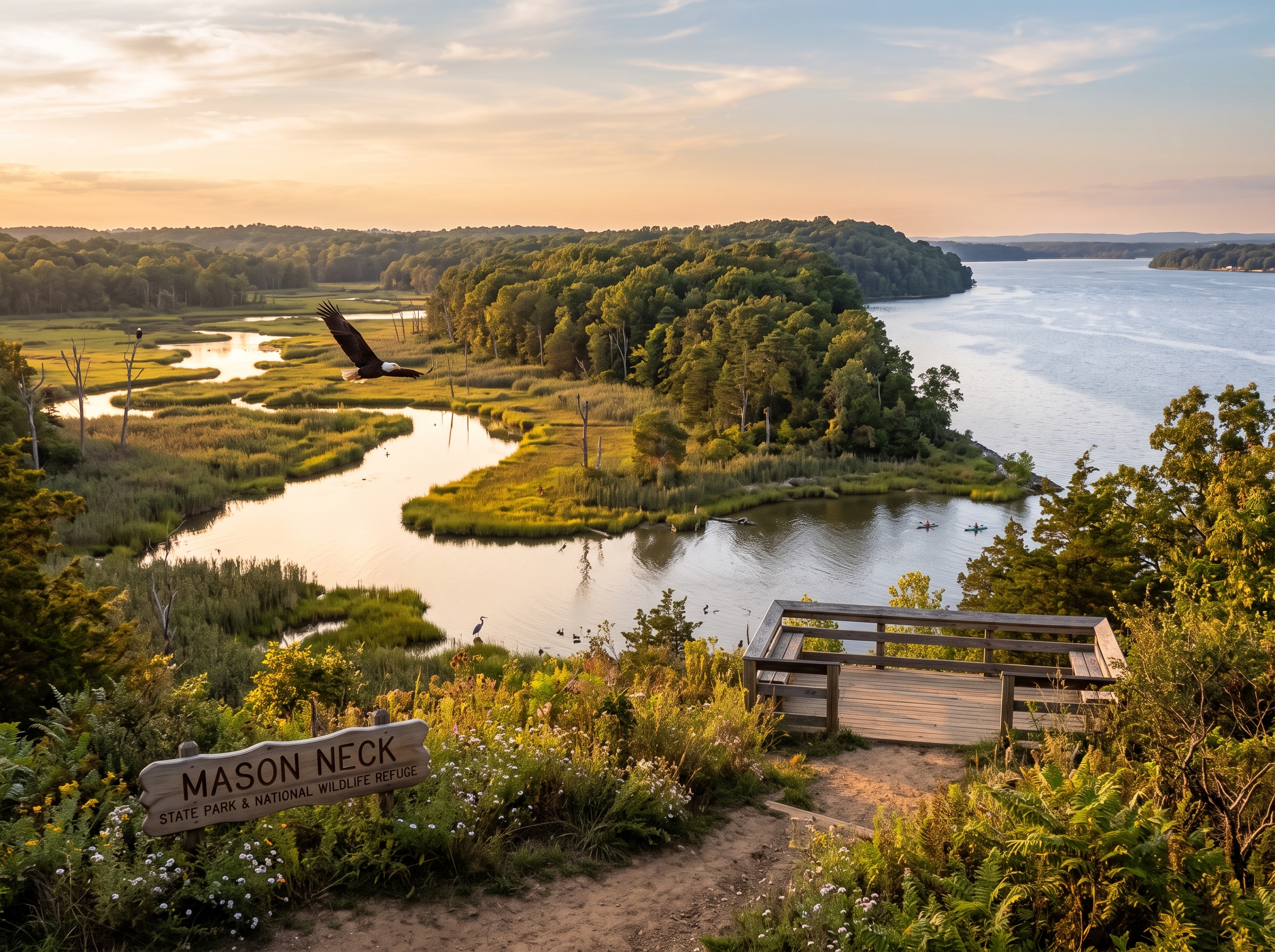
Mason Neck, Virginia, represents the absolute zenith of coastal tranquility, low-density conservation, and historic prestige in Northern Virginia. Extending southward as a 9,000-acre peninsula into the tidal Potomac River within southeastern Fairfax County's Mount Vernon Magisterial District (encompassing postal ZIP code 22079), Mason Neck is bounded by Belmont Bay, Gunston Cove, and the Occoquan River.
Remarkably, approximately two-thirds—more than 6,000 contiguous acres—of the entire peninsula is permanently preserved in perpetuity as federal wildlife refuge, Commonwealth state parkland, regional parks, and Bureau of Land Management reserves. This extraordinary geographic shield guarantees that Mason Neck remains completely insulated from the high-density commercial strip development and cookie-cutter tract housing characteristic of suburban corridors elsewhere in the National Capital Region.
As an unincorporated census-designated place (CDP) governed directly by the Fairfax County Board of Supervisors, Mason Neck operates free of municipal town governments, subjecting property owners strictly to standard county ad valorem taxation. Characterized by expansive multi-acre waterfront estates with deeded riparian deep-water piers, private equestrian farms, and custom woodland retreats, Mason Neck delivers an untamed maritime and pastoral lifestyle located just 25 miles south of Washington, D.C.
The Six Structural Pillars of Mason Neck Real Estate
- 6,000+ Acres of Permanent Public Conservation. Two-thirds of the peninsula is legally shielded from development across the Elizabeth Hartwell National Wildlife Refuge, Mason Neck State Park, Pohick Bay Regional Park, and Meadowood BLM lands.
- Riparian Deep-Water Potomac Privileges. Deeded riparian rights and private deep-water boat docks along Belmont Bay and the Potomac River, providing direct navigation to the Chesapeake Bay and Atlantic Ocean.
- Gunston Hall Colonial Legacy. The historic 550-acre plantation seat of George Mason—author of the Virginia Declaration of Rights—anchoring the peninsula in foundational American history.
- Low-Density Conservation Zoning (R-E & R-C). Strict minimum 2-acre and 5-acre zoning overlays combined with private well and septic requirements that permanently preclude high-density tract subdivisions.
- Equestrian & Outdoor Sporting Culture. Extensive private horse farms with direct access to Meadowood's 13 miles of bridle trails, 18-hole championship golf at Pohick Bay, and world-class kayaking on Kane's Creek.
- South County Academic Pyramid. Seamless public education provided through Gunston Elementary School (located right on the peninsula) feeding into South County Middle and High Schools.
2. Comprehensive Historical Evolution
The historical trajectory of Mason Neck embodies a continuous legacy of American political philosophy, plantation agriculture, and a twentieth-century grassroots conservation crusade that established a national precedent for wildlife preservation.
George Mason & Gunston Hall (1755–1792)
In the early eighteenth century, the peninsula—then known as Dogue's Neck—was assembled into substantial agrarian landholdings by the Mason family. Between 1755 and 1759, George Mason IV constructed Gunston Hall on a high bluff overlooking the tidal Potomac. A brilliant political philosopher and statesman, Mason authored the Virginia Declaration of Rights at Gunston Hall in 1776, a document whose principles of individual liberty and religious freedom served as the intellectual foundation for Thomas Jefferson's Declaration of Independence and James Madison's United States Bill of Rights.
Constructed of native brick laid in Flemish bond, Gunston Hall is an architectural tour de force. Its interior woodwork was hand-carved by English indentured artisan William Buckland, featuring the earliest documented Chinese Chippendale and Palladian classical revival rooms in colonial North America. Today, the preserved 550-acre National Historic Landmark operates as a prestigious educational institution and museum.
The Elizabeth Hartwell Conservation Crusade (1960s)
In the mid-twentieth century, Mason Neck faced an existential threat. Speculative land developers proposed constructing a municipal airport, an industrial deep-water port, and a massive subdivision containing over 20,000 high-density tract homes that would have eradicated the peninsula's natural ecology.
In response, local resident Elizabeth Hartwell orchestrated one of the most celebrated grassroots environmental battles in American history. Hartwell documented that the quiet bays and mature hardwood forests of Mason Neck sheltered the last active nesting population of the endangered American bald eagle in Northern Virginia. Her tireless lobbying of county, state, and federal officials culminated in 1969 with the establishment of the Mason Neck National Wildlife Refuge—the first federal wildlife refuge created specifically for the preservation of the bald eagle. Subsequent acquisitions by the Commonwealth of Virginia (Mason Neck State Park) and NOVA Parks permanently cemented the peninsula's protected status.
3. Public Conservation Dominance: Over 6,000 Preserved Acres
The presence of four major public conservation tracts covering two-thirds of the peninsula creates an extraordinary environmental endowment for private homeowners:
- Elizabeth Hartwell Mason Neck National Wildlife Refuge: Encompassing 2,277 acres of oak-hickory forests, freshwater marshes (including the Great Marsh), and tidal feeding shallows managed by the U.S. Fish and Wildlife Service, providing undisturbed sanctuary for eagles, ospreys, great blue herons, and river otters.
- Mason Neck State Park: Operated by the Virginia Department of Conservation and Recreation across 1,814 coastal acres, featuring modern visitor centers, educational programs, guided canoe and kayak excursions, and miles of elevated wooden boardwalk nature trails.
- Pohick Bay Regional Park: Covering 1,000 acres along Pohick Bay, featuring an 18-hole championship public golf course, full-service marina with boat slips and launch ramps, waterfront camping cabins, and aquatic facilities.
- Meadowood Special Recreation Management Area: An 800-acre public reserve operated by the Bureau of Land Management (BLM) at the entrance of the peninsula on Gunston Road, offering 13 miles of equestrian and hiking trails, two horse arenas, and Northern Virginia's finest mountain bike single-track course.
4. Potomac Riverfront, Belmont Bay & Riparian Living
Waterfront real estate on Mason Neck offers an intimate connection to the waters of the tidal Potomac River basin that cannot be replicated in suburban subdivisions:
Belmont Bay & Occoquan River Confluence
Properties lining Belmont Bay on the western rim of the peninsula enjoy wide-water vistas stretching across to Prince William County and the historic town of Occoquan. Deep navigation channels allow homeowners to dock center-console fishing boats, cruising yachts, and sailboats at private residential piers, providing seamless access south to the Chesapeake Bay or north to Old Town Alexandria and National Harbor.
Gunston Cove & Kane's Creek Estuaries
Along the protected inlets of Gunston Cove and Kane's Creek, water conditions remain calm and protected from main-channel river chop. These tranquil riparian zones are ideal for paddleboarding, sea kayaking, tidal waterfowl hunting, and recreational crabbing and fishing, with cooling breezes moderating summer temperatures.
5. Housing Stock Typologies & Architectural Stratification
Because Mason Neck strictly prohibits cookie-cutter suburban tract subdivisions, its housing stock is composed entirely of bespoke custom architecture situated on generous acreage:
1. Custom Potomac & Belmont Bay Waterfront Estates
Positioned on parcels ranging from two to ten or more acres, these luxury custom residences feature coastal shingle, brick Georgian revival, and transitional contemporary architectural designs. Features include multi-car side-load garages, custom swimming pools with riverfront views, outdoor entertaining pavilions, private gated entry drives, and permitted deep-water boat docks with motorized lifts.
2. Multi-Acre Equestrian Estates & Hobby Farms
Interior parcels throughout Mason Neck often encompass three to twelve acres of fenced pastures and mature timber. Designed for horse owners, these properties boast multi-stall horse barns, wash racks, tack rooms, riding rings, and direct access to public bridle trail corridors connecting into the BLM Meadowood reserve.
3. Secluded Custom Woodland Residences
Constructed from the 1970s through the modern era, these bespoke single-family homes are carefully sited within dense stands of oak, beech, and tulip poplar trees. Emphasizing privacy, natural lighting, and harmony with the surrounding forest, homes feature cedar siding, native stone chimneys, wrap-around verandas, and expansive multi-level decking.
4. Coastal Enclaves & Harbor View
Select residential pockets, such as Harbor View along Belmont Bay, feature custom single-family residences with deeded access to private community docks, boat launching ramps, and neighborhood river access points, providing a nautical lifestyle on more manageable lot footprints.
6. Environmental & Ecological Regulatory Frameworks
Property ownership on Mason Neck is subject to strict environmental protections designed to safeguard its delicate coastal ecosystem:
Chesapeake Bay Resource Protection Areas (RPAs)
Under the Chesapeake Bay Preservation Act, statutory 100-foot Resource Protection Area (RPA) buffers encompass all tidal shorelines, contiguous tidal wetlands, and tributary streams. Within this critical 100-foot buffer, ground disturbance, tree clearing, and impervious construction are strictly regulated to filter nonpoint-source pollutants and protect water quality.
Bald Eagle Habitat Protection Zones
Because Mason Neck remains a vital nesting area for bald eagles, property owners must comply with the federal Bald and Golden Eagle Protection Act and U.S. Fish and Wildlife Service guidelines. During active nesting seasons, seasonal buffer distances may restrict excessive exterior land clearing or loud construction activities within designated radius zones of active eagle nest trees.
Private Well & Septic Drainfield Requirements
To prevent overdevelopment, Fairfax County does not extend municipal public sewer mains through the conservation peninsula. As a result, residential homes on Mason Neck rely on private drinking water wells and state-approved engineered on-site sewage disposal systems (septic drainfields). The requirement for extensive septic reserve absorption areas serves as a permanent structural barrier against land subdivision.
7. Zoning & Land-Use Governance
Land use on Mason Neck is tightly controlled under the modernized Fairfax County Zoning Ordinance (zMOD):
- R-E (Residential Estate District): The dominant residential classification, requiring a minimum lot size of two acres (87,120 square feet). This district preserves estate-scale residential development with generous front-, side-, and rear-yard setbacks.
- R-C (Residential Conservation District): Applies to environmentally fragile parcels, mandating minimum lot sizes of five acres (217,800 square feet) to protect regional watersheds and reduce impermeable ground cover.
- Absence of Commercial Zoning: There are no commercial strip centers, gas stations, or fast-food drive-throughs anywhere on the peninsula, preserving a serene pastoral atmosphere free of commercial signage.
8. Multimodal Transportation & Commuter Arteries
While Mason Neck feels like an untouched coastal sanctuary, it maintains straightforward access to major Northern Virginia transportation arteries:
- Gunston Road (Route 242): The single primary vehicular artery serving the peninsula, connecting residents northwest directly to Route 1 (Richmond Highway) and Interstate 95.
- Interstate 95 & Express Lanes: Direct highway access ramps at Lorton allow rapid vehicular commuting north toward Springfield, Tysons, and Washington, D.C., and south across the Occoquan into Woodbridge and Quantico.
- Virginia Railway Express (VRE): Two commuter rail stations—the Lorton Station and the Woodbridge Station—are located within a 10-to-15 minute drive, offering comfortable, traffic-free train service to Alexandria, Crystal City, and Washington Union Station.
9. Public Education & The South County Academic Pyramid
Residents of Mason Neck are served by the nationally recognized Fairfax County Public Schools (FCPS) system, organized within the South County High School pyramid:
Gunston Elementary School
Located directly on the peninsula along Gunston Road, Gunston Elementary School provides an intimate, community-centered learning environment with small student-to-teacher ratios, highly involved parent organizations, and an emphasis on environmental science and outdoor education inspired by the surrounding parkland.
South County Middle & High School
Students advance to South County Middle School and South County High School in nearby Lorton. South County High School is renowned for its academic excellence, offering extensive Advanced Placement (AP) coursework, the AP Capstone Diploma program, competitive STEM pathways, and state-championship athletic teams.
10. Outdoor Recreation, Boating & Equestrian Lifestyle
Daily life on Mason Neck is shaped by nature, nautical pursuits, and equestrian sports:
- Private & Public Boating: In addition to private deep-water residential piers, Pohick Bay Marina offers dry-dock boat storage, public boat launching ramps, and seasonal boat slip rentals capable of accommodating motor cruisers and sailboats.
- Equestrian Trails: With miles of designated horse trails in Meadowood and dedicated community bridle paths, Mason Neck is one of the few remaining equestrian havens in Fairfax County where residents can ride directly from their private stables into public park systems.
- Dark Skies & Birdwatching: The absence of commercial street lighting creates a rare "dark sky" environment where star-gazing is exceptional, accompanied by daily sightings of nesting bald eagles, ospreys, foxes, and wild turkeys.
11. Gunston Hall Historic Cultural Anchor
Gunston Hall serves as the cultural and intellectual centerpiece of the peninsula. Beyond its museum tours of William Buckland's carved interior woodwork, the estate features expansive formal gardens containing historic eighteenth-century boxwood allées, archeological excavations, and an extensive research library dedicated to early American constitutional history. Throughout the year, Gunston Hall hosts symposia, colonial craft demonstrations, and community celebrations that celebrate George Mason's enduring civic contribution to human rights.
12. Comprehensive Submarket Matrix Table
The matrix below outlines the distinctive residential sectors of Mason Neck, comparing architectural typologies, lot dimensions, riparian access, and governance models:
| Residential Sector | Primary Architectural Typology | Dominant Construction Era | Density & Lot Size Profile | Waterfront & Riparian Access | Governance & HOA Structure |
|---|---|---|---|---|---|
| Belmont Bay & Potomac Riverfront Estates | Custom Waterfront Manors, Coastal Shingle, Georgian Brick | 1980s – Contemporary Custom | Very Low Density; 2.0 to 10.0+ Acres | Deeded Riparian Rights; Private Deep-Water Piers | Fee-Simple Ownership; Non-HOA / Private Covenants |
| Multi-Acre Equestrian & Farm Holdings | Country Colonials, Modern Farmhouses, Custom Ranches | 1970s – Present | Very Low Density; 3.0 to 15.0+ Acres | Interior Pastoral; Access to Bridle Trail Corridors | Fee-Simple Ownership; Non-HOA Autonomy |
| Secluded Woodland Interior Enclaves | Contemporary Timber & Stone, Cedar-Clad Custom Homes | 1965 – 2005 | Low Density; 2.0 to 5.0 Acres | Surrounded by Federal & State Hardwood Buffers | Fee-Simple Ownership; No Mandatory Association |
| Harbor View & Coastal Enclaves | Custom Single-Family Coastal Residences | 1960s – 1990s | Medium-Low Density; 0.5 to 1.5 Acres | Community Boat Launch, Shared Pier & Dock Slip Access | Voluntary / Mandatory Civic Association (POAA) |
13. Taxation, Civic Governance & Riparian Permitting
As an unincorporated community administered under Fairfax County, Mason Neck operates with administrative simplicity:
Unified County Ad Valorem Property Taxation
Real estate on Mason Neck is assessed annually at 100% fair market value by the Fairfax County Department of Tax Administration (DTA) in accordance with Virginia Code Title 58.1. Property owners pay solely the unified county real estate tax and standard countywide service levies, avoiding separate incorporated town taxes.
Riparian Dock & Pier Permitting Standards
Installing or expanding a private boat dock, pier, or boat lift along Belmont Bay or the Potomac River requires strict statutory approvals from the Virginia Marine Resources Commission (VMRC), the U.S. Army Corps of Engineers (USACE), and the Fairfax County Wetlands Board to protect navigable channels and tidal submerged aquatic vegetation (SAV).
14. 10 Comprehensive Evergreen FAQs
1. Is Mason Neck an incorporated municipality or an unincorporated part of Fairfax County?
Mason Neck is an unincorporated peninsula and census-designated place (CDP) situated entirely within the Mount Vernon Magisterial District of Fairfax County. It possesses no independent town charter or town government. All public safety, school administration, and property taxation are managed directly by Fairfax County, exempting property owners from secondary town taxes.
2. How much of Mason Neck's land is protected from future development?
Approximately two-thirds (over 6,000 acres) of Mason Neck's 9,000-acre peninsula is permanently protected as public conservation land, national wildlife refuge, regional parkland, or state park. This extraordinary level of land protection creates an immutable green barrier that permanently insulates private residences from high-density suburban encroachment or commercial retail sprawl.
3. What is the historical significance of Gunston Hall on Mason Neck?
Gunston Hall is the historic 550-acre plantation estate of George Mason (1725–1792), author of the Virginia Declaration of Rights—which served as the direct intellectual foundation for the United States Bill of Rights. Completed circa 1759, the Georgian brick mansion is a National Historic Landmark renowned for its exquisite wood carvings by master artisan William Buckland and historic boxwood gardens.
4. What architectural home styles define Mason Neck real estate?
Mason Neck is characterized by low-density, custom residential architecture: waterfront estates and coastal shingle-style manors with private deep-water piers along Belmont Bay and the Potomac, expansive multi-acre equestrian properties with barns and paddocks, custom contemporary homes with floor-to-ceiling glass, and colonial revival residences nestled in dense hardwood canopies.
5. Are private boat docks and riparian rights available on Mason Neck?
Yes, many waterfront parcels fronting Belmont Bay, Gunston Cove, Kane's Creek, and the open tidal Potomac River possess deeded riparian rights allowing private piers, floating docks, and boat lifts. Construction and renovation of residential docks require joint statutory permits from the Virginia Marine Resources Commission (VMRC), the U.S. Army Corps of Engineers (USACE), and the Fairfax County Wetlands Board.
6. What environmental protections govern properties on Mason Neck?
Because the peninsula is surrounded by tidal waters, all shorelines and perennial tributaries are protected by mandatory 100-foot Resource Protection Areas (RPAs) under the Chesapeake Bay Preservation Act. In addition, the presence of the Mason Neck National Wildlife Refuge enforces seasonal protective buffer zones around active bald eagle nesting sites pursuant to federal Bald and Golden Eagle Protection Act guidelines.
7. Do homes on Mason Neck use public water and sewer or private systems?
To prevent high-density overdevelopment and safeguard the sensitive estuarine ecology, public sewer infrastructure is deliberately restricted across most of the peninsula. Residential properties rely on private drinking water wells and engineered on-site sewage disposal systems (septic drainfields). This infrastructural constraint naturally preserves large lot sizes and prevents tract subdivisions.
8. Which public schools serve residents of Mason Neck?
Mason Neck is served by Fairfax County Public Schools (FCPS) within the South County High School pyramid. Elementary students attend Gunston Elementary School, situated right on Gunston Road on the peninsula. Middle school students attend South County Middle School, progressing to South County High School in Lorton, known for its AP Capstone diploma program and competitive athletics.
9. What major parks and recreation facilities are located on Mason Neck?
The peninsula features Elizabeth Hartwell Mason Neck National Wildlife Refuge (the nation's first federal refuge for bald eagles), Mason Neck State Park (hiking trails, kayak launches), Pohick Bay Regional Park (18-hole championship golf course, full-service marina, boat ramps, camping), and Meadowood Special Recreation Management Area (800 BLM acres of horse, hiking, and mountain bike trails).
10. What is the primary commuter route connecting Mason Neck to regional employment nodes?
The peninsula is served by Gunston Road (Route 242), a two-lane scenic roadway providing direct connection northwest to Route 1 (Richmond Highway) and Interstate 95 (including the I-95 Express Lanes). Commuters also enjoy convenient access to commuter heavy rail via the Virginia Railway Express (VRE) Lorton and Woodbridge Stations, each located within a 10-to-15 minute drive.
15. Legal & Fair Housing Disclaimer
This real estate and community monograph is published strictly for informational, educational, and demographic research purposes. All municipal boundaries, zoning districts, school attendance zones, tax assessments, and conservation reserves are derived from official Fairfax County public records, the Virginia Department of Wildlife Resources (DWR), the U.S. Fish and Wildlife Service, and the Code of Virginia, and are subject to periodic administrative modification. Prospective purchasers, sellers, and investors must independently examine official property disclosures, deed encumbrances, riparian permits, and health department septic certifications through licensed legal and real estate professionals prior to executing contractual agreements. This publication strictly adheres to Title VIII of the Civil Rights Act of 1968 (The Federal Fair Housing Act) and the Virginia Fair Housing Law, prohibiting discrimination on the basis of race, color, religion, sex, handicap, familial status, elderliness, or national origin.