
Newington, VA Real Estate: The Definitive Guide to Spatial Morphology, Mount Air Heritage, Fort Belvoir & Multimodal Corridors
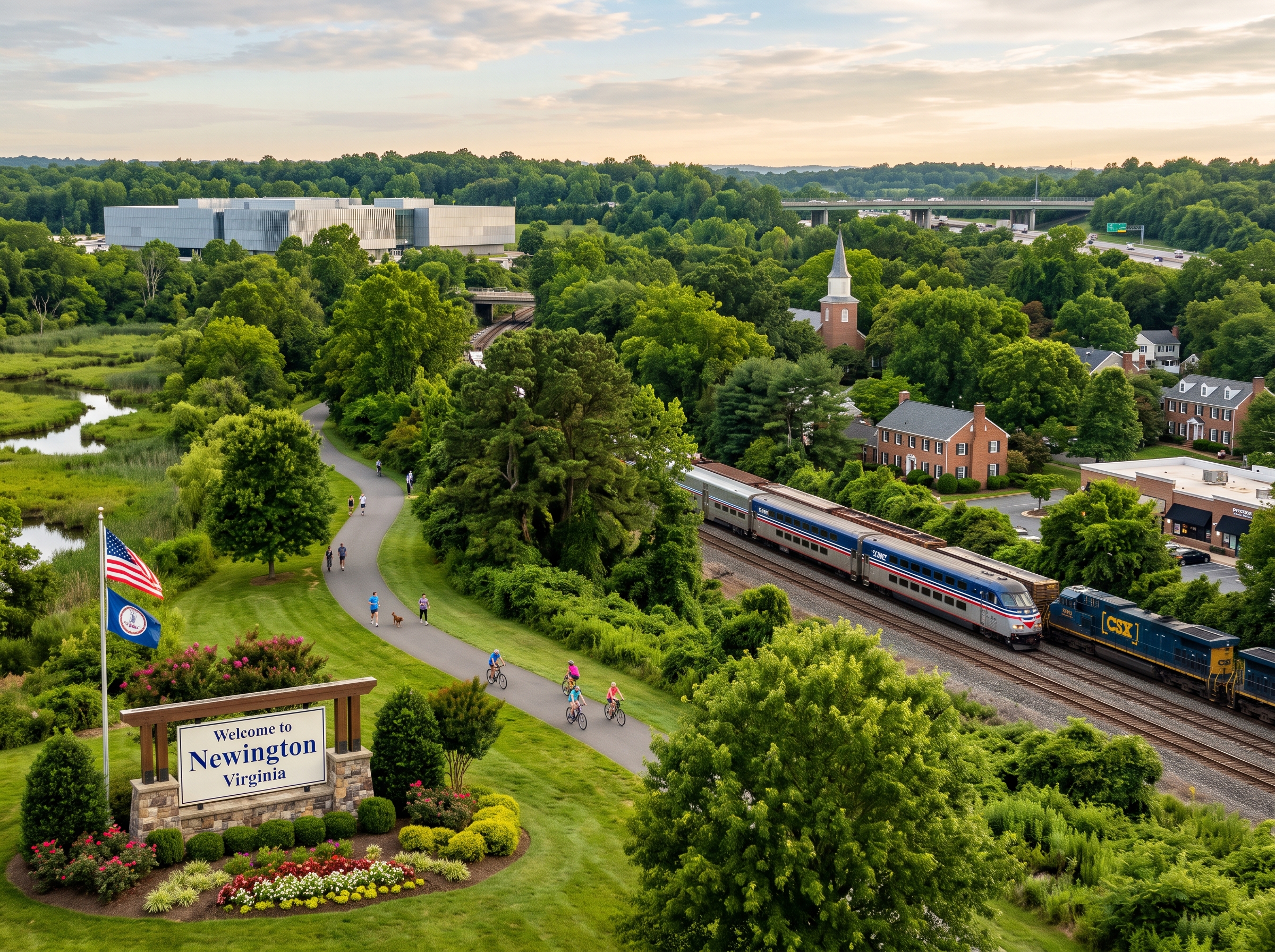
Executive Summary & Essential Community Takeaways
- Strategic 4.6 Square-Mile South County Hub: Spanning approximately 4.6 square miles in southern Fairfax County (ZIP code 22153), Newington is positioned directly between Springfield to the north, Lorton to the south, Fort Belvoir to the east, and Newington Forest to the west, just 14 miles southwest of central Washington, D.C.
- Deep 18th-Century Provenance: Mount Air Historic Site: Rooted in colonial Virginia history as part of the historic Mount Air Plantation estate of Dennis McCarty and Sarah Ball McCarty (cousin of George Washington), Newington transitioned from an agricultural river basin into a vital 19th-century railroad depot along the RF&P line before modern residential establishment.
- Substantial Single-Family Lots with Zero Mandatory HOA: Classic residential sectors such as Saratoga, Hunter Estates, and Hollybrook Farms feature detached ramblers, split-levels, and Center-Hall Colonials situated on mature quarter- to half-acre parcels that operate with zero mandatory HOA dues or restrictive architectural boards.
- Direct Gateway to Fort Belvoir & National Defense Anchors: Bordering Fort Belvoir along its eastern boundary, Newington delivers under-five-minute access to Tulley Gate, the Defense Logistics Agency (DLA) headquarters, the National Geospatial-Intelligence Agency (NGA) Springfield campus, and the Fort Belvoir Community Hospital.
- Pristine Stream Valleys & Cross County Trail Access: Traversed by the scenic Accotink Stream Valley and bordered by the Pohick Creek basin, Newington offers immediate access to the 40-mile Gerry Connolly Cross County Trail (CCT), Loisdale Park, and protected federal conservation buffers.
- Unsurpassed Multimodal Commuter Infrastructure: Features direct access to Interstate 95 (Exits 166 and 167 with direct Express Lanes access), the Fairfax County Parkway (Route 286), the Saratoga Park-and-Ride facility (direct express commuter buses to the Pentagon and downtown D.C.), and the Franconia-Springfield Metrorail (Blue Line) and VRE terminal.
1. Spatial Morphology, Geographic Coordinates & Territorial Extents
Newington, Virginia, occupies an essential geographic crossroads in the southern quadrant of Fairfax County. Designated by the United States Census Bureau as a formal Census-Designated Place (CDP) under Federal Information Processing Standard (FIPS) code 51-55752 and Geographic Names Information System (GNIS) identifier 1495074, the community covers a land area of approximately 4.6 square miles. Geographically centered at coordinates 38°44′7″ N latitude and 77°12′13″ W longitude, Newington sits at an average elevation of 108 feet above sea level, resting upon the transitional geological boundary between the crystalline rocks of the Appalachian Piedmont and the sedimentary gravels and sands of the Atlantic Coastal Plain.
The community is bounded logically by both natural stream contours and major transportation infrastructure. To the north, the territorial extent blends into the established commercial and residential neighborhoods of Springfield along the Franconia-Springfield Parkway (Route 289) and Backlick Road. To the east, Newington directly abuts the sprawling, permanently protected timberlands and military installations of the Fort Belvoir Military Reservation. To the south, the community transitions smoothly into Lorton across Telegraph Road, Accotink Creek, and Pohick Road. To the west, the boundary meets the master-planned residential enclaves of Newington Forest and the Pohick Creek Stream Valley.
From an administrative perspective, Newington spans components of three Fairfax County Magisterial Districts: the Mount Vernon District, the Franconia District (formerly Lee District), and the Springfield District. Residential mailing addresses within the community bear the Springfield postal designation under ZIP code 22153, with specialized municipal and logistical functions utilizing ZIP code 22122. This central southern orientation places residents within a brisk 14-mile radius of Washington, D.C., eight miles south of the City of Alexandria, and four miles north of the Occoquan River basin.
2. Historical Genesis: The 18th-Century Mount Air Plantation & The RF&P Railroad Depot
The documented heritage of Newington extends across more than two and a half centuries of Virginian statecraft, agriculture, and industrial transportation. In the early 18th century, the rolling woodlands and fertile creek basins surrounding Accotink Creek formed part of the extensive Mount Air Plantation estate. The property was acquired by Dennis McCarty, a prominent colonial planter who served as a justice of the peace and member of the Virginia House of Burgesses. McCarty married Sarah Ball, a direct first cousin of Mary Ball Washington (mother of General George Washington), forging intimate familial and civic ties between Mount Air and nearby Mount Vernon.
Throughout the late 18th and early 19th centuries, the estate passed to Sarah Ball McCarty and her second husband, Colonel Richard Chichester. George Washington made frequent recorded visits to Mount Air, documenting horseback journeys across the Accotink lowlands in his personal diaries to dine and confer with the Chichester family. The historic Mount Air manor house survived through multiple wars, standing as an architectural landmark on Telegraph Road until a catastrophic fire in 1992. Today, the Fairfax County Park Authority preserves the historic grounds as the Mount Air Historic Site, featuring conserved brick foundation walls, ornamental heritage gardens, interpretive educational plaques, and protected woodland buffers.
The middle of the 19th century brought transformative industrial modernization to the region with the construction of the Richmond, Fredericksburg and Potomac Railroad (RF&P). Recognizing the strategic value of the Accotink Creek crossing, the railroad established a primary depot station named Newington. The depot served as a critical loading terminal for local timber, dairy goods, and produce destined for Alexandria and Washington, D.C. During the American Civil War, the rail line and surrounding bridges were contested transport arteries, protected by Union encampments defending the southern approaches to the capital.
Following World War II, as northern Virginia transitioned from rural farmland to the primary administrative and technological engine of the mid-Atlantic, the agrarian pastures surrounding Newington Depot were systematically developed into residential subdivisions. Subdivisions like Saratoga and Newington Station were carefully engineered to provide serene, suburban neighborhood sanctuaries for civil servants, military officers, engineers, and expanding families seeking expansive lots, excellent public schools, and direct commuter corridors.
3. Architectural Typologies: Mid-Century Ramblers, Split-Levels & Classic Colonials
The residential architecture of Newington reflects the golden age of American post-war suburban craftsmanship, distinguished by enduring construction standards, generous spatial proportions, and natural materials. Unlike modern high-density subdivisions characterized by uniform vinyl façades, Newington's detached residential fabric features robust structural framing, poured concrete or concrete-block foundations, and authentic regional brick and cedar clapboard exteriors.
The single-family housing stock across Newington is dominated by three signature mid-to-late 20th-century architectural typologies:
- Brick Ranchers and Ramblers (1960s–1970s): Characterized by sprawling single-level footprints, low-pitched gable or hip roofs with wide overhanging eaves, and expansive front-facing picture windows. These residences typically encompass three to four bedrooms on the primary level, complemented by full finished walkout basements that effectively double the usable square footage. Their single-floor living design continues to attract buyers seeking long-term accessibility and open floor plan potential.
- Multi-Level Split-Levels and Split-Foyers: Highly favored for their clever vertical zoning and efficient spatial separation between formal entertaining areas, private family quarters, and lower-level recreational suites. These homes feature staggered floor levels, exposed masonry fireplaces in ground-level family rooms, integrated garage bays, and rear walkout sliders leading to private stone patios and expansive wooded backyards.
- Traditional Center-Hall Colonials: Embodying timeless Virginian architectural symmetry, these two-story residences showcase formal central foyers flanked by classical living and dining rooms, rear-oriented family gathering rooms with brick wood-burning hearths, spacious eat-in kitchens, and four to five bedrooms on the upper level. Exterior detailing frequently includes pedimented porticos, decorative window shutters, and dentil crown molding.
- Established Brick-Front Townhomes: Enclaves such as Saratoga and Newington Station incorporate three-story colonial townhome residences featuring authentic brick façades, walkout lower levels, private fenced rear courtyards, and dedicated reserved parking. These homes provide functional multi-level living spaces with minimal exterior yard maintenance obligations.
4. Distinct Residential Enclaves: Newington Station, Saratoga, Hollybrook Farms & Mount Air
Newington is composed of several established, tightly-knit residential sectors, each displaying its own neighborhood character, street pattern, and housing profile:
Saratoga: Anchored around Northumberland Road and Saratoga Elementary School, Saratoga represents the beating heart of Newington's residential community. Established in the late 1960s and 1970s, Saratoga features a balanced combination of handsome detached colonials and ramblers along curving, sidewalk-lined avenues, as well as several tranquil townhome clusters. The community boasts an active neighborhood culture, centered around the Saratoga Community Pool, local athletic courts, and direct pedestrian pathways connecting to local elementary classrooms and neighborhood parks.
Newington Station: Situated conveniently between Backlick Road and Alban Road, Newington Station is an impeccably designed residential community offering both detached single-family dwellings and brick-front townhomes. Known for its quiet cul-de-sacs, mature oak and tulip poplar canopies, and neighborhood recreational amenities—including private community swimming pools, tennis courts, and children's playgrounds—Newington Station remains one of the most sought-after enclaves for families and defense professionals.
Hollybrook Farms & Hunter Estates: Located in the eastern and southern sectors of Newington, these subdivisions are celebrated for their expansive half-acre to three-quarter-acre parcels. The generous lot sizes, mature woodland borders, and deep front setbacks create a park-like, semi-rural ambiance that is exceedingly rare this close to the Interstate 95 corridor. Residences here are almost entirely custom or semi-custom detached homes with private driveways and multi-car garages.
Mount Air & Amberleigh: Adjacent to the Mount Air Historic Site and Telegraph Road, these neighborhoods feature a combination of picturesque single-family homes and contemporary multi-level townhomes. Surrounded by lush conservation buffers and tree-lined perimeter buffers bordering Fort Belvoir, residents experience exceptional privacy alongside instantaneous transit accessibility to the Telegraph Road Gate and Fairfax County Parkway.
5. Modern Renovation Trends, Structural Additions & Interior Upgrades
Because Newington's original homes were constructed with exceptional structural integrity—utilizing true dimensional framing lumber, copper plumbing supply lines, and concrete sub-foundations—the community has experienced substantial capital reinvestment and interior modernization over the past two decades. Discerning homeowners recognize that investing in substantial upgrades yields exceptional long-term utility while preserving the generous lot sizes and mature trees that new developments cannot replicate.
The most prevalent renovation trends across Newington's single-family homes include:
- Open-Concept Great Room Conversions: Removing non-load-bearing partition walls between traditional compartmentalized kitchens, formal dining rooms, and living spaces to create expansive, light-filled great rooms anchored by oversized central quartz or granite islands, professional-grade stainless steel appliances, and custom recessed LED lighting.
- Primary Suite Vertical Additions & Bumping: Expanding existing upper levels or converting rear overhangs to create luxurious primary bedroom suites featuring cathedral ceilings, custom walk-in closets, and spa-inspired bathrooms equipped with dual vanities, frameless glass showers, and freestanding soaking tubs.
- Finished Basement Transformations: Upgrading full-height walkout basements into comprehensive secondary living quarters, home theaters, executive telecommuting offices, fitness studios, and au pair or guest suites with dedicated full bathrooms and wet bars.
- High-Performance Mechanical Conversions: Replacing original atmospheric oil and gas systems with high-efficiency variable-capacity electric heat pumps, tankless continuous water heaters, heavy-duty architectural asphalt shingles, and low-E argon-insulated double-hung vinyl windows.
- Outdoor Living Sanctuaries: Capitalizing on expansive backyard footprints by installing custom multi-level composite decks, screened cedar porches, natural flagstone patios, built-in masonry fire pits, and fully fenced private grounds for recreation and pet containment.
6. Civic Sovereignty: Voluntary Associations & Zero Mandatory HOA on Detached Homes
A defining institutional advantage of Newington's detached single-family home market is the absence of restrictive, mandatory Homeowners Associations across its primary single-family subdivisions. In communities such as original Saratoga, Hunter Estates, and Hollybrook Farms, property owners enjoy unencumbered fee-simple sovereignty. There are no mandatory monthly or annual dues, no rigid architectural committees dictating exterior paint shades or landscaping species, and no burdensome procedural constraints on parking work vehicles or recreational watercraft in driveways.
Property maintenance and neighborhood pride are instead fostered through dedicated voluntary civic organizations, such as the Saratoga Community Association. These civic bodies coordinate seasonal social gatherings, Fourth of July parades, community yard sales, and stream valley cleanup initiatives, while serving as a unified voice before the Fairfax County Board of Supervisors regarding local zoning, road maintenance, and traffic calming measures.
For buyers who prefer turnkey maintenance and shared community amenities, Newington's townhome enclaves operate under well-managed mandatory HOAs. These associations oversee common-area turf mowing, exterior building maintenance reservations, private snow removal, dedicated parking enforcement, and the operation of community swimming pools, clubhouse facilities, and tennis and pickleball courts. This dual structure gives prospective residents the exact level of governance and maintenance involvement that best fits their lifestyle.
7. Commercial Synergy: The Alban Road & Loisdale Logistics Corridors
A vital element of Newington's economic strength is its carefully planned spatial separation between peaceful residential enclaves and dynamic commercial enterprise zones. Along the Alban Road, Backlick Road, and Loisdale Road corridors, Newington hosts a thriving ecosystem of clean commercial, light-industrial, professional trade, and regional defense contracting operations.
This logistical zoning provides crucial advantages for the local tax base and everyday resident convenience. Essential trade contractors, high-end automotive service centers, architectural supply showrooms, craft breweries, indoor sports training academies, and distribution hubs are located mere minutes from neighborhood cul-de-sacs without intruding upon residential tranquillity. The area is also home to key regional facilities for the federal government and defense logistics partners who support operations at nearby Fort Belvoir and the Pentagon.
Daily retail and dining needs are fulfilled right within the community at the Saratoga Shopping Center, located centrally at the intersection of Rolling Road and Northumberland Road. Anchored by a full-service Giant Food supermarket, Saratoga Center features an assortment of neighborhood conveniences, including pharmacies, banking institutions, veterinary clinics, specialty dry cleaners, and beloved local eateries ranging from casual family diners to artisanal pizza and Mediterranean bistros.
8. Parks, Stream Valleys & Outdoor Recreation: Accotink Stream Valley & Loisdale Park
Despite its exceptional proximity to major highways, Newington is enveloped by some of the most expansive parkland networks in southern Fairfax County. The Fairfax County Park Authority (FCPA) maintains an impressive portfolio of preserved green spaces, active sports complexes, and tranquil nature corridors throughout the community:
- Accotink Stream Valley Park: A magnificent natural greenway that meanders through Newington along Accotink Creek. The park preserves dense riparian forests of river birch, sycamore, and red maple, providing critical wildlife habitat and tranquil nature trails for bird watching, dog walking, and peaceful stream-side exploration.
- Loisdale Park: Situated in the southeastern quadrant near Loisdale Road, this neighborhood park provides lighted athletic fields, youth soccer pitches, a multi-use basketball court, modern playground structures, and open turf fields suitable for neighborhood pick-up sports and seasonal community gatherings.
- Amberleigh Park: Nestled adjacent to the Amberleigh enclave, this scenic community park features winding paved multi-use loops, shaded fitness stations, tennis and pickleball facilities, and direct pedestrian trail connectors leading into adjoining county conservation corridors.
- Rolling Wood Park & Saratoga Park: Neighborhood green sanctuaries offering shaded children's play areas, picnic pavilions, and direct connectivity to local neighborhood pedestrian paths, ensuring that every resident lives within a short walk of outdoor recreation.
9. Environmental Hydrology: Accotink Creek Basin & Gerry Connolly Cross County Trail (CCT)
The environmental hydrology of Newington is defined by the Accotink Creek and Pohick Creek watersheds, two of Fairfax County's primary freshwater tributaries draining into the Potomac River and the Chesapeake Bay. These stream valleys serve as critical natural stormwater drainage networks, micro-climate moderators, and ecological wildlife corridors supporting white-tailed deer, red foxes, great blue herons, and migratory songbirds.
Traversing directly through the heart of Newington is the renowned Gerry Connolly Cross County Trail (CCT), a premier 40-mile continuous multi-use pathway that connects Great Falls on the Potomac River in northern Fairfax County all the way south to Occoquan Regional Park. In Newington, the CCT follows the banks of Accotink Creek along paved and packed-gravel paths. Residents can step onto the trail directly from local neighborhood access points to embark on long-distance cycling excursions, half-marathon training runs, or peaceful weekend nature walks under a continuous canopy of mature hardwoods.
Fairfax County rigorously protects these riparian stream valley buffers through Environmental Quality Corridors (EQCs) and Resource Protection Areas (RPAs) established under the Chesapeake Bay Preservation Act. These legal covenants permanently restrict commercial and residential construction along the floodplains, guaranteeing that Newington's lush green corridors will remain permanently preserved for future generations.
10. Fairfax County Public Schools (FCPS): Saratoga Elementary, Key Middle & Secondary Pyramids
The high academic standards of Fairfax County Public Schools (FCPS)—consistently recognized among the premier public school systems in the United States—represent a cornerstone of Newington's enduring residential appeal. Families moving to the community benefit from dedicated educators, cutting-edge STEM curricula, extensive Advanced Placement (AP) and International Baccalaureate (IB) offerings, and comprehensive fine arts and athletic programming.
The educational journey across Newington is anchored by several distinguished neighborhood institutions:
- Saratoga Elementary School: Located centrally on Northumberland Road within the Saratoga neighborhood, this highly regarded community school serves as a beloved educational and social anchor. Saratoga Elementary emphasizes early literacy, STEAM integration, inclusive special education programs, and active parent-teacher collaboration. Its central location allows many neighborhood students to walk or bike safely to school along dedicated community pathways.
- Island Creek Elementary School: Serving select northeastern residential sections of the Newington area, Island Creek is celebrated for its outstanding academic progress, award-winning environmental education projects, and vibrant student extracurricular activities.
- Key Middle School: Serving the middle grades (7–8), Key Middle School provides rigorous pre-AP coursework, world language instruction, and supportive transitional environments that prepare young adolescents for high school achievement.
- South County Middle School: Serving the western sectors of the community, South County Middle offers advanced academic programming, state-of-the-art technological labs, and an extensive array of music, drama, and athletic teams.
- Secondary High School Pyramids: Depending upon specific residential street addresses, Newington high school students advance to John R. Lewis High School, Hayfield Secondary School, or South County High School. Each institution offers exhaustive AP and Honors courses, dual-enrollment college credits, career and technical education academies, championship athletic programs, and exemplary graduation rates.
11. Strategic Military Proximity: The Fort Belvoir Gateway & Defense Community Nexus
Few residential communities in northern Virginia provide closer, more effortless access to major defense installations than Newington. The eastern boundary of the CDP directly abuts the Fort Belvoir Military Reservation, making Newington the premier residential choice for active-duty military service members, Department of Defense civilian personnel, and federal contractors.
Key defense and intelligence hubs accessible within five to ten minutes of Newington doorsteps include:
- Fort Belvoir Main Post & Tulley Gate: Direct vehicular access via Backlick Road, Telegraph Road, and the Fairfax County Parkway places service members at Fort Belvoir's primary entry gates in under five minutes, eliminating lengthy commuter gridlock.
- Defense Logistics Agency (DLA) Headquarters: Situated right at Fort Belvoir, DLA serves as the combat logistics support agency for the United States military, employing thousands of civil servants and defense logistics specialists who make their homes across Newington.
- National Geospatial-Intelligence Agency (NGA) Springfield Campus: Located just three miles north along the Backlick Road / Boston Boulevard corridor at Fort Belvoir North Area, this massive intelligence facility employs thousands of geospatial analysts, software developers, and national security experts.
- Alexander T. Augusta Military Medical Center (Fort Belvoir Community Hospital): A modern, world-class 120-bed military medical facility delivering comprehensive specialty healthcare, emergency trauma services, and surgical care to active military, retirees, and their families.
12. Multimodal Commuter Infrastructure: I-95 Express Lanes, Saratoga Park-and-Ride & Franconia-Springfield Metro/VRE
Newington's geographic positioning provides one of the most efficient, versatile multimodal commuter networks anywhere in the Washington metropolitan region. Whether commuting north to the Pentagon, downtown D.C., and Tysons, or south to Marine Corps Base Quantico and Fredericksburg, residents possess an unparalleled variety of transit options.
Primary transit corridors and commuter assets serving Newington include:
- Interstate 95 & 95 Express Lanes: Newington features immediate access to I-95 via Exit 166 (Backlick Road / Fairfax County Parkway) and Exit 167 (Fuller Heights / Loisdale Road). The dynamically tolled 95 Express Lanes allow commuters and High Occupancy Vehicles (HOV-3+) to bypass regional congestion, connecting smoothly into the 395 Express Lanes directly to the Pentagon and Washington, D.C.
- Fairfax County Parkway (Route 286): Providing an essential east-west high-speed arterial, the Parkway connects Newington directly with Burke, Fairfax Station, the City of Fairfax, Reston, and Herndon without requiring travel on the Capital Beltway.
- Saratoga Park-and-Ride Facility: Located right within the community on Barta Road, this expansive commuter hub provides hundreds of free parking spaces. Commuters board dedicated Fairfax Connector express buses that travel directly to the Pentagon Transit Center, the Franconia-Springfield Metrorail Station, and downtown Washington, D.C.
- Franconia-Springfield Metrorail (Blue Line) & VRE Station: Situated just five minutes north of Newington, this multi-modal terminal provides rapid rail transit via Metrorail's Blue Line into Arlington, Ronald Reagan Washington National Airport, and central D.C., as well as Virginia Railway Express (VRE) Fredericksburg Line commuter rail service south to Spotsylvania and north to Washington Union Station.
- Lorton VRE Station & Amtrak Auto Train: Just five minutes south, the Lorton VRE station provides additional rail options, while the adjacent Amtrak terminal serves as the exclusive northern terminus for the nonstop Auto Train to Sanford, Florida.
13. Virginia Statutory Assessment Framework Under Code § 58.1-3201 & Fairfax County Mass Appraisal Equalization
Real property taxation across Newington is governed by the uniform statutory standards established under the Code of Virginia § 58.1-3201, which mandates that all real estate subject to local taxation must be appraised and assessed at one hundred percent (100%) of its true fair market value. Unlike jurisdictions that utilize arbitrary assessment ratios, fractional rollbacks, or speculative valuation tiers, the Commonwealth of Virginia enforces a rigorous statutory baseline designed to ensure equitable tax distribution across all property classes.
To fulfill this constitutional and statutory mandate, the Fairfax County Department of Tax Administration (DTA) executes an annual computerized mass appraisal equalization program. DTA appraisal specialists analyze verified, arm's-length real estate transactions that have closed within specific neighborhood submarket codes across Newington over the preceding calendar year. Valuations are adjusted to reflect definitive property attributes, including:
- Finished Living Area & Above-Grade Volume: Accurate measurement of gross above-grade living square footage, excluding unconditioned spaces.
- Subterranean Space & Walkout Basements: Differentiated valuation of fully finished below-grade living areas, walkout exterior entries, and unfinished storage utility spaces.
- Lot Topography & Environmental Buffers: Parcel acreage, usable backyard topography, cul-de-sac positioning, and proximity to protected stream valley parkland.
- Documented Capital Improvements: Permitted physical enhancements verified through Fairfax County Land Development Information Services (LDIS), including primary suite additions, kitchen remodels, detached garages, and composite outdoor living structures.
Property owners receive their official Notice of Real Estate Assessment annually in late February. Property owners retain the statutory right to challenge their assessment through an administrative review with the Department of Tax Administration, followed if necessary by a formal appeal before the independent, citizen-led Fairfax County Board of Equalization (BOE) and the Circuit Court of Fairfax County.
14. Comparative Analysis Matrix: Newington vs. Surrounding Communities
When evaluating residential opportunities in southern and central Fairfax County, prospective buyers frequently weigh Newington against neighboring communities. The comparative matrix below highlights key structural, governance, and infrastructural distinctions:
| Community | Primary Eras | Dominant Architecture | HOA Governance | Signature Parks & Amenities | High School Pyramids |
|---|---|---|---|---|---|
| Newington | 1965–1985 | Brick Ramblers, Split-Levels & Colonials | None (Detached) / Local (Townhomes) | Accotink Stream Valley & Loisdale Park | Lewis, Hayfield & South County |
| Newington Forest | 1978–1990 | Contemporary Colonials & Townhomes | Mandatory Community HOA | Pohick Creek & Community Pools | South County High School |
| Lorton | 1970s–2010s | Modern Townhomes, Colonials & Infill | Varies (Majority Mandatory HOA) | Laurel Hill Park & Workhouse Arts | South County High School |
| Franconia | 1950s–1980s | Mid-Century Ramblers, Splits & Townhomes | None (Vast Majority Detached) | Franconia Park & Rec Center | Edison & Lewis High School |
| Kingstowne | 1985–2005 | Master-Planned Townhomes & Colonials | Mandatory Master Association | Kingstowne Lake & Town Center | Hayfield & Edison High School |
| Springfield | 1950–1975 | Brick Ramblers, Split-Levels & Splits | None (Voluntary Civic Assocs) | Lake Accotink Park & Brookfield | West Springfield & Lewis High |
15. Frequently Asked Questions Regarding Newington, VA Real Estate
What are the precise geographic boundaries and spatial dimensions of Newington, Virginia?
The Newington Census-Designated Place (CDP) spans approximately 4.6 square miles in southern Fairfax County (ZIP codes 22153 and 22122, Mount Vernon, Franconia, and Springfield Districts). It is positioned between Springfield to the north, Lorton to the south, the Fort Belvoir military reservation to the east, and Newington Forest and Pohick Creek to the west, bisected by Interstate 95, the Fairfax County Parkway (Route 286), Backlick Road, and Alban Road.
What is the historical origin of the Newington community?
Newington traces its origins to the 18th-century Mount Air Plantation, established by Dennis McCarty and later stewarded by Sarah Ball McCarty and Richard Chichester, frequent associates and relatives of George Washington. In the 19th century, the Richmond, Fredericksburg and Potomac Railroad (RF&P) established the Newington Depot, anchoring the area as a vital regional transit and agricultural hub prior to modern suburban subdivision in the 1960s and 1970s.
What is the relationship between Newington and Newington Forest?
Historically, both areas were counted together under the broader Newington identifier. Ahead of the 2010 U.S. Census, the Census Bureau formally partitioned the western master-planned residential enclave into its own distinct Census-Designated Place known as Newington Forest. Today, Newington refers to the eastern community encompassing Saratoga, Newington Station, Mount Air, and the Alban Road commercial-logistics corridor.
What architectural styles predominate throughout Newington neighborhoods?
Newington offers a versatile architectural fabric consisting of established mid-century and late-20th-century brick ramblers, split-level and split-foyer residences, and two-story Center-Hall Colonials situated on quarter-acre to half-acre tree-canopied lots. The community also features well-planned multi-level brick-front townhome enclaves with private fenced rear terraces.
Does Newington have a mandatory Homeowners Association (HOA)?
The majority of detached single-family residences in Newington enjoy complete property sovereignty with zero mandatory HOA fees or restrictive architectural review committees, supported instead by voluntary civic associations. Townhome enclaves operate with localized HOAs that maintain common green spaces, reserved parking, and community recreation facilities.
What recreational facilities and parks exist within Newington?
Newington is enveloped by abundant parkland, including the Accotink Stream Valley Park, Pohick Stream Valley Park, Loisdale Park, Amberleigh Park, and Saratoga Park. The 40-mile Gerry Connolly Cross County Trail (CCT) traverses the community along Accotink Creek, providing continuous off-road hiking, cycling, and equestrian connectivity.
Which Fairfax County Public Schools serve the Newington community?
Newington is primarily served by Saratoga Elementary School (located within the community on Northumberland Road) and Island Creek Elementary School, advancing to Key Middle School or South County Middle School, and feeding into John R. Lewis High School, Hayfield Secondary School, or South County High School, depending on specific neighborhood attendance zones.
What is Newington's proximity to Fort Belvoir and defense facilities?
Newington directly borders the western boundary of Fort Belvoir. Residents enjoy 5-minute access to Tulley Gate, the Telegraph Road Gate, the Defense Logistics Agency (DLA) headquarters, Fort Belvoir Community Hospital, and the National Geospatial-Intelligence Agency (NGA) Springfield campus, making it an exceptionally popular home base for military, intelligence, and defense contractor personnel.
What commuter transit and highway corridors serve Newington?
Newington provides exceptional multimodal connectivity via Interstate 95 (Exits 166 and 167 with direct Express Lanes access), Fairfax County Parkway (Route 286), and Franconia-Springfield Parkway (Route 289). Commuters utilize the Saratoga Park-and-Ride facility on Barta Road for express buses to the Pentagon and downtown Washington, D.C., with Franconia-Springfield Metrorail (Blue Line) and VRE trains just five minutes away.
How does Fairfax County assess real property values across Newington?
Under Code of Virginia § 58.1-3201, all real property is assessed annually at 100 percent of true fair market value. The Fairfax County Department of Tax Administration (DTA) conducts computerized mass appraisal equalizations annually based on verified arm's-length sales of comparable homes within specific neighborhood submarket codes.
Navigating Real Estate in Newington & South Fairfax County
Whether you are preparing to list an expanded single-family colonial or rambler in Saratoga, seeking a low-maintenance townhome in Newington Station near Fort Belvoir, or evaluating properties near the Saratoga Park-and-Ride and Franconia-Springfield Metro, partner with trusted Northern Virginia real estate authority Elena Gorbounova for discreet, data-driven representation.