
North Springfield, VA Real Estate: The Definitive Guide to Spatial Morphology, Edward R. Carr Mid-Century Architecture, Lake Accotink & Annandale High IB Pyramid
Executive Summary & Essential Community Takeaways
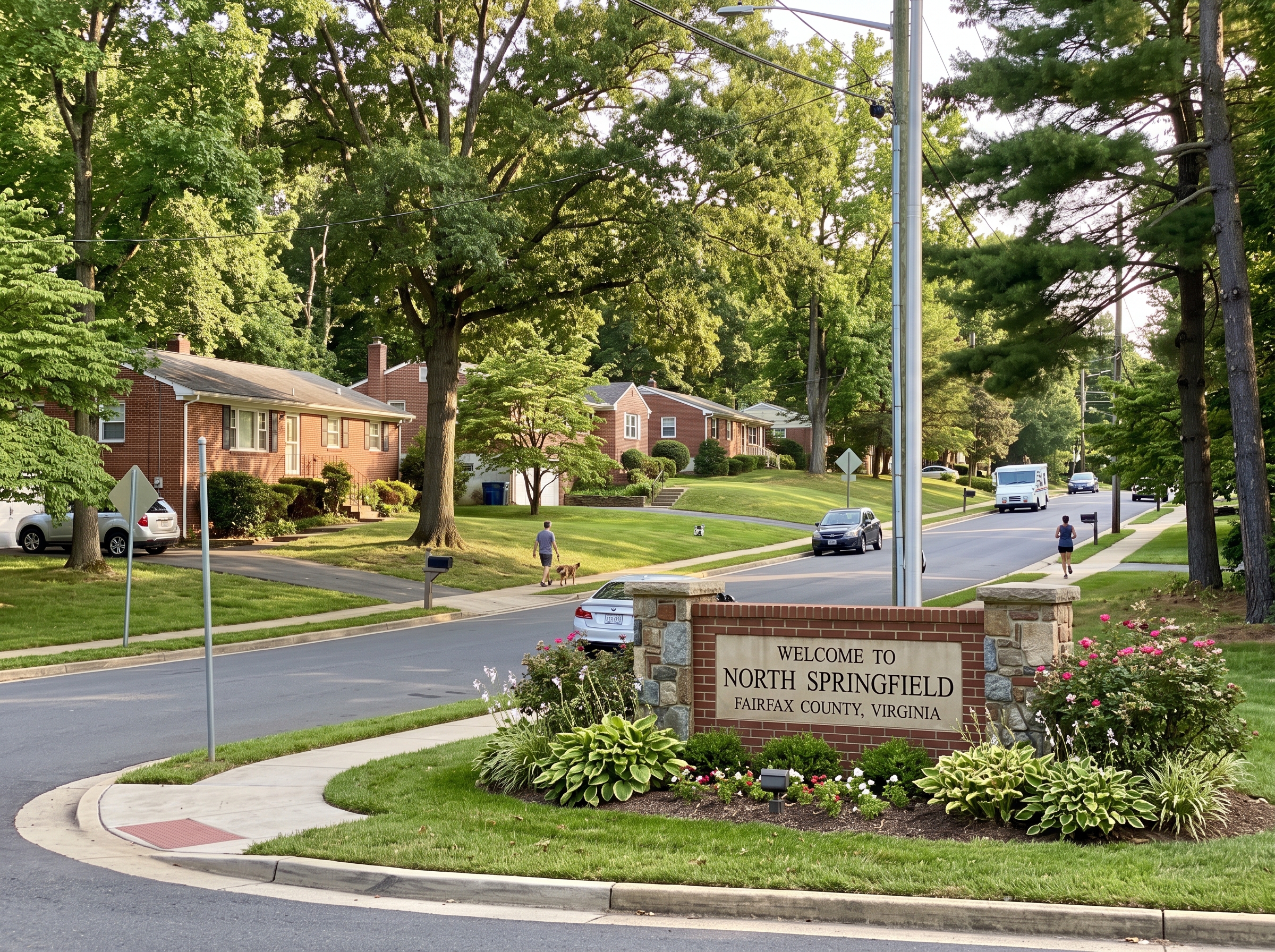
- Foundational 1950s Master-Planned Enclave: Encompassing approximately 1.55 square miles in southern Fairfax County (ZIP code 22151), North Springfield was initiated in 1955 by legendary builder Edward R. Carr (Edward R. Carr, Inc., and Crestwood Construction Corporation), transforming rolling rural farmland into one of the earliest and most enduring suburban communities in the National Capital Region.
- Classic Post-War Brick Architecture & Zero Mandatory HOA: Renowned for solid brick construction across single-level ramblers, tri-level split-levels, and mid-century Cape Cods. Residents enjoy the exceptional freedom of having no mandatory HOA fees or restrictive design committees, with community cohesion preserved by the voluntary North Springfield Civic Association (NSCA), founded in 1956.
- The Famous "House Schools" Legacy of 1956: So rapid was North Springfield’s initial post-war population boom that while North Springfield Elementary School was under construction, Fairfax County Public Schools rented ten newly built residential homes from Edward R. Carr on Axton and Kempsville Streets, converting living rooms and bedrooms into temporary neighborhood classrooms for 350 children.
- Direct Eastern Access to 496-Acre Lake Accotink Park: North Springfield’s western perimeter borders Lake Accotink Park, granting residents immediate pedestrian access to the 3.9-mile lake shoreline loop trail, the 40-mile Gerry Connolly Cross County Trail (CCT), boat launches, fishing piers, and peaceful woodland preserves.
- Prestigious Annandale High School IB World Pyramid: Neighborhood children attend North Springfield Elementary School (PreK–5) and Holmes Middle School (grades 6–8) before advancing to Annandale High School—globally recognized for its rigorous International Baccalaureate (IB) Diploma Program, diverse global student body, and championship athletic traditions.
- Unrivaled Multimodal Commuter Convenience: Perfectly positioned between Braddock Road (Route 620) and the Capital Beltway (I-495 Exits 52 and 54) with direct ramps to the 495 Express Lanes, express bus transit straight to the Pentagon, and proximity to the Backlick Road Virginia Railway Express (VRE) station.
1. Spatial Morphology, Geographic Coordinates & Territorial Extents
The North Springfield Census-Designated Place (CDP) encompasses approximately 1.55 square miles (4.02 square kilometers) of prime rolling piedmont territory in southern Fairfax County, Virginia. Situated at nominal geographic coordinates 38°48′14″ North latitude and 77°12′30″ West longitude (FIPS Code 51-57560; GNIS Feature ID 1498564) at an average elevation of 302 feet above sea level, North Springfield occupies a central position within the Annandale and Springfield suburban nexus, carrying the postal designation of Springfield (ZIP code 22151).
The community’s geographic borders are distinctly carved by major vehicular, hydrologic, and rail corridors. To the north, Braddock Road (State Route 620) defines the perimeter, linking North Springfield westward toward George Mason University and the City of Fairfax, and eastward toward Annandale and Interstate 395. To the east, the boundary follows the riparian corridor of Backlick Run and Backlick Road, separating the residential neighborhood from the commercial and industrial centers of central Springfield.
To the south, North Springfield is bordered by the Norfolk Southern Railway (Washington District line) and the southern loop of the Capital Beltway (Interstate 495). To the west, the community terminates along the serene, forested wetlands of Flag Run and the eastern shoreline of Lake Accotink Park. This self-contained perimeter insulates North Springfield’s residential streetscapes from arterial pass-through traffic while offering residents rapid vehicular access to every major employment corridor across Northern Virginia and Washington, D.C.
2. Post-WWII Genesis & The Vision of Edward R. Carr
The creation of North Springfield was intimately linked to the dramatic post-World War II expansion of the federal government, the military headquarters at the Pentagon, and defense research organizations across the Washington metropolitan area. With the completion of the Henry G. Shirley Memorial Highway (Interstate 395) in the early 1950s, rural Fairfax County suddenly became readily accessible to downtown commuters.
Anticipating this unprecedented wave of suburban housing demand, prominent Washington builder Edward R. Carr—founder of Edward R. Carr, Inc., a past president of the National Association of Home Builders (NAHB), and co-founder of Crestwood Construction Corporation—acquired several hundred acres of fertile farmland and timber tracts in 1954. Carr broke ground on model homes in late 1954, officially opening North Springfield to prospective homebuyers in 1955.
North Springfield was master-planned as the second major planned community in the Springfield area, following Carr’s initial Crestwood development. Carr envisioned a complete, family-centered neighborhood featuring curvilinear streets that contoured naturally around local drainage ridges, generous public park reservations, a central community swimming pool, and sites dedicated to public education. Carr’s vision successfully transformed quiet Virginia countryside into a thriving, multi-generational suburban neighborhood that remains among the most stable and cherished communities in Fairfax County.
3. The Historic 1956 "House Schools" of Axton and Kempsville Streets
The explosive popularity of North Springfield in the mid-1950s gave rise to one of the most celebrated and charming episodes in the history of Fairfax County Public Schools: the phenomenon of the "house schools."
By early 1956, hundreds of young military veterans and government civil servants had purchased new homes in North Springfield and moved in with their young children. However, the construction of the planned North Springfield Elementary School had suffered delays and could not open in time for the 1956–1957 academic year. Facing severe overcrowding in adjacent school districts, Fairfax County school administrators devised an ingenious emergency solution in partnership with developer Edward R. Carr.
Fairfax County Public Schools rented ten newly completed, unoccupied single-family residential homes from Carr along Axton Street and Kempsville Street. Builders postponed the installation of kitchen appliances and interior doors, converting living rooms, dining rooms, and bedrooms into temporary neighborhood classrooms for approximately 350 elementary children. Teachers utilized built-in closets for book storage, and children played during recess in the interconnected backyards.
When North Springfield Elementary School finally opened its permanent doors on Leesville Boulevard, the temporary house schools were promptly returned to Edward R. Carr, who completed their interior kitchens and sold them to eager homebuyers as private residences. Today, long-time residents still proudly point out the historic "schoolhouse homes" along Axton and Kempsville Streets as enduring symbols of the community’s resilient post-war beginnings.
4. Distinct Neighborhood Sub-Enclaves: Bonneywood, Leewood Estates & North Springfield Proper
While developed under a cohesive suburban identity, North Springfield comprises several distinctive geographic sections and sub-enclaves that lend architectural variety to the streetscapes:
North Springfield Proper
Representing the primary residential core developed by Edward R. Carr between 1955 and 1962, this expansive sector surrounds Leesville Boulevard, Axton Street, and Kempsville Street. Characterized by uniform building setbacks, mature oak and tulip poplar tree canopies, and wide sidewalks, this section houses North Springfield Elementary School, North Springfield Park, and the North Springfield Swim Club.
Bonneywood
Integrated into the western sector of the community along the edges of Flag Run, Bonneywood features mid-century ramblers and split-levels situated on gently sloping parcels that back directly onto wooded stream valley buffers. Its quiet cul-de-sacs experience virtually no through-traffic, creating a private woodland sanctuary.
Leewood Estates
Positioned along Woodland Drive in the northwestern corner of the CDP, Leewood Estates was developed by custom homebuilder Sidney Weinberg & Sons. Offering customized split-levels and expanded two-story colonial revivals on larger lots, Leewood Estates introduced bespoke architectural detailing, including dentil cornices, multi-bay windows, and side-load garages.
5. Mid-Century Architectural Typologies: Ramblers, Split-Levels & Cape Cods
The architectural fabric of North Springfield is celebrated as a pristine example of mid-century American residential craftsmanship. Edward R. Carr and his engineering team designed homes with solid structural integrity, featuring heavy timber framing, solid brick masonry exteriors, poured concrete or cinder-block foundations, and low-pitched gables.
1. Classic Mid-Century Brick Ramblers
The single-story rambler (ranch) represents the predominant architectural form in North Springfield. Spanning between 1,150 and 1,500 square feet on the primary level, these homes feature efficient three- and four-bedroom floor plans with formal living rooms, wood-burning brick masonry fireplaces, and broad multi-pane picture windows. Many models were built with full daylight basements that double the home's usable square footage, while others feature slab foundations with integrated carports or attached garages.
2. Tri-Level Split-Level Residences
Engineered to take full advantage of North Springfield’s rolling piedmont contours, the tri-level split-levels offer clear zoning across staggered elevations. The main level hosts the foyer, kitchen, and formal dining salon; a short flight of hardwood stairs leads to an elevated wing containing the primary suite and secondary bedrooms; and a lower ground-level tier features an expansive family recreation room, laundry room, and exterior walk-out to the rear terrace.
3. Mid-Century Cape Cods
Occurring throughout select blocks, the 1.5-story Cape Cod models feature steeply pitched gable roofs accented by classic front dormer windows. These charming homes provide two bedrooms and a full bath on the main level, with two additional bedrooms and extensive under-eave storage on the upper level, offering flexibility for growing households.
6. Contemporary Structural Reconfigurations & Daylight Basements
Over the past two decades, North Springfield has experienced an extraordinary wave of architectural modernization. Because Edward Carr’s mid-century homes were constructed with clear-span engineered roof trusses, the interior non-load-bearing partition walls can be easily removed without compromising structural stability.
Design-build contractors and modern homeowners frequently convert original compartmentalized floor plans into breathtaking open-concept great rooms. Kitchens are expanded to feature 10-foot waterfall quartz prep islands, custom soft-close shaker cabinetry, commercial-grade induction cooktops, and integrated stainless-steel appliances.
Furthermore, the presence of full daylight walk-out basements on sloping parcels allows homeowners to double their living envelopes. Lower levels are routinely finished into luxury secondary living suites, high-definition home theaters, executive work-from-home offices, and personal fitness gyms. In the rear yards, owners construct expansive multi-tiered composite decks and stone patio terraces with built-in outdoor gas firepits, creating seamless indoor-outdoor entertaining spaces under mature oak canopies.
7. Lake Accotink Park (Eastern Trailhead) & The Cross County Trail
A crowning lifestyle advantage of North Springfield is its direct western adjacency to Lake Accotink Park, a 496-acre regional park encompassing a 55-acre freshwater reservoir, protected wetlands, and dense hardwood forests managed by the Fairfax County Park Authority (FCPA).
Neighborhood walking paths and trailheads situated along North Springfield’s western cul-de-sacs connect residents directly into the park’s recreational infrastructure. Residents step immediately onto the 3.9-mile Lake Accotink Loop Trail, a crushed-stone multi-use pathway that encircles the reservoir, offering views of bald eagles, blue herons, osprey, and migratory waterfowl.
Importantly, Lake Accotink serves as a vital artery for the Gerry Connolly Cross County Trail (CCT), an uninterrupted 40-mile trail network stretching across Fairfax County from the Potomac River at Great Falls south to the Occoquan Reservoir. Long-distance trail runners, gravel cyclists, and hikers in North Springfield can travel miles northward through Wakefield Park and Mantua, or southward toward Springfield without crossing roadways.
At the Lake Accotink marina, residents enjoy kayak, canoe, and pedal boat rentals, public boat launches, fishing piers stocked with bass and catfish, shaded picnic pavilions, an antique wooden carousel, a miniature golf course, and summer outdoor concerts under the stars, all set against the dramatic historic Norfolk Southern railroad trestle.
8. North Springfield Park, Flag Run & Backlick Run Watershed Hydrology
In addition to Lake Accotink, community recreation is anchored locally by North Springfield Park, a 5-acre neighborhood park located at 7025 Leesville Boulevard. The park features manicured youth baseball diamonds, open soccer practice fields, modern playground equipment, and shaded picnic tables where neighborhood families gather for weekend sporting events.
Hydrologically, North Springfield is blessed with rich riparian ecology. The western portion of the community drains into Flag Run, a perennial tributary that flows directly into Lake Accotink, while the eastern sectors drain toward Backlick Run. Fairfax County’s Department of Public Works and Environmental Services (DPWES) actively oversees environmental stream restorations along these waterways, implementing native riparian buffer plantings, bank stabilization, and stormwater bioretention facilities to protect water quality within the Accotink Creek and Chesapeake Bay watersheds.
9. Fairfax County Public Schools (FCPS): The Annandale High IB Pyramid
Educational excellence in North Springfield is delivered through the distinguished Annandale High School Pyramid of Fairfax County Public Schools (FCPS Region 6), celebrated for its rigorous academic curriculum, rich cultural diversity, and world-class educational pathways.
North Springfield Elementary School (PreK–5)
Located at 7602 Leesville Boulevard in the center of the neighborhood, North Springfield Elementary School is a beloved community institution where generations of neighborhood children walk to school along tree-lined sidewalks. The school offers a rigorous general education curriculum, comprehensive English for Speakers of Other Languages (ESOL) services, full-time Advanced Academic Program (AAP) talent development, and specialized STEAM (Science, Technology, Engineering, Arts, and Math) labs that nurture early scientific inquiry.
Holmes Middle School (Grades 6–8)
Students advance to Holmes Middle School, situated just two miles northeast on Montrose Street. Holmes Middle delivers a robust preparatory environment featuring Honors courses across core subjects, award-winning band, orchestra, and choral programs, and exploratory technology electives that ease the academic transition into high school.
Annandale High School (An International Baccalaureate World School)
The apex institution of the feeder pattern is Annandale High School, located on Medford Drive. Renowned globally as an accredited International Baccalaureate (IB) World School, Annandale offers the prestigious IB Diploma Programme—a rigorous pre-university curriculum recognized by top universities worldwide for cultivating critical thinking, international-mindedness, and advanced analytical research.
Beyond academics, Annandale boasts the storied "Atoms" athletic tradition, with championship programs in football, soccer, basketball, track and field, and cheerleading. Annandale High School graduates regularly earn admission to elite colleges and universities across the nation, including the University of Virginia, William & Mary, Virginia Tech, Cornell, Columbia, Georgetown, and Johns Hopkins.
10. Civic Sovereignty: The North Springfield Civic Association (NSCA)
Unlike contemporary master-planned developments encumbered by heavy-handed mandatory Homeowners Associations (HOAs) and burdensome monthly assessments, North Springfield operates under a voluntary, highly effective civic stewardship model led by the North Springfield Civic Association (NSCA).
Founded in 1956 at the inception of the community, the NSCA has served as the passionate civic voice of the neighborhood for seven decades. The association publishes a printed neighborhood directory and monthly newsletter (The North Springfield Review), coordinates annual neighborhood-wide yard sales, and sponsors cherished community traditions—including the annual Fourth of July Parade and Picnic, Halloween costume parades, and holiday home decorating contests. Homeowners enjoy the distinct economic benefit of zero mandatory HOA dues while maintaining pride of ownership and high standards of neighborhood upkeep.
11. Aquatics & Recreation: The North Springfield Swim Club (NSSC)
During the summer months, the epicenter of neighborhood recreation and social life is the North Springfield Swim Club (NSSC), located on a private wooded parcel at 7409 Leesville Boulevard. Established as a private, member-owned non-profit recreational facility, the club features a heated 25-meter six-lane competition lap pool, a dedicated one-meter diving well, an enclosed zero-depth toddler wading pool, shaded picnic pavilions with gas grills, and lighted tennis and pickleball courts.
The club is home to the championship North Springfield Dolphins swim and dive teams, which compete enthusiastically in the prestigious Northern Virginia Swimming League (NVSL). Generations of local children have learned to swim with the Dolphins, and Friday night team potlucks, teen raft nights, adult social socials, and water aerobics classes make NSSC the vibrant heartbeat of summer in North Springfield.
12. Multimodal Commuter Infrastructure & Transportation Logistics
North Springfield’s strategic positioning in southern Fairfax County makes it an exceptional haven for daily commuters across the National Capital Region.
Vehicular travelers enjoy instantaneous access to the Capital Beltway (Interstate 495) via Exit 52 (Little River Turnpike / Route 236) to the north and Exit 54 (Braddock Road) to the west. Commuters can enter the 495 Express Lanes directly, allowing for swift, predictable travel northward to Tysons Corner, the Dulles Technology Corridor, and Bethesda, Maryland. Eastward along Braddock Road or Edsall Road, commuters connect directly to Interstate 395 (Shirley Highway), reaching the Pentagon, Reagan National Airport, and downtown Washington, D.C., in under 20 minutes outside of peak hours.
Public transit options are equally robust. Express commuter buses operated by the Washington Metropolitan Area Transit Authority (Metrobus) and Fairfax Connector run directly along Braddock Road, offering non-stop rush-hour service directly to the Pentagon Transit Center.
For rail commuters, the Backlick Road Station of the Virginia Railway Express (VRE) is located less than two miles southeast of the neighborhood. The VRE Manassas Line provides comfortable passenger rail service equipped with complimentary Wi-Fi, transporting passengers directly to Alexandria, Crystal City (Amazon HQ2), L'Enfant Plaza, and Washington Union Station. For Metrorail access, the Franconia-Springfield Station (Blue Line) and the Vienna/Fairfax-GMU Station (Orange Line) are each within a short 10-to-12-minute drive.
13. Virginia Statutory Property Taxation Under Code § 58.1-3201
Real estate taxation in North Springfield is administered in strict compliance with the statutory mandate established in the Code of Virginia § 58.1-3201, which requires that all real property across the Commonwealth must be assessed for tax purposes at one hundred percent (100%) of its true fair market value.
The Fairfax County Department of Tax Administration (DTA) conducts comprehensive annual reassessments of every taxable parcel in North Springfield. The DTA utilizes computerized mass appraisal market equalization techniques that analyze verified, arm's-length sales of comparable homes within specific neighborhood submarket codes. The appraisal models factor in lot square footage, topography, structural improvements, effective age, and physical condition.
Because tax assessments in Fairfax County are equalized annually to reflect real-time market transactions, property owners benefit from transparent, predictable valuations without arbitrary administrative surprises. Homeowners also maintain the statutory right to appeal assessments annually to the DTA and the Fairfax County Board of Equalization (BOE) should physical discrepancies arise.
14. Comparative Analysis Matrix: North Springfield vs. Peer Communities
To evaluate North Springfield within the broader Northern Virginia housing ecosystem, the following matrix compares the community against adjacent central Fairfax County residential enclaves across key architectural, parkland, and civic criteria:
| Community | Primary Build Eras | Dominant Architectural Typologies | Mandatory HOA | Primary Park & Trail Asset | FCPS High School Feeder |
|---|---|---|---|---|---|
| North Springfield | 1955–1962 | Edward Carr Brick Ramblers, Split-Levels & Capes | None (Voluntary NSCA) | Lake Accotink Park & North Springfield Park | Annandale High (IB World) |
| Ravensworth | 1959–1965 | Crestwood Brick Ramblers & Split-Levels | None (Voluntary RFCA) | Lake Accotink Park (496 ac) & CCT | Lake Braddock Secondary (7–12) |
| West Springfield | 1965–1978 | Brick Ramblers, Split-Levels, Colonials & Townhomes | Varies by Subd (None in Orange Hunt) | Hidden Pond Nature Center & Pohick Trails | West Springfield High (Spartans) |
| Annandale | 1950–1970 | Ramblers, Mid-Century Moderns & Colonials | Varies by Subdivision | Mason District Park & Pine Ridge Park | Annandale High (IB World) |
| Kings Park | 1960–1968 | Traditional Ramblers, Colonials & Tri-Levels | None (Voluntary Civic Assn) | Royal Lake Park & Pohick Stream Valley | Lake Braddock Secondary (7–12) |
| Long Branch | 1964–1972 | Mid-Century Split-Levels, Colonials & Ramblers | None (Voluntary Olde Creek) | Long Branch Stream Valley Park & CCT | W.T. Woodson High School |
15. Frequently Asked Questions Regarding North Springfield, VA Real Estate
What are the precise geographic boundaries of North Springfield, Virginia?
The North Springfield Census-Designated Place (CDP) encompasses approximately 1.55 square miles in southern Fairfax County (ZIP code 22151). It is bound by Braddock Road (Route 620) to the north, Backlick Run and Backlick Road to the east, the Norfolk Southern Railway and Capital Beltway (I-495) to the south, and Flag Run and Lake Accotink Park to the west.
Who developed North Springfield and when did construction begin?
North Springfield was master-planned and constructed by prominent builder Edward R. Carr (Edward R. Carr, Inc., and Crestwood Construction Corporation), with model homes opening in 1955. It became the second major planned community in the Springfield area following the completion of the Shirley Highway.
What were the historic 1956 "house schools" in North Springfield?
During the 1956 population boom, construction of North Springfield Elementary School was delayed. Fairfax County Public Schools rented ten newly completed residential homes from Edward R. Carr on Axton and Kempsville Streets, using living rooms and bedrooms as temporary neighborhood classrooms for 350 children until the permanent school opened.
What architectural styles are found in North Springfield?
The neighborhood is celebrated for solid mid-century brick construction, primarily featuring single-level ramblers (ranch-style homes), tri-level split-levels, and mid-century Cape Cods. Many feature full daylight basements, attached carports or garages, and mature quarter-acre wooded lots.
Which public schools serve North Springfield children?
North Springfield is zoned within the Annandale High School pyramid of Fairfax County Public Schools (FCPS Region 6). Students attend North Springfield Elementary School (PreK–5) on Leesville Boulevard, Holmes Middle School (grades 6–8), and Annandale High School (grades 9–12), globally recognized for its International Baccalaureate (IB) Diploma Program.
Does North Springfield have a mandatory Homeowners Association (HOA)?
No. North Springfield has no mandatory HOA, freeing homeowners from compulsory monthly dues or restrictive architectural committees. Community events, directories, and advocacy are managed voluntarily by the North Springfield Civic Association (NSCA), founded in 1956.
How does North Springfield access Lake Accotink Park?
North Springfield borders the eastern shoreline of the 496-acre Lake Accotink Park. Neighborhood pathways connect residents directly onto the 3.9-mile lake loop trail, the 40-mile Gerry Connolly Cross County Trail (CCT), boat launches, fishing piers, and protected wildlife preserves.
What recreational and swimming amenities exist in North Springfield?
Community recreation is anchored by the member-owned North Springfield Swim Club (NSSC) on Leesville Boulevard, featuring a 25-meter six-lane pool, diving well, toddler pool, and tennis courts. In addition, the 5-acre North Springfield Park provides youth baseball diamonds and playgrounds.
What commuter transit options serve North Springfield residents?
Residents enjoy direct access to the Capital Beltway (I-495 Exits 52 and 54) and the 495 Express Lanes, express commuter buses along Braddock Road directly to the Pentagon, the Backlick Road Virginia Railway Express (VRE) station (less than two miles away), and nearby Metrorail access.
How are real estate property taxes assessed in North Springfield?
Under Code of Virginia § 58.1-3201, all real property is assessed annually at 100 percent of true fair market value. The Fairfax County Department of Tax Administration (DTA) conducts computerized mass appraisal equalizations annually based on verified arm's-length sales of comparable homes within the neighborhood submarket.
Navigating Real Estate in North Springfield & Central Fairfax County
Whether you are preparing to list a classic Edward R. Carr brick rambler, considering an open-concept architectural renovation, or seeking an established home bordering Lake Accotink Park zoned for the Annandale High IB pyramid, partner with trusted Northern Virginia real estate authority Elena Gorbounova for private, data-driven representation.