
Penn Daw, VA Real Estate: The Definitive Guide to Spatial Morphology, Historic Motor Hotel Heritage, Embark Richmond Highway BRT & Residential Enclaves
Executive Summary & Essential Community Takeaways
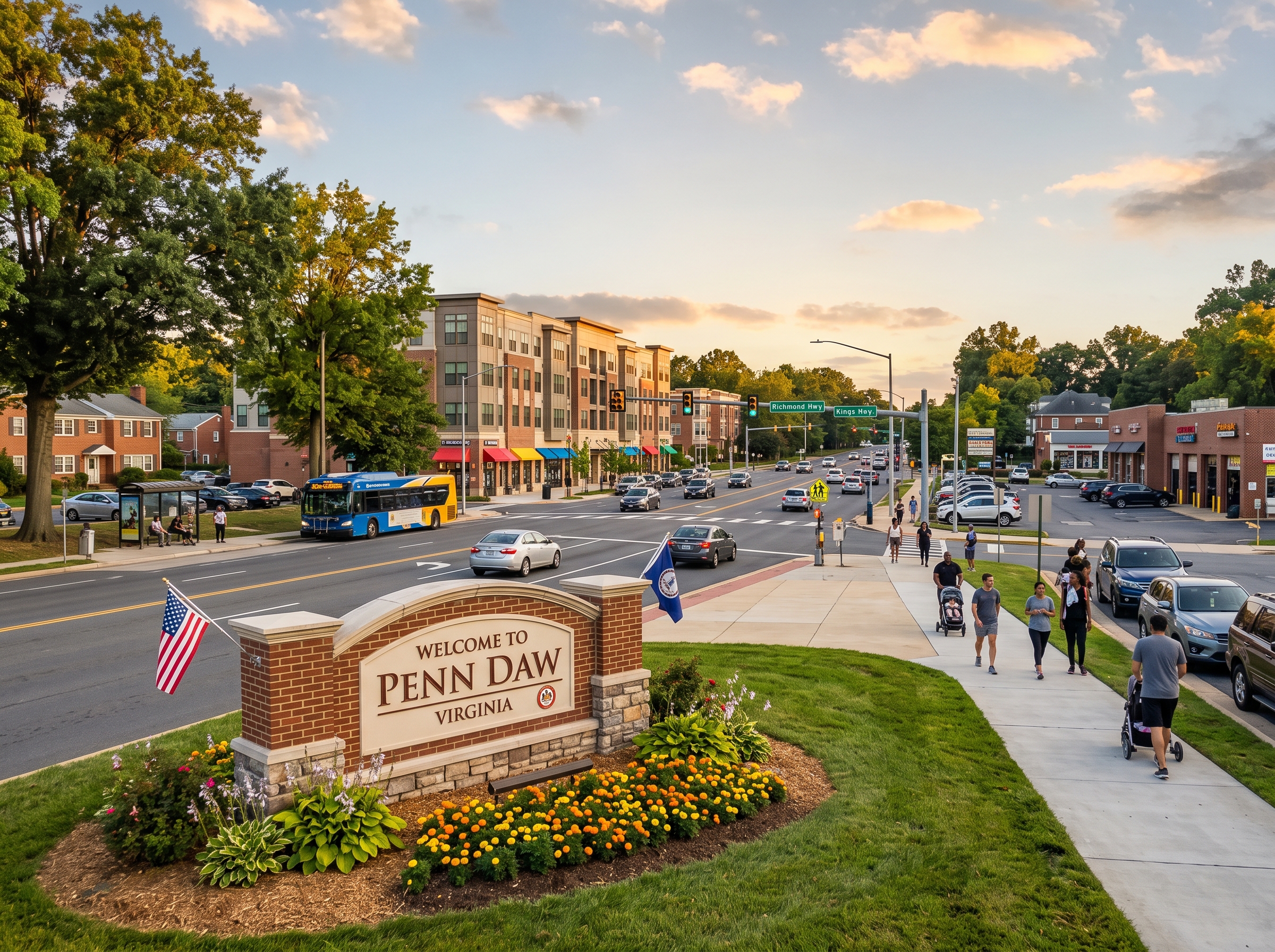
- Strategic South County Crossroads: Centered at the historic convergence of U.S. Route 1 (Richmond Highway), North Kings Highway (Route 241), and South Kings Highway, Penn Daw is an unincorporated census-designated place in Fairfax County's Mount Vernon Magisterial District, positioned directly between Huntington to the north and Groveton to the south.
- Historic Motor Hotel Heritage: Derives its historic identity from the celebrated Penn-Daw Motor Hotel, established in 1927 by C.C. Penn and A.H. Dawson. Regarded as one of America's earliest and finest automobile-era cottage courts, the complex served cross-country travelers on the historic Capital Highway connecting Washington, D.C., to the southern Atlantic seaboard.
- Embark Richmond Highway BRT Catalytic Transformation: Penn Daw is a designated Community Business Center (CBC) under the Fairfax County Comprehensive Plan, slated to host a flagship median-running Bus Rapid Transit (BRT) station under the multi-million-dollar Embark Richmond Highway project, connecting residents seamlessly north to Huntington Metrorail and south to Fort Belvoir.
- Immediate Yellow Line Metrorail Connectivity: Located less than one mile from the Huntington Metrorail Station (southern terminus of the WMATA Yellow Line), providing rapid, one-seat subway commutes to Old Town Alexandria, Reagan National Airport (DCA), Amazon HQ2 at National Landing, the Pentagon, and downtown Washington, D.C.
- Diverse Housing Spectrum: Encompasses charming post-war brick cottages and Cape Cods in the established Fairhaven neighborhood (platted 1949), mid-century brick ramblers and split-levels in Penn Daw Terrace and Marlo Heights, luxury multi-story executive townhomes in modern infill enclaves, and contemporary mixed-use transit-oriented apartment communities.
- Dual Premier FCPS Feeder Pyramids: Primarily aligned with the Thomas A. Edison High School pyramid (International Baccalaureate IB World School, Global STEM Academy, Mark Twain Middle, and Cameron Elementary) with select sectors feeding into the West Potomac High School pyramid (AP Capstone, Carl Sandburg Middle Full-Time AAP Level IV Center).
1. Spatial Morphology, Crossroads Geography & Regional Setting
Penn Daw occupies a strategically vital geographic territory within the coastal plain piedmont transition zone of southeastern Fairfax County, Virginia. Situated directly within the Mount Vernon Magisterial District and carrying the Alexandria postal designation (encompassing ZIP codes 22303 and 22306), the community serves as an indispensable bridge connecting the urbanized, transit-rich nodes of Huntington and Alexandria to the expansive, established residential parklands of the Mount Vernon corridor.
The spatial morphology of Penn Daw is defined by its historic roadway geometry. The central spine of the community is formed by U.S. Route 1 (Richmond Highway), the historic north-south arterial that traverses the eastern seaboard. At Penn Daw, Route 1 intersects with two crucial regional radials: North Kings Highway (State Route 241), which branches northwest toward Huntington, Telegraph Road, and the City of Alexandria; and South Kings Highway, which curves southwest into the Franconia and Rose Hill districts. This prominent tri-axial crossroads created an early commercial trading and travel junction that continues to define the submarket's vibrancy.
Geographically, Penn Daw is bounded by the Cameron Run stream valley and Huntington to the north, the elevated ridgeline of Beacon Hill and Groveton to the south, the established riverine neighborhoods of Belle Haven and New Alexandria to the east, and Telegraph Road and Rose Hill to the west. The elevation rises steadily from the low-lying coastal floodplains near Cameron Run southward toward the high plateau of Beacon Hill, creating diverse micro-topographies featuring elevated residential bluffs, protected wooded hollows, and panoramic suburban vistas.
2. Historical Lineage: The 1927 Penn-Daw Motor Hotel & Early Automobile Tourism
Unlike many Northern Virginia suburban enclaves that trace their naming to colonial plantations or English manorial estates, Penn Daw possesses a unique and storied twentieth-century heritage rooted in the birth of American automobile travel.
During the 1910s and 1920s, the widespread adoption of the Model T Ford and personal motor vehicles transformed American transportation. The historic turnpike connecting Washington, D.C., to Richmond was designated as federal U.S. Route 1—celebrated as the "Capital Highway" and the principal vehicular pipeline connecting the industrial Northeast with Florida. In 1927, visionary business partners and land developers C.C. Penn and A.H. Dawson recognized the strategic commercial value of the crossroads where Kings Highway converged with Route 1, exactly eight miles south of the United States Capitol.
Combining their respective surnames, Penn and Dawson established the Penn-Daw Motor Hotel (often referred to simply as the Penn-Daw Hotel). Widely cited by transportation historians as one of the very first and most sophisticated "cottage courts" or motor hotels in the United States, the Penn-Daw facility rejected the crude tourist camps of the era. Instead, it comprised an idyllic semi-circle of white painted brick and wood-frame colonial revival cottages, complete with green shutters, brick fireplaces, private tiled bathrooms, central steam heat, and individual attached garages for each automobile.
The central complex featured a celebrated full-service colonial dining room renowned for Southern hospitality, serving Virginia ham, Maryland fried chicken, and fresh seafood to touring families, foreign diplomats, members of Congress, and tourists journeying to George Washington's Mount Vernon estate. The hotel incorporated a modern Texaco filling station, mechanical repair shop, and manicured landscaped lawns. The venture was so widely renowned that the surrounding community, post office substation, and commercial district permanently adopted the moniker "Penn Daw."
Following the outbreak of World War II and the monumental wartime expansion of the Pentagon, Fort Belvoir, and federal civil service bureaus, the lands surrounding Penn Daw were rapidly surveyed for permanent residential communities. Between 1948 and 1960, the agricultural acreage surrounding the motor court blossomed into planned suburban neighborhoods platted for returning veterans, establishing the foundation of today's mature residential enclaves.
3. Residential Architecture & Distinct Micro-Enclaves
Penn Daw features an extraordinarily varied architectural landscape, encompassing classic post-war suburban homes, established mid-century estates, modern luxury townhome infill, and transit-oriented contemporary multi-family communities:
Fairhaven: Classic Post-WWII Brick Cottages & Cape Cods (Platted 1949–1953)
Bordering the northwest perimeter of Penn Daw along North Kings Highway, the historic Fairhaven neighborhood represents one of Fairfax County's quintessential post-World War II planned communities. Platted between 1949 and 1953 by prominent regional builders, Fairhaven was designed to provide durable, attainable, high-quality homeownership for returning military veterans and federal civil servants.
The architectural fabric of Fairhaven consists of compact, sturdy 1.5-story Cape Cods, single-story ramblers, and two-story brick cottages. Constructed with solid masonry facades, traditional steep-pitch gables, and concrete foundations, these homes originally ranged from 800 to 1,200 square feet. Over subsequent decades, generations of homeowners have expanded these dwellings, adding second-story dormers, rear family room additions, finished basements, and covered front porches. Set along traditional curbed residential streets with private driveways and generous rear yards, Fairhaven maintains an enduring, close-knit neighborhood character.
Penn Daw Terrace & Marlo Heights: Mid-Century Brick Ramblers & Split-Levels
To the south and west of the commercial core, neighborhoods like Penn Daw Terrace and Marlo Heights showcase authentic 1950s and 1960s suburban residential architecture. These single-family enclaves feature sprawling all-brick ramblers and multi-level split-levels situated on generous parcels spanning 0.20 to 0.35 acres, sheltered by towering canopies of mature oaks and maples.
The homes boast open horizontal layouts, large multi-pane picture windows, original hardwood oak strip flooring, full daylight walkout basements with masonry wood-burning fireplaces, and attached carports or side-entry garages. Because of their generous lot dimensions and solid structural integrity, many of these homes have been extensively renovated with modern chef's kitchens, luxury primary suites, and expansive outdoor entertaining decks.
Contemporary Luxury Townhome Infill Enclaves (1995–Present)
Over the past two decades, high land values and intense transit demand spurred by the nearby Huntington Metrorail Station have catalyzed high-end residential townhome infill development across Penn Daw. Communities such as The Towns at South Kings, Highlands at Penn Daw, and the residential enclaves adjacent to Kings Crossing deliver sophisticated multi-level living.
These residences range from 1,800 to over 2,800 finished square feet across three to four finished levels. They showcase stately colonial and transitional brick facades, integral rear-load two-car garages, nine-foot and ten-foot main-level ceilings, gourmet center-island kitchens with granite and quartz countertops, primary bedroom retreats with ensuite spa baths, and private composite rooftop terraces designed for private evening entertaining.
Transit-Oriented Contemporary Mixed-Use Communities
Directly fronting the Richmond Highway corridor, modern mixed-use developments exemplify the contemporary urban evolution of Penn Daw. Flagship residential communities like The Shelby and Novus Penn Daw deliver luxury apartment and condominium living. These mid-rise buildings feature sophisticated architectural massing, private landscaped courtyards, resort-style swimming pools, high-end fitness centers, electric vehicle (EV) charging infrastructure, co-working lounges, and pet grooming spas, offering a maintenance-free lifestyle tailored to professionals commuting into National Landing, the Pentagon, and downtown Washington, D.C.
4. Comprehensive Architectural Typologies Comparison Table
The following analytical matrix summarizes the primary residential typologies represented throughout the Penn Daw submarket, illustrating historical construction eras, spatial footprints, structural materials, and micro-enclave distributions:
| Architectural Typology | Primary Eras Platted | Finished Living Area | Structural & Facade Materials | Lot Profiles & Primary Enclaves |
|---|---|---|---|---|
| Fairhaven Post-War Cottages & Cape Cods | 1949 – 1954 | 900 – 1,800 sq ft (including additions) | Solid brick masonry, wood-frame dormers, asphalt gables, poured foundations | 0.12 to 0.18-acre curbed parcels; Fairhaven Ave, Fort Dr, 남 Kingston Ave |
| Mid-Century Brick Ramblers | 1953 – 1965 | 1,800 – 3,200 sq ft (with finished walkout) | Full brick veneer, concrete masonry footings, large bay windows, dual fireplaces | 0.20 to 0.35-acre wooded lots; Penn Daw Ter, Shields Ave, Marlo Heights |
| Multi-Level Split-Levels | 1958 – 1972 | 2,000 – 2,800 sq ft (3 to 4 levels) | Brick and architectural siding, multi-tier rooflines, lower-level family suites | 0.22 to 0.30-acre terraced parcels; South Kings Hwy border lanes |
| Executive Infill Townhomes | 1998 – 2018 | 1,900 – 2,850 sq ft (3 to 4 levels) | Brick-front facades, engineered floor trusses, 2-car garages, rooftop decks | Zero-lot-line HOA communities; The Towns at South Kings, Highlands at Penn Daw |
| Transit-Oriented Multi-Family | 2014 – Present | 650 – 1,450 sq ft (1 to 3 bedrooms) | Steel and wood podium construction, fiber-cement panels, interior parking garages | Urban mixed-use frontage; The Shelby, Novus Penn Daw along Route 1 |
5. Embark Richmond Highway Bus Rapid Transit (BRT) & Penn Daw CBC Transformation
Penn Daw stands at the very center of Northern Virginia's most ambitious transportation and economic development initiative: Embark Richmond Highway.
Adopted by the Fairfax County Board of Supervisors into the county's Policy Plan and Comprehensive Plan, Embark Richmond Highway is a multi-million-dollar infrastructure initiative executed in coordination with the Virginia Department of Transportation (VDOT) and the Federal Transit Administration (FTA). The initiative introduces a dedicated, median-running Bus Rapid Transit (BRT) system stretching along a 12-mile corridor of U.S. Route 1, providing rapid, rail-like transit with prepaid boarding, off-board fare collection, level-platform boarding, signal priority at intersections, and modern architecturally distinctive stations.
Under the county master plan, Penn Daw is officially designated as a Community Business Center (CBC), slated to host a flagship multimodal BRT transit station near the intersection of Route 1 and South Kings Highway. This infrastructure transformation will bring fundamental benefits to property owners:
- High-Frequency Rapid Transit: Direct, dedicated-lane transit connecting Penn Daw north to the Huntington Metrorail Station (Yellow Line) in under five minutes, and south to Beacon Hill, Groveton, Hybla Valley, and Fort Belvoir.
- Complete Streets & Urban Greening: Replacement of automobile-dominated strip corridors with tree-lined pedestrian boulevards, nine-foot-wide multi-use shared bicycle/walking paths on both sides of Route 1, native plantings, and modern bioswales.
- Transit-Oriented Mixed-Use Revitalization: Phased redevelopment of aging automobile strip plazas into walkable mixed-use town center clusters combining street-level retail, neighborhood restaurants, outdoor public plazas, and residential housing.
6. Commuter Logistics & Multimodal Regional Connectivity
Few suburban communities in the Washington metropolitan area offer the comprehensive commuter flexibility enjoyed by Penn Daw residents:
Huntington Metrorail Station (WMATA Yellow Line Terminus)
Located just one mile north along North Kings Highway, the Huntington Metrorail Station serves as the southern terminal anchor of the Yellow Line. The station features two large parking garages, dedicated commuter drop-off kiss-and-ride loops, and extensive Fairfax Connector bus transit bays. From Huntington, passengers enjoy a direct, one-seat subway commute to premier regional destinations:
- Old Town Alexandria (King Street-Old Town): 1 stop (approximately 4 minutes).
- Potomac Yard & Virginia Tech Innovation Campus: 3 stops (approximately 8 minutes).
- Ronald Reagan Washington National Airport (DCA): 4 stops (approximately 11 minutes).
- National Landing & Amazon HQ2 (Crystal City): 5 stops (approximately 13 minutes).
- The Pentagon: 6 stops (approximately 16 minutes).
- Downtown Washington, D.C. (L'Enfant Plaza & Gallery Place): 7 to 9 stops (approximately 19–23 minutes).
Regional Roadway Networks & Interstate Connectivity
- U.S. Route 1 (Richmond Highway): The primary commercial and transit conduit, providing direct northward access to the City of Alexandria and southward access to Fort Belvoir, the National Museum of the United States Army, and Prince William County.
- Interstate 495 (Capital Beltway): Exit 177 is located less than 1.5 miles north, providing immediate connection to the Woodrow Wilson Memorial Bridge crossing into Prince George's County, Maryland (National Harbor and MGM Casino), as well as westward access toward Tysons Corner and I-95/I-395.
- Defense Corridor Proximity: Penn Daw is exceptionally situated for military and defense personnel, positioned just five miles north of Fort Belvoir and minutes from the National Geospatial-Intelligence Agency (NGA) and the Mark Center in Alexandria.
7. Dual Public Education Feeder Networks
Educational services in Penn Daw are administered by the prestigious Fairfax County Public Schools (FCPS) division. Depending on specific micro-enclave boundaries, residents are served by two acclaimed academic feeder pyramids:
The Thomas A. Edison High School Pyramid
The northern and western residential sectors of Penn Daw, including Fairhaven, feed into the Thomas A. Edison High School pyramid:
- Cameron Elementary School: Situated on Huntington Avenue, Cameron Elementary provides foundational Pre-K through sixth-grade instruction characterized by inquiry-based learning, digital curriculum integration, and Advanced Academic Services (AAP).
- Mark Twain Middle School: Located on Franconia Road, Twain Middle serves grades seven and eight with Honors curricula, introductory foreign language study, and robust exploratory STEM and performing arts courses.
- Thomas A. Edison High School: An authorized International Baccalaureate (IB) World School, Edison High delivers the globally recognized IB Diploma Programme, the Global STEM Academy, and the elite career and technical labs of the Edison Academy.
The West Potomac High School Pyramid
Southern and eastern sectors of Penn Daw align with the West Potomac High School pyramid:
- Belle View & Groveton Elementary Schools: Celebrated for community focus, STEAM labs, and dedicated early-childhood enrichment.
- Carl Sandburg Middle School: A premier middle school hosting a dedicated Full-Time Advanced Academic Programs (AAP) Level IV Center, offering rigorous academic enrichment for highly capable students.
- West Potomac High School: Renowned for its comprehensive Advanced Placement (AP) Capstone Diploma program, collegiate health and media arts at West Potomac Academy, and championship athletic programs.
8. Commercial Corridors, Gourmet Dining & Retail Centers
Penn Daw offers an abundance of daily conveniences, major retail anchors, and diverse culinary destinations immediately at residents' doorsteps:
Kings Crossing Shopping Center & Penn Daw Plazas
The commercial anchor of the community is Kings Crossing, situated at the junction of Route 1 and South Kings Highway. This bustling retail center is anchored by a comprehensive Walmart Supercenter, alongside national banking branches, pharmacies, automotive care centers, specialty retail shops, and casual dining eateries. Surrounding commercial plazas along Route 1 host independent international bakeries, Latin American and Mediterranean restaurants, coffee houses, and daily professional services.
Beacon Center & Surrounding Retail Hubs
Located less than one mile south on Beacon Hill, the expansive Beacon Center retail complex provides major retail staples, including a full-service Giant Food supermarket, Lowe's Home Improvement, Marshalls, PetSmart, and diverse casual dining options.
Historic Old Town Alexandria (Less Than Three Miles North)
In less than five to seven minutes, Penn Daw residents can access the historic brick-paved streets of Old Town Alexandria. World-renowned dining options along King Street feature award-winning fine dining restaurants, waterfront oyster bars, independent artisan boutiques, the Torpedo Factory Art Center, and vibrant farmers markets held in Market Square since 1753.
9. Parks, Recreation & Environmental Corridors
Penn Daw benefits from immediate access to extensive parkland systems and regional waterfront recreation:
Local Enclave Parks & Playgrounds
- Mount Eagle Park: A serene wooded park preserving historic forested slopes and walking trails near the site of Bryan Fairfax's eighteenth-century country estate.
- Farrington Park: A quiet neighborhood green space featuring mature trees, open turf fields, and children's playground equipment.
- Burgundy Park & Community Center: Offers lighted athletic fields, basketball courts, picnic areas, and community meeting rooms.
Regional Waterfront Trails & Recreation Centers
- Belle Haven Park & The Mount Vernon Trail: Situated just 1.5 miles east along the Potomac River, Belle Haven Park provides access to the 18-mile paved Mount Vernon Trail, connecting cyclists and runners to Washington, D.C., in the north and George Washington's Mount Vernon in the south, alongside the Belle Haven Marina offering kayak and sailboat rentals.
- Cameron Run Regional Park (NOVA Parks): Located directly to the north across Cameron Run, featuring the Great Waves Waterpark, miniature golf, batting cages, and banquet facilities.
- Mount Vernon RECenter: A state-of-the-art Fairfax County Park Authority recreational facility located just south on Route 1, housing a 50-meter Olympic indoor competition pool, an indoor ice skating rink, and comprehensive fitness centers.
10. Structural Maintenance, Building Mechanics & Renovation Guidelines
Purchasing or renovating a post-war home in Penn Daw—particularly in established neighborhoods like Fairhaven and Penn Daw Terrace—involves key structural and mechanical considerations:
Underground Sewer Lateral Video Scoping
Because homes in Fairhaven and Penn Daw Terrace were constructed between 1949 and 1965, original underground plumbing utilized cast iron or vitrified clay sewer laterals connecting to the Fairfax County public municipal main. Over several decades, mature tree root systems can infiltrate joints, and cast iron pipes can experience internal channeling or scaling. Conducting a fiber-optic video camera sewer scope inspection is essential during pre-purchase due diligence to verify pipe structural integrity.
Electrical Service Panel Modernization
Original post-war residential electrical panels typically provided 60-amp or 100-amp capacity. To safely operate modern high-draw appliances, central heat pumps, Level 2 electric vehicle (EV) charging stations, and home office suites, homeowners should upgrade to a 200-amp main breaker panel equipped with modern Arc-Fault Circuit Interrupters (AFCI) and Ground-Fault (GFCI) protection compliant with the Virginia Uniform Statewide Building Code (USBC).
Foundation Drainage & Crawlspace Vapor Barriers
Homes featuring crawlspace foundations or walkout basements should maintain positive exterior grading, directing rainwater runoff away from foundation walls. In crawlspace homes, installing a continuous heavy-duty (10-mil to 20-mil) polyethylene vapor barrier across bare earth, paired with proper foundation perimeter insulation, mitigates coastal plain soil humidity and preserves subfloor framing.
11. Real Property Tax Equalization & Fairfax County DTA Assessment Framework
Real estate taxation in Penn Daw is administered under the statutory authority of the Commonwealth of Virginia and Fairfax County. Because Penn Daw is an unincorporated census-designated place within Fairfax County, property owners are subject exclusively to Fairfax County real property tax levies, with zero separate town or city millages.
Virginia Code Title 58.1-3201: The 100% Fair Market Value Mandate
Under Virginia Code § 58.1-3201, all real property throughout the Commonwealth must be assessed for tax purposes at one hundred percent (100%) of its true fair market value. The Fairfax County Department of Tax Administration (DTA) conducts comprehensive annual reassessments of every taxable parcel in Penn Daw. Valuations are established via computerized mass appraisal market equalization based on verified arm's-length sales of comparable properties within identical neighborhood submarket codes, accounting for lot size, topography, structural improvements, and physical condition.
Annual Assessment Calendar & Payment Schedules
- January 1 (Statutory Effective Date): Property assessments are legally established as of January 1 of each calendar year, reflecting real estate market transactions occurring during the preceding twelve months.
- Late February (Assessment Notice Distribution): The DTA mails official Notice of Real Estate Assessment cards to all property owners, itemizing land value, structural improvement value, and total equalized taxable valuation.
- Semi-Annual Payment Deadlines: Real estate tax payments in Fairfax County are billed in two equal installments:
- First Installment: Statutorily due on or before July 28.
- Second Installment: Statutorily due on or before December 5.
- Countywide Dedicated Levies: Properties in Penn Daw are subject to the Countywide Stormwater Management Service District Tax, dedicated to maintaining stream valley restoration, dam safety, and regional drainage infrastructure.
Statutory Assessment Appeals Mechanism
Property owners who believe their annual assessment exceeds fair market value, is non-uniform compared to contiguous properties, or contains clerical errors have the legal right to challenge the valuation through a formal two-tiered process:
- Administrative Review: An informal appeal submitted directly to the Department of Tax Administration, typically required by early April. An assigned county residential appraiser reviews structural data, square footage calculations, physical property condition, and relevant sales comps.
- Board of Equalization (BOE) Appeal: A formal evidentiary appeal submitted to the citizen-led Board of Equalization of Real Estate Assessments, typically requiring filing by June 1. If dissatisfied with the BOE ruling, property owners retain the statutory right to file a petition with the Circuit Court of Fairfax County under Virginia Code § 58.1-3984.
12. Frequently Asked Questions Regarding Penn Daw, VA Real Estate
Is Penn Daw an incorporated municipality or an unincorporated community in Fairfax County?
Penn Daw is an unincorporated census-designated place (CDP) governed directly by the Fairfax County Board of Supervisors within the Mount Vernon Magisterial District. It utilizes an Alexandria postal address (ZIP codes 22303 and 22306) for mail delivery, but it is entirely located within Fairfax County. Public education, public safety, road maintenance, and land-use zoning are administered by Fairfax County.
What was the historical origin of the name "Penn Daw"?
The community derives its distinctive name from the historic Penn-Daw Motor Hotel, established in 1927 by developers C.C. Penn and A.H. Dawson along U.S. Route 1 (Richmond Highway). As one of America's earliest and most celebrated roadside motor courts of the automobile era, the complex featured colonial-style guest cottages, a fine dining room, and service garages catering to travelers journeying between New York, Washington, D.C., and the southern states.
What architectural styles characterize the residential neighborhoods of Penn Daw?
Penn Daw features a rich continuum of housing typologies: post-WWII 1940s and 1950s solid brick and wood-frame cottages and Cape Cods in Fairhaven; classic mid-century brick ramblers and split-levels in Penn Daw Terrace and Marlo Heights; contemporary multi-level brick-front executive townhomes in infill enclaves like The Towns at South Kings; and modern transit-oriented mixed-use apartment communities along Richmond Highway.
What is the Embark Richmond Highway Bus Rapid Transit (BRT) initiative?
Embark Richmond Highway is a comprehensive multi-million-dollar regional transportation and urban revitalization project led by Fairfax County and VDOT. It creates a dedicated median-running Bus Rapid Transit (BRT) system along Route 1 with a planned flagship station at Penn Daw (near South Kings Highway), connecting residents with rapid, high-frequency transit directly north to the Huntington Metrorail Station and south to Fort Belvoir.
How does commuter transit operate from Penn Daw to major regional employment centers?
Penn Daw boasts exceptional commuter logistics. The Huntington Metrorail Station (Yellow Line terminus) is located approximately one mile north, delivering a direct one-seat ride to Old Town Alexandria, Reagan National Airport (DCA), Amazon HQ2 at National Landing, the Pentagon, and downtown Washington, D.C. Major roadways include U.S. Route 1, North Kings Highway (Route 241), and immediate access to the Capital Beltway (I-495 Exit 177).
Which public school pyramids serve students in Penn Daw?
Penn Daw is served by Fairfax County Public Schools (FCPS) through two primary feeder pyramids: the Thomas A. Edison High School pyramid (Cameron Elementary, Mark Twain Middle, and Edison High featuring the International Baccalaureate IB Diploma Programme and Global STEM Academy) and the West Potomac High School pyramid (Belle View/Groveton Elementary, Carl Sandburg Middle Full-Time AAP Center, and West Potomac High featuring the AP Capstone).
What commercial and retail centers are located within and adjacent to Penn Daw?
Residents enjoy convenient shopping at Kings Crossing Shopping Center (anchored by a Walmart Supercenter, retail services, and dining), Penn Daw Shopping Center, the nearby Beacon Center (featuring Giant Food and Lowe's Home Improvement), and immediate access to Old Town Alexandria's historic King Street dining and shopping district just three miles north.
What parks, trails, and recreational facilities serve the Penn Daw community?
Recreational amenities include Mount Eagle Park, Farrington Park, Burgundy Park and Community Center, Cameron Run Regional Park (featuring Great Waves Waterpark), and direct access eastward to Belle Haven Park and the scenic multi-use Mount Vernon Trail along the George Washington Memorial Parkway.
What structural maintenance considerations are important for Fairhaven and mid-century homes in Penn Daw?
Critical homeowner maintenance considerations include conducting video camera sewer scope inspections of original cast iron and clay sewer laterals, upgrading electrical panels to modern 200-amp service with AFCI/GFCI protection, ensuring positive foundation grading slopes, and inspecting crawlspace vapor barriers and insulation to maintain structural durability.
How are real estate property assessments and taxes governed in Penn Daw?
Under Virginia Code § 58.1-3201, all real property in Penn Daw is assessed annually at 100 percent of fair market value by the Fairfax County Department of Tax Administration (DTA). Notices are mailed every February based on verified arm's-length market sales, with payments due semi-annually on July 28 and December 5, and statutory appeal rights through the Board of Equalization.
13. Academic References, Historic Archives & Statutory Legal Disclaimers
This architectural monograph, environmental assessment, and regional real estate reference treatise incorporates verified historical archives, public planning documents, and statutory legal frameworks:
- Fairfax County Comprehensive Plan: Area IV, Mount Vernon Magisterial District Plan & Penn Daw Community Business Center (CBC) Revitalization Guidance, Fairfax County Department of Planning and Development, Fairfax, Virginia.
- Virginia Department of Transportation (VDOT): Embark Richmond Highway Bus Rapid Transit (BRT) Environmental Impact & Engineering Design Specifications, Richmond, Virginia.
- Washington Metropolitan Area Transit Authority (WMATA): Huntington Metrorail Station Planning Profile & Yellow Line Service Guidelines, Washington, D.C.
- Fairfax County Public Schools (FCPS): Office of Facilities Planning, Thomas A. Edison High School & West Potomac High School Feeder Boundary Alignment Directory, Gatehouse Administration Center, Falls Church, Virginia.
- Code of Virginia (Statutory Authority): Title 58.1 (Taxation), § 58.1-3201 (Fair Market Value Mandates) and § 58.1-3370 (Board of Equalization Procedures), Commonwealth of Virginia, Richmond, Virginia.
- United States Geological Survey (USGS): Alexandria and Mount Vernon 7.5-Minute Topographic Quadrangles, Cameron Run and Dogue Creek Watershed Drainage Surveys, Reston, Virginia.
Statutory Research & Regulatory Notice: This architectural monograph, environmental review, and submarket treatise is published strictly for informational, educational, and spatial orientation purposes. Real estate boundaries, school attendance zones, Bus Rapid Transit construction schedules, and tax assessment schedules are subject to ongoing administrative modifications by the Fairfax County Board of Supervisors, the Fairfax County School Board, and the Virginia Department of Transportation (VDOT). This publication does not constitute formal appraisal valuations, structural architectural inspections, or legal counsel. Prospective purchasers and property owners must verify official parcel-specific records directly with the Fairfax County Department of Tax Administration (DTA) and Land Development Services (LDS).