Reston, VA Real Estate: The Definitive Guide to Master-Planned Urbanism, Lakefront Living & the Silver Line Tech Corridor
1. Executive Summary & Foundational Takeaways
Reston, Virginia, stands as one of the most internationally acclaimed and influential achievements in modern American urban planning. Conceived and founded in 1964 by visionary developer Robert E. Simon (whose initials R-E-S formed "Reston"), this 11.5-square-mile master-planned community in northwestern Fairfax County—predominantly situated within the Hunter Mill Magisterial District across postal ZIP codes 20190, 20191, and 20194—revolutionized post-war suburban development by rejecting automobile-dependent subdivision sprawl in favor of pedestrian-oriented, mixed-use village clusters.
Guided by Simon's famous Seven Guiding Principles, Reston was engineered to enable residents to live, work, play, and age in place across every stage of life. Its unique land-use architecture is preserved under Fairfax County's Planned Residential Community (PRC) zoning ordinance, which concentrates residential density around village centers and rapid transit corridors while legally setting aside vast, contiguous tracts for communal recreation and nature preservation.
Today, Reston is governed by the Reston Association (RA), overseeing more than 1,350 acres of open green parkland, four expansive recreational lakes (Lake Anne, Lake Thoreau, Lake Audubon, and Lake Newport), 15 community swimming pools, 52 tennis/pickleball courts, and 55 miles of paved pathways. With dual stations on the Washington Metrorail Silver Line (Wiehle-Reston East and Reston Town Center), immediate adjacency to the Dulles Technology Corridor (Route 267), and an elite public educational pyramid anchored by South Lakes High School (International Baccalaureate Diploma Programme), Reston represents a balanced fusion of cosmopolitan urbanism and natural tranquility.
The Six Structural Pillars of Reston Real Estate
- Robert E. Simon's Master-Planned Vision. Pioneering 1964 new-town urban design balancing residential clusters, commercial village centers, recreational open space, and architectural individuality.
- Planned Residential Community (PRC) Zoning. Specialized Fairfax County zoning classification safeguarding continuous greenbelts, four man-made lakes, and cluster density protections.
- Reston Association (RA) Recreational Empire. Comprehensive governance maintaining 1,350+ acres of forests and wetlands, 15 swimming pool facilities, 52 tennis courts, and 55 miles of paved trails.
- Dual Metrorail Silver Line Stations. Direct heavy rail connectivity at Wiehle-Reston East and Reston Town Center, offering one-seat transit to Tysons, Arlington, Washington, D.C., and Dulles International Airport.
- Reston Town Center Urban Downtown. Open-air metropolitan core featuring luxury high-rise condominium towers, Michelin-caliber dining, retail pavilions, and Class-A corporate headquarters.
- South Lakes High School IB Academic Pyramid. Celebrated International Baccalaureate secondary curriculum paired with acclaimed elementary STEM and arts academies.
2. Geopolitical Identity & Planned Community Governance
Reston is an unincorporated census-designated place (CDP) governed under the municipal authority of the Fairfax County Board of Supervisors, represented within the Hunter Mill Magisterial District. Because it is not an incorporated town, Reston levies no separate municipal town property taxes.
Civil services and infrastructure are provided through unified county and community mechanisms:
- Fairfax County Police Department (FCPD): Headquartered locally at the Reston District Station (Station 4) on Cameron Glen Drive, providing dedicated community policing and traffic enforcement.
- Fairfax County Fire and Rescue: Operating Station 25 (Reston) and Station 39 (North Point) with advanced life support and hazardous materials response capabilities.
- Reston Association (RA): Operating as a master property owners association established by deed covenants. RA manages community facilities, enforces architectural design review board (DRB) guidelines, and levies annual assessments dedicated exclusively to parkland and recreational facility maintenance.
In compliance with Virginia Code Title 58.1-3201, all real property in Reston is assessed annually at 100 percent of fair market value by the Fairfax County Department of Tax Administration (DTA). Homeowners pay solely the unified county real estate tax rate, plus their annual Reston Association assessment.
3. Historical Evolution: Robert E. Simon & The New Town Revolution
The historical trajectory of Reston began in 1961 when New York real estate developer Robert E. Simon Jr. sold his family's interest in Carnegie Hall and purchased 6,750 acres of rolling farm and woodland in rural Fairfax County. Simon was profoundly disillusioned by the sterile, car-dominated post-WWII tract developments of Levittown and suburban Long Island.
Simon engaged renowned modernist architects Whittlesey & Conklin to draft a master plan for an integrated, self-sufficient town based on seven fundamental principles:
- Housing choice across a full spectrum of lifestyles and income levels.
- The ability for residents to live, work, and retire in the same community.
- The primacy of the individual and human dignity over structural conformity.
- Direct, daily access to natural beauty, lakes, and recreational leisure.
- Commercial, cultural, and civic life embedded within walking distance of home.
- Architectural excellence and structural innovation.
- Financial viability through sustained private-sector enterprise.
Crucially, Simon insisted from Reston's very founding in 1964 that the community be open to all races and backgrounds—making Reston the first racially integrated planned community in Virginia, predating the federal Fair Housing Act of 1968. The opening of Lake Anne Village Center in late 1965 introduced America to a revolutionary European-style plaza that received global acclaim from architectural and sociological luminaries.
4. Lake Anne Historic District & Modernist Waterfront Architecture
Lake Anne Village Center remains the intellectual and spiritual heart of Reston. Formally listed on the National Register of Historic Places, Lake Anne is celebrated as one of the world's finest examples of mid-century modern and Brutalist waterfront design.
Architect James Rossant designed the center around Washington Plaza, a crescent-shaped pedestrian esplanade flanking the northern shore of the 27-acre man-made lake. The plaza integrates multi-story poured-concrete residential flats above street-level commercial storefronts, cafes, and artisan boutiques.
Surrounding the plaza are the iconic Waterview Cluster and Inlet Cluster townhomes, featuring flat-roof modernist lines, private boat moorings, and expansive floor-to-ceiling glass capturing shimmering water views. Lake Anne hosts Reston's celebrated Saturday farmers market, the Reston Museum, community art galleries, and waterfront outdoor dining, offering an authentic European town square ambiance.
5. Reston Town Center: The Metropolitan Core of Western Fairfax
While Lake Anne represents Reston's historic European village roots, Reston Town Center (RTC) represents its 21st-century metropolitan evolution. Developed collaboratively by Mobil Land Development and Boston Properties starting in 1990, RTC is the undisputed urban core of western Fairfax County.
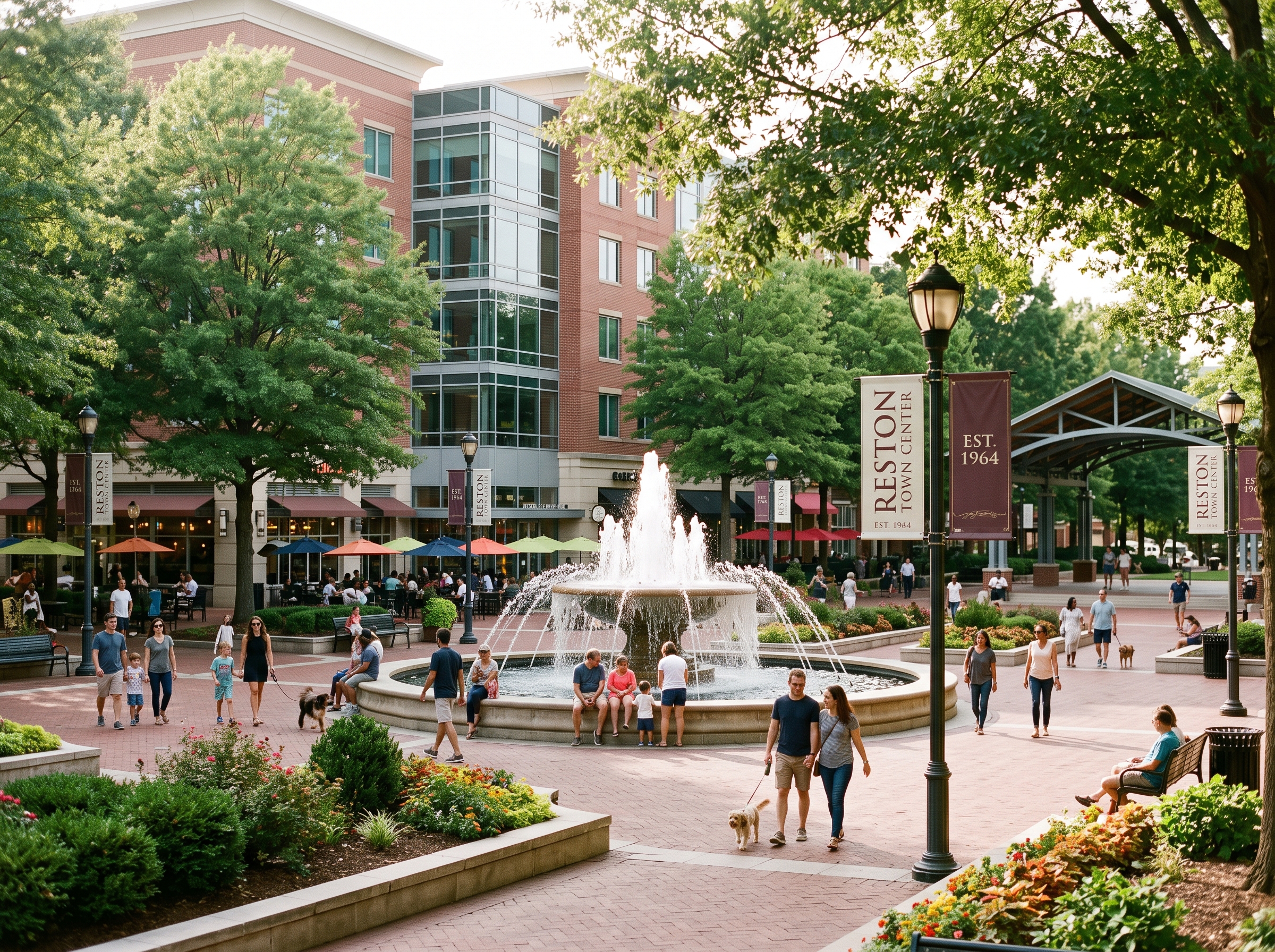
Designed as an open-air downtown with wide brick sidewalks, central boulevards, and landscaped gathering plazas, RTC is anchored by Market Street, Fountain Square, and the Reston Town Center Pavilion. In winter, the pavilion converts into a premier outdoor ice skating rink, while in summer it hosts regional jazz concerts, fine arts festivals, and holiday parades.
Residential living in RTC consists of luxury mid-rise and high-rise condominium towers—including The Midtown at Reston Town Center and The Carlton House. These luxury residences offer 24-hour concierge service, rooftop swimming pools, state-of-the-art fitness centers, private clubrooms, and doorstep access to high-end retailers, national flagship restaurants, cinema complexes, and the Reston Town Center Metrorail Station.
6. Housing Stock & Architectural Morphology
Reston's housing stock is arguably the most architecturally diverse in Northern Virginia, spanning four distinct typological categories:
- Waterfront & Lakefront Cluster Townhomes: Surrounding Lake Anne, Lake Thoreau, and Lake Audubon, these clustered residences feature cedar siding, brick accents, multi-level decks, private pontoon boat docks, and direct access to water recreation.
- High-Rise & Mid-Rise Elevator Condominiums: Concentrated within Reston Town Center and transit corridors along Wiehle Avenue and Sunset Hills Road, offering single-level open floor plans, private terraces, garage parking, and full urban convenience.
- Detached Executive Single-Family Residences: Situated throughout North Reston (Lake Newport, Aldrin enclaves) and South Reston (Glade and Hunters Woods), featuring spacious center-hall colonials and transitional homes on quarter-acre to half-acre wooded parcels.
- Contemporary Patio & Golf Course Homes: Bordering the 166-acre Reston National Golf Course, offering low-maintenance single-family living with direct fairway and putting green vistas.
7. Neighborhood & Submarket Comparative Matrix
The following analytical matrix compares the architectural, spatial, and transit profiles across seven prominent residential submarkets in Reston:
| Residential Submarket | Predominant Housing Typology | Era / Architectural Style | Walkability & Transit Access | Water & Open Space Proximity | Key Defining Characteristics |
|---|---|---|---|---|---|
| Lake Anne Historic Core | Brutalist Flats & Modernist Townhomes | 1964–1970s Mid-Century Modern | Maximum to Washington Plaza shops & dining | Direct Lake Anne waterfront & boat docks | Historic district designation; Waterview cluster; Saturday farmers market; iconic concrete architecture |
| Reston Town Center Core | High-Rise & Mid-Rise Luxury Condos | 1990s–Present Modern Urban High-Rise | Pedestrian downtown; RTC Metro Station | Urban plazas, fountains & seasonal ice rink | 24-hr concierge; luxury amenities; Michelin-rated dining; doorstep boutique retail |
| Lake Thoreau & Audubon | Cedar Cluster Townhomes & Singles | 1970s–1980s Contemporary Woodland | Walkable to South Lakes Village Center | Waterfront living on Thoreau & Audubon | Private pontoon boating; serene woodland settings; interconnected trail bridges |
| North Reston (Lake Newport) | Executive Colonials & Luxury Clusters | 1980s–2000s Traditional & Transitional | Walkable to North Point Village Center | Lake Newport parklands & Olympic pool | Spacious multi-story floor plans; attached 2-to-3 car garages; Lake Newport tennis club |
| Hunters Woods / Glade | Mid-Century Ranches & Colonials | 1960s–1980s Established Suburban | Direct trails to Hunters Woods Center & RCC | Glade Stream Valley & turquoise trails | Reston Community Center (RCC) CenterStage theater; indoor aquatic center; mature oaks |
| Reston National Golf Enclave | Patio Homes & Fairway Townhomes | 1970s–1990s Golf-Course Residential | Close to Wiehle-Reston East Metro | Fairway vistas across 166-acre course | Ed Ault golf course views; single-level living options; low-maintenance association care |
| Reston Station / Wiehle Hub | Contemporary Mid-Rises & Infill Flats | 2014–Present Transit-Oriented Urban | Doorstep to Wiehle-Reston East Metro | Direct access to W&OD multi-use trail | Helmut Jahn-designed skyline; Google and tech campus adjacency; civic plaza |
8. Public Education & Fairfax County Public Schools (FCPS) Pyramids
Public education across Reston is administered by Fairfax County Public Schools (FCPS), recognized nationwide for academic excellence and collegiate readiness. Reston neighborhoods feed primarily into two secondary educational pyramids:
- The South Lakes High School Pyramid: Serving central, southern, and eastern Reston. South Lakes High School (Home of the Seahawks) is renowned regionally for offering the complete International Baccalaureate (IB) Diploma Programme, which emphasizes rigorous multi-disciplinary inquiry, global perspectives, and collegiate-level research. Feeder schools include Langston Hughes Middle School and esteemed primary institutions including Terraset Elementary (famed for its earth-sheltered, energy-efficient architecture), Hunters Woods Elementary for the Arts and Sciences, and Sunrise Valley Elementary.
- The Herndon High School Pyramid: Serving northern quadrants of Reston. Herndon High School offers extensive Advanced Placement (AP) coursework, competitive athletics, and specialized engineering and technical academies, supported by Aldrin Elementary and Armstrong Elementary.
High-achieving eighth-grade students residing anywhere in Reston are eligible to apply for admission to Thomas Jefferson High School for Science and Technology (TJHSST), the regional governor's school in Alexandria consistently ranked as the top public high school in the United States.
9. Transportation Infrastructure, Silver Line Metrorail & Commuter Corridors
Reston boasts some of the most advanced multi-modal transportation infrastructure in the Commonwealth of Virginia:
- Dual Silver Line Metrorail Stations: Reston is anchored by two rapid-rail stations on the Washington Metrorail Silver Line: Wiehle-Reston East Station (opened in 2014) and Reston Town Center Station (opened in 2022). These stations provide effortless, one-seat passenger rail transit eastward to Tysons, Ballston, Rosslyn, downtown Washington, D.C., and Capitol Hill, and westward to Washington Dulles International Airport and Ashburn.
- Dulles Toll Road (Route 267): Running directly through the spine of Reston, the Dulles Toll Road and its parallel Airport Access Highway provide high-speed vehicular connectivity east to the Capital Beltway (I-495) and west into Loudoun County.
- Washington & Old Dominion (W&OD) Railroad Trail: This 45-mile paved linear parkway slices directly through the center of Reston, serving as an essential multi-modal commuter highway for thousands of daily bicycle and electric-mobility commuters traveling between Leesburg, Reston, Vienna, and Arlington.
- Fairfax Connector & Internal Shuttles: Extensive local feeder bus routes operated by Fairfax Connector link every residential neighborhood and village center directly to Metrorail platforms.
10. Parks, Lakes & The Reston Association (RA) Empire
Recreational amenity access in Reston is managed on a scale unmatched by any other planned community in Virginia through the Reston Association (RA):
- Four Recreational Lakes: Lake Anne (27 acres), Lake Thoreau (40 acres), Lake Audubon (43 acres), and Lake Newport (11 acres). Residents enjoy pontoon boating, electric-powered cruising, kayaking, stand-up paddleboarding, and catch-and-release bass and panfish fishing.
- 15 Swimming Pool Complexes: Distributed across every quadrant of the community, including Olympic-sized 50-meter lap pools, heated facilities, zero-depth family entry pools, and active neighborhood swim teams (Reston Swim Team Association).
- 52 Tennis & Pickleball Courts: Lighted championship facilities with clay and hard courts, professional coaching clinics, and community tournaments.
- 55 Miles of Paved Pathway Networks: Completely grade-separated pedestrian and cycling trails utilizing bridges and underpasses beneath major roads, allowing children and adults to navigate between homes, schools, village centers, and pools without crossing vehicular traffic.
- Lake Fairfax Park (Fairfax County Park Authority): An adjacent 476-acre county park featuring the 18-acre Lake Fairfax, The Water Mine Family Swimmin' Hole water park, extensive mountain biking singletrack, and overnight camping facilities.
11. Corporate Tech Corridor & Regional Economic Synergy
Reston is far more than a bedroom commuter suburb—it serves as the intellectual and corporate capital of the Dulles Technology Corridor, often called the "Silicon Valley of the East."
Major global technology, defense, and consulting corporations maintain substantial regional headquarters and campus facilities within Reston, including Google (at Reston Station), Microsoft, General Dynamics, Leidos, CACI, Carahsoft, Bechtel, and Qualtrics.
This concentrated corporate ecosystem generates a continuous, resilient influx of high-earning software architects, cyber-defense engineers, executive leadership, and legal professionals who seek primary residences within minutes of their corporate offices, driving permanent structural demand across Reston's luxury housing market.
12. Commercial Village Centers & Everyday Retail Infrastructure
A central tenet of Simon's master plan was that no resident should live more than a half-mile from daily goods and services. Reston implements this through five dedicated village centers:
- Lake Anne Village Center: Historic lakeside shops, waterfront restaurants, coffee houses, and community services.
- Hunters Woods Village Center: Anchored by Safeway, diverse retail, and the Reston Community Center (RCC), which features the CenterStage performing arts theater and a heated indoor aquatic complex.
- South Lakes Village Center: Overlooking Lake Thoreau, featuring grocery conveniences, lakeside dining patios, medical practices, and professional services.
- North Point Village Center: Serving northern Reston with Giant Food, specialty retail, financial institutions, and casual dining.
- Reston Town Center & Spectrum: Providing comprehensive department retail, Target, Best Buy, and luxury specialty stores.
13. Zoning Framework & Design Review Board (DRB) Oversight
Reston's architectural integrity and environmental beauty are rigorously protected by the Reston Association Design Review Board (DRB):
- PRC Zoning Flexibility: Planned Residential Community zoning allows cluster developments with zero-lot-line footprints, townhome pods, and multi-family structures while requiring mandatory open-space dedication.
- Design Review Board (DRB) Standards: Any exterior modification to a home within Reston Association jurisdiction—including exterior paint colors, roof materials, door styles, deck additions, fencing, and tree removals—must receive formal approval from the DRB.
- Tree Canopy Protection: Reston maintains strict covenants protecting mature hardwood trees. Property owners cannot remove trees exceeding designated diameter thresholds without formal arborist evaluation and association permits.
14. Real Estate Market Dynamics: Tenured Ownership & Structural Liquidity
The residential market in Reston is defined by deep structural demand, exceptional inventory absorption, and cross-generational retention:
- Aging in Place Viability: Because Reston offers housing ranging from entry-level garden condominiums to multi-level townhomes, lakefront clusters, detached colonials, and luxury elevator high-rises, residents frequently spend their entire adult lives within the community, moving seamlessly between housing typologies as their families expand and eventually downsize.
- High Tech & Executive Demand: Proximity to the Silver Line Metrorail and global tech employers along Route 267 guarantees steady buyer interest across all macroeconomic market phases.
- Statutory Assessment Predictability: Real property assessments are conducted annually at 100 percent of fair market value under Virginia Code Title 58.1-3201 by the Fairfax County Department of Tax Administration (DTA), ensuring equitable county-wide property taxation.
15. Strategic Advisory & Buyer/Seller Due Diligence Framework
Purchasing real estate in Reston requires specific attention to association covenants, resale disclosure packages, and jurisdictional boundaries:
- Reston Association (RA) vs. Non-RA Parcels: While most homes in Reston are members of RA and subject to annual assessments and DRB oversight, certain subdivisions and condominium complexes are independent. Buyers must verify whether a property belongs to RA and possesses access privileges to RA pools and tennis facilities.
- Cluster Association Assessments: Townhome and cluster home owners in Reston typically pay dual assessments: the annual Reston Association fee plus a monthly or quarterly cluster fee dedicated to local trash removal, private parking lot paving, and common area groundskeeping.
- Dock Rights & Lake Easements: Waterfront property buyers should verify private dock permits, mooring rights, and shoreline maintenance easements with both the cluster association and Reston Association.
- DRB Compliance Verification: Sellers should ensure all past exterior alterations possess documented DRB approvals to prevent title delays or escrow holdbacks during the resale disclosure review period.
16. Frequently Asked Questions Regarding Reston Real Estate
What was Robert E. Simon's founding vision for Reston?
Founded in 1964 by Robert E. Simon (whose initials R-E-S formed "Reston"), the community was designed around seven guiding principles of modern urban planning. Simon envisioned an inclusive new town where residents could live, work, play, and age in place across diverse housing typologies, preserving extensive open natural spaces, lakes, and cluster woodlands rather than succumbing to automobile-dependent tract sprawl.
What is the Reston Association (RA) and what amenities does it provide?
The Reston Association (RA) is one of the largest and most comprehensive community associations in the United States, governing residential properties within Reston's planned community footprint. RA maintains more than 1,350 acres of open parkland, four major lakes (Anne, Thoreau, Audubon, and Newport), 15 outdoor swimming pools, 52 tennis and pickleball courts, and 55 miles of paved, shaded multi-use pathways.
How does Metrorail Silver Line access operate in Reston?
Reston is directly served by two Washington Metrorail Silver Line stations: Wiehle-Reston East Station (opened 2014) and Reston Town Center Station (opened 2022). These stations provide seamless, one-seat rapid rail transit east into Tysons, Arlington, and downtown Washington, D.C., and west directly to Washington Dulles International Airport and eastern Loudoun County.
What is Planned Residential Community (PRC) zoning?
PRC (Planned Residential Community) is a specialized zoning classification within the Fairfax County Zoning Ordinance (zMOD) specifically tailored to Reston. It permits clustered residential density in townhomes, lakefront clusters, and urban mid-rises while legally mandating the preservation of substantial open recreational green space, stream valleys, and community lakes.
What architectural styles define Lake Anne Village Center?
Lake Anne Village Center is celebrated internationally for its mid-century European-style Brutalist and modernist architecture, designed by architects Whittlesey & Conklin (James Rossant). Built in the mid-1960s, the center features crescent-shaped concrete residential flats above pedestrian retail arcades on Washington Plaza, flanked by modern Waterview townhomes with private boat moorings.
What public high school pyramids serve Reston?
Reston is primarily served by South Lakes High School (home of the Seahawks, renowned for its prestigious International Baccalaureate IB Diploma Programme) fed by Langston Hughes Middle and elementary schools including Terraset and Hunters Woods. Northern sections feed into Herndon High School. Students are also eligible for competitive regional admission to Thomas Jefferson High School for Science and Technology (TJHSST).
What distinguishes Reston Town Center (RTC)?
Reston Town Center is the premier open-air downtown urban district of western Fairfax County. It features luxury high-rise condominium towers (such as The Midtown and The Carlton), Class-A trophy office buildings housing national tech firms, an open-air pavilion (hosting outdoor ice skating in winter), boutique shopping, fine dining, and pedestrian gathering plazas.
How are real estate property taxes assessed in Reston?
Pursuant to Virginia Code Title 58.1-3201, all real property in Reston is assessed annually at 100 percent of fair market value by the Fairfax County Department of Tax Administration (DTA). Homeowners pay unified county property taxes (supporting public schools, safety, and infrastructure) alongside annual Reston Association (RA) assessments for local recreational maintenance.
What boating and lake recreation amenities exist in Reston?
Reston encompasses four distinct man-made lakes: Lake Anne, Lake Thoreau, Lake Audubon, and Lake Newport. Residents enjoy pontoon boating, electric-powered cruising, kayaking, stand-up paddleboarding, and freshwater fishing from private neighborhood docks and community launches.
What major tech employers anchor the Reston corridor?
Situated within the Dulles Technology Corridor along Route 267, Reston hosts major corporate regional headquarters, research hubs, and aerospace contractors including Google, Microsoft, General Dynamics, Leidos, CACI, Carahsoft, and Bechtel, creating a robust local employment base that sustains continuous housing demand.
17. Municipal & Architectural Data Verification Checklist
Essential Public Records Checklist for Prospective Buyers
- Reston Association (RA) Membership Confirmation. Confirm parcel deed covenants to verify active RA status, annual dues structure, and facility pass entitlements.
- Design Review Board (DRB) Compliance Inspection. Obtain an official RA resale disclosure packet confirming zero outstanding architectural covenant violations.
- Cluster Association Reserve Study. For townhome and condominium purchases, review cluster association financial reserves, roofing schedules, and private road paving budgets.
- School Feeder Verification. Cross-reference property addresses with the FCPS Boundary Locator to confirm South Lakes High (IB) vs. Herndon High school pyramids.
- Silver Line Metrorail Proximity. Map walking or bus transit distances to Wiehle-Reston East or Reston Town Center Metrorail platforms.
Informational & Research Monograph Notice: This research monograph is published exclusively for educational, historical, and community research purposes. All municipal boundaries, school attendance zones, architectural classifications, zoning codes, and transit routes are compiled from published public records of Fairfax County, Virginia, and the Reston Association.
Equal Housing Opportunity: All real estate practices adhere strictly to the Federal Fair Housing Act, the Virginia Fair Housing Law, and local human rights ordinances. No representations are made regarding property valuations or mortgage underwriting terms. Prospective buyers and sellers are advised to consult licensed Virginia real estate attorneys, land use planners, and the Fairfax County Department of Planning and Development for property-specific zoning verifications.