
Vienna VA Real Estate: The Definitive Guide to History, Neighborhoods, Zoning & Community Character
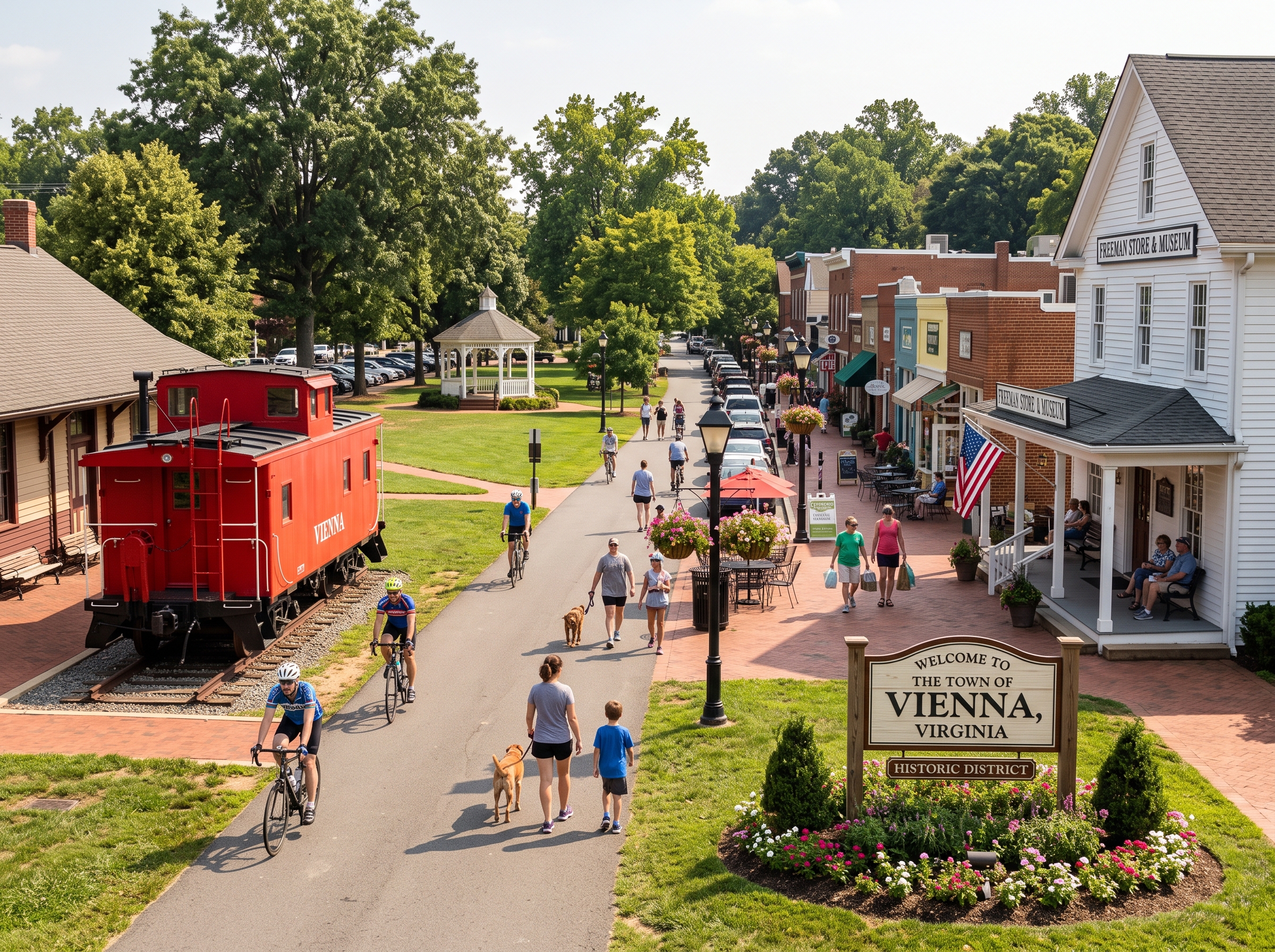
Vienna, Virginia occupies an extraordinary place in Northern Virginia. Positioned twelve miles west of Washington, D.C. and directly south of Tysons, Vienna seamlessly pairs small-town civic identity with premier regional accessibility. Originally established as a rural 18th-century settlement along ancient ridgeline turnpikes, Vienna evolved around the Washington and Old Dominion railroad line into an incorporated municipality celebrated for its independent town government, historic Church Street district, vibrant community traditions, and top-tier Fairfax County public schools.
Understanding the Vienna real estate landscape requires analyzing two distinct geographic jurisdictions: the incorporated Town of Vienna (ZIP 22180)—which administers its own independent town council, police department, public works, and municipal zoning ordinance—and Greater Vienna (ZIPs 22181 and 22182), which encompasses spacious wooded acreage enclaves, contemporary architectural master-plans, and the cultural anchor of Wolf Trap National Park under Fairfax County administration. This comprehensive monograph delivers an exhaustive examination of Vienna’s morphology, history, neighborhood enclaves, school pyramids, and municipal frameworks.
Foundational Market Principles of Vienna, Virginia
- Incorporated Municipal Autonomy. Properties inside the Town of Vienna operate under independent municipal governance, receiving town police protection, dedicated leaf vacuuming, sidewalk maintenance, and snow clearance funded through town administration.
- Independent Municipal Zoning Code. Inside town limits, residential development is strictly governed by Town of Vienna zoning categories (RS-10, RS-12.5, RS-16) enforcing specific lot coverage maximums (traditionally 25%), 35-foot height limits, and town building permits distinct from Fairfax County.
- The W&OD Trail Linear Park Spine. The 45-mile paved Washington & Old Dominion Railroad Regional Park bisects the center of Vienna, functioning as an active transportation, cycling, and pedestrian boulevard connecting neighborhoods to Church Street cafes and regional job hubs.
- Dual High School Pyramids of Excellence. Vienna is anchored by the historic James Madison High School pyramid in central and southern sectors and the George C. Marshall High School International Baccalaureate (IB) pyramid in northern sectors, stabilizing long-term property demand.
- Architectural Infill Transformation. Older 1950s ramblers and Cape Cods on quarter-acre to third-acre lots are systematically replaced by high-end Craftsman, transitional, and modern farmhouse custom builds.
- Orange Line Metrorail & Commuter Gateways. The Vienna / Fairfax-GMU Metrorail Station serves as the western terminus of the Orange Line, complemented by Interstate 66, Route 123 (Maple Avenue), and immediate access to Tysons.
Quick Navigation: Vienna Guide Sections
1. Vienna at a Glance
| Structural Dimension | Regional Characteristic |
|---|---|
| Jurisdictional Status | Dual: Incorporated Town of Vienna (Chartered 1890) & Unincorporated Greater Vienna (Fairfax County) |
| Magisterial Districts | Hunter Mill Magisterial District (Town & West) and Providence Magisterial District (East/South) |
| Postal ZIP Codes | 22180 (Town of Vienna & South), 22181 (West Vienna & Flint Hill border), 22182 (North Vienna, Wolf Trap & Tysons border) |
| Physical Land Area | Approximately 4.4 square miles (Town of Vienna incorporated) / 14.8+ square miles across greater postal sectors |
| Physiographic Setting | Rolling Piedmont upland province; natural drainage toward Accotink Creek and Difficult Run |
| Linear Park Corridor | Washington & Old Dominion (W&OD) Railroad Regional Park (45-mile paved trail) |
| Key Commuter Arterials | Route 123 (Maple Ave / Chain Bridge Rd), Route 243 (Nutley St), Interstate 66, Route 7 (Leesburg Pike), Dulles Toll Road (Route 267) |
| Heavy Rail Transit Access | Vienna / Fairfax-GMU Metrorail Station (Orange Line terminus) & nearby Silver Line stations in Tysons / Greensboro |
| Public High School Pyramids | James Madison High School Pyramid & George C. Marshall High School Pyramid (Fairfax County Public Schools) |
| Cultural Anchors | Wolf Trap National Park for the Performing Arts, Meadowlark Botanical Gardens, Freeman Store & Museum, Vienna Town Green |
2. Detailed Historical Evolution of Vienna
Vienna’s emergence from an indigenous trading crossroads to a thriving 21st-century town unfolded across seven pivotal eras:
| Historical Era | Dominant Character | Transformative Events & Infrastructure |
|---|---|---|
| Pre-1750s | Indigenous Algonquian Trails | Necostin and Doeg hunting routes along Accotink Creek ridgelines; Charles Broadwater colonial land patent (1742). |
| 1767–1850s | Ayr Hill Farming Settlement | Named Ayr Hill by John Hunter in 1767 after Ayr, Scotland; construction of taverns, blacksmith shops, and early agrarian homesteads. |
| 1850s | Naming of Vienna & Railroad Arrival | Dr. William Hendrick purchases property and renames village after Vienna, New York; Alexandria, Loudoun & Hampshire Railroad reaches town in 1859. |
| 1861–1865 | Civil War: Battle of Vienna & Pickets | Battle of Vienna (June 17, 1861)—first railroad ambush in military history; Union outposts and Confederate cavalry skirmishes. |
| 1866–1889 | Reconstruction & Freedom Hill | Northern migrants introduce modern dairying; freedmen establish Freedom Hill community; First Baptist Church of Vienna founded (1867). |
| 1890–1940 | Town Incorporation & Electric Trolleys | Town of Vienna formally incorporated in 1890 with Major Orrin E. Hine as first mayor; W&OD electric passenger interurban service begins. |
| 1950s–Present | Metropolitan Growth & W&OD Linear Park | Suburban expansion; Orange Line Metro opens to Vienna (1986); W&OD rail line converted into premier 45-mile regional trail. |
From Ayr Hill to the Naming of Vienna
In the mid-18th century, the settlement was centered around the intersection of ancient overland trading paths that later formed Lawyers Road, Chain Bridge Road, and Old Courthouse Road. In 1767, prominent landowner John Hunter acquired land and named the crossroads Ayr Hill in honor of his native Ayr, Scotland. Ayr Hill served as an essential stopping point for stagecoaches and grain wagons traveling from Loudoun and Fauquier counties to the deepwater port of Alexandria.
In the early 1850s, Dr. William Hendrick, a physician hailing from Vienna in Ontario County, New York, moved to the settlement. Hendrick purchased a prominent estate and offered to construct a substantial general store and post office hub, provided the community adopt the name of his beloved hometown. Postal authorities formally renamed the village Vienna in the 1850s, setting the stage for its railroad-driven expansion.
The Civil War and the Historic Battle of Vienna
The arrival of the Alexandria, Loudoun and Hampshire Railroad in 1859 transformed Vienna into a strategic transportation node. During the opening months of the American Civil War, Vienna witnessed one of the conflict's earliest armed engagements.
On June 17, 1861, Union Brigadier General Robert C. Schenck embarked on a reconnaissance mission aboard an armed train carrying 271 soldiers of the 1st Ohio Volunteer Infantry toward Vienna. Confederate Colonel Maxcy Gregg, commanding South Carolina infantry and an artillery battery, lay in wait near the railroad curve at Park Street. As the Union locomotive approached, Confederate artillery opened fire, disabling the train and inflicting Union casualties. The Battle of Vienna earned distinction in military history as the very first time an armed railroad train was deployed in tactical combat. Throughout the remainder of the war, Vienna served as a contested Union picket outpost, with skirmishes occurring around the Vienna depot and along Lawyers Road.
Post-War Reconstruction, Freedom Hill, and Incorporation
Following the Civil War, Northern migrants settled in Vienna, purchasing former plantation acreage and establishing productive dairy farms, peach orchards, and market gardens. Emancipated African Americans established the historic settlement of Freedom Hill near the border of Vienna and Tysons, building independent schools and churches. In 1867, Union veteran Major Orrin E. Hine collaborated with local freedmen to establish the First Baptist Church of Vienna, which remains one of the area’s oldest continuous congregations.
In 1890, Vienna formally incorporated as an independent town under the laws of the Commonwealth of Virginia, electing Major Orrin E. Hine as its inaugural mayor. Incorporation granted Vienna self-governing powers, enabling the town to establish its own police department, enact municipal ordinances, and pave local streets independent of Fairfax County’s rural county court system.
The W&OD Railroad: From Steam Freight to World-Class Linear Park
The Washington and Old Dominion Railroad operated steam freight and electric passenger trains through downtown Vienna until its final abandonment in 1968. In the 1970s, the Northern Virginia Regional Park Authority (NOVA Parks) acquired the abandoned 45-mile right-of-way, converting it into the Washington & Old Dominion (W&OD) Railroad Regional Park. Today, this paved multi-use trail bisects the center of Vienna, running directly past the restored 1859 train station and historic red caboose, serving as a recreational and bicycle commuting corridor that defines town life.
3. Physical Geography, Topography, and Stream Valley Networks
Vienna is situated on the elevated Piedmont upland plateau, with rolling topography ranging from 380 feet to over 490 feet above sea level. The town’s natural terrain forms a drainage divide between two critical Fairfax County watershed systems:
- Accotink Creek Watershed: Originating near central Vienna, Accotink Creek drains the eastern and southern sectors of the town, flowing through Accotink Stream Valley Park toward Lake Accotink and the Potomac River.
- Difficult Run Watershed: Originating along northern and western Vienna, stream tributaries including Piney Branch and Wolftrap Creek carve rolling, wooded valleys flowing northwest into the 384-acre Difficult Run watershed basin.
Fairfax County and the Town of Vienna maintain strict environmental protections across these stream corridors under the Chesapeake Bay Preservation Act, enforcing 100-foot Resource Protection Area (RPA) vegetative buffers that preserve mature stands of Virginia oak, beech, tulip poplar, and hickory trees.
4. The Complete Vienna Neighborhood Dossier
Vienna comprises diverse residential enclaves ranging from historic walkable grid streets inside town boundaries to wooded multi-acre luxury acreage in Greater Vienna:
1. Historic Town Core & Church Street Corridor (Town of Vienna)
The historic heart of Vienna is centered around Church Street and the Town Green. Characterized by 19th-century Victorian cottages, early 20th-century Craftsman bungalows, and modern boutique brick retail, this district offers an unmatched pedestrian lifestyle. Residents walk to the Freeman Store and Museum (built 1859), local coffee shops, independent bakeries, the Vienna Farmers Market, and community festivals.
2. Northeast and Southeast Vienna (Inside Town Limits)
Encompassing traditional residential blocks east of Maple Avenue (Route 123), these quadrants feature established RS-10 and RS-12.5 zoning with level 0.23- to 0.35-acre lots. Neighborhoods surrounding Glyndon Park, Southside Park, and Cedar Lane have witnessed substantial architectural infill: original 1950s ramblers have been replaced with custom modern farmhouses and transitional colonials featuring wide front porches, attached two-car garages, and open floor plans.
3. Northwest and Southwest Vienna (Inside Town Limits)
Positioned west of Maple Avenue, neighborhoods along Lawyers Road, Malcolm Road, and Meadow Lane offer tree-lined residential streets within walking distance of Vienna Elementary, the Vienna Community Center, Waters-Caffi Field, and Northside Park. The area balances classic mid-century colonials with modern custom rebuilds.
4. Shouse Village (Greater Vienna / Wolf Trap Border)
Situated off Route 7 near Wolf Trap National Park, Shouse Village is an acclaimed planned community established in the 1970s. Designed to harmonize with rolling topography, Shouse Village features 268 contemporary and split-level residences surrounded by 60 acres of community-owned wooded common ground, walking trails, two scenic ponds, an outdoor swimming pool, and tennis courts.
5. Wolf Trap, Wolftrap Woods, and Sun Valley (22182)
Positioned in northern Greater Vienna bordering Wolf Trap National Park for the Performing Arts and Meadowlark Botanical Gardens, these enclaves feature spacious 0.5- to 1.5-acre wooded parcels. Homes include expansive custom transitionals, contemporary retreats, and traditional brick manors framed by towering hardwood canopies and private cul-de-sacs.
6. Clarks Crossing and Tamarack (22182)
Nestled along the W&OD Trail corridor between Vienna and Reston, Clarks Crossing and Tamarack preserve a semi-rural, equestrian-inspired atmosphere. Lots range from 0.8 to over 2 acres, offering private wooded retreats, custom equestrian estates, and direct trail access.
7. West Vienna & Flint Hill Border (22181)
Situated along Lawyers Road, Vale Road, and Fox Mill Road bordering Oakton, western Vienna features rolling half-acre to two-acre home sites. Properties encompass luxury custom builds and renovated colonials enjoying proximity to both downtown Vienna and the Vienna / Fairfax-GMU Orange Line Metrorail station.
8. North Vienna & Tysons Border Enclaves (22182)
Bordering Route 7 and Tysons, these neighborhoods offer direct vehicular and transit links to Tysons Galleria and Silver Line stations, appealing to corporate executives and tech professionals who seek suburban detached residences minutes from urban employment cores.
5. Architectural Typologies and the Infill Mechanism
| Architectural Typology | Primary Era | Defining Structural Attributes | Prevalent Enclaves |
|---|---|---|---|
| Victorian & Turn-of-Century Frame | 1880–1920 | Cross-gable roofs, wraparound porches, decorative spindlework, heart-pine flooring, stone pier foundations. | Church Street Historic District, Windover Avenue, Ayr Hill Ave |
| Mid-Century Brick Ramblers & Cape Cods | 1948–1962 | Single-story living, low-pitch gables, brick veneer, unfinished daylight basements, 1,200–2,200 sq ft. | Northeast & Southeast Vienna, Malcolm Rd, Glyndon |
| Colonial Revivals & Split-Levels | 1964–1988 | Two-story symmetrical brick facades, central staircases, formal living/dining rooms, attached two-car garages, 2,800–4,200 sq ft. | Southwest Vienna, Wolftrap Woods, Vienna Woods |
| Modern Contemporary & Deck Houses | 1970–1985 | Cedar siding, soaring vaulted ceilings, floor-to-ceiling glass, passive solar orientation, multi-level decks. | Shouse Village, Wolf Trap corridor, Clarks Crossing |
| Craftsman & Modern Farmhouse Infill | 2010–Present | Stone water-tables, vertical board-and-batten siding, black architectural windows, open Great Rooms, designer chef kitchens, 4,500–6,500 sq ft. | Town of Vienna infill parcels, Tapawingo Rd, Park St |
6. Town of Vienna Municipal Zoning vs. Fairfax County Regulations
A critical legal distinction that competitors frequently overlook is the fundamental difference between building inside the incorporated Town of Vienna versus Greater Vienna in unincorporated Fairfax County:
| Regulatory Parameter | Town of Vienna (Inside Town Limits - 22180) | Fairfax County (Greater Vienna - 22181 / 22182) |
|---|---|---|
| Governing Body & Permits | Town of Vienna Planning & Zoning Department (Town Hall) | Fairfax County Department of Land Development Services (Herrity Building) |
| Primary Single-Family Zones | RS-10 (min. 10,000 sq ft lot), RS-12.5 (min. 12,500 sq ft), RS-16 (min. 16,000 sq ft) | R-1 (min. 36,000 sq ft), R-2 (min. 18,000 sq ft), R-3 (min. 8,400 sq ft), R-E (min. 2 acres) |
| Lot Coverage Limits | Strict 25% maximum lot coverage cap for principal dwelling structure (modified under Town Code) | FAR (Floor Area Ratio) calculations and setback-defined building envelopes |
| Building Height Caps | Maximum 35 feet from average finished grade | Maximum 35 feet from average grade |
| Front Yard Setbacks | Standard 30 to 35 feet depending on zone and blockface average | Standard 35 to 40 feet in R-1 / R-2 zones |
| Side Yard Setbacks | Combined side yard requirements (typically 25 ft total, min 10 ft one side) | Typically 15 to 20 feet minimum per side |
| Water & Sewer Utilities | Town of Vienna Department of Public Works municipal water and sewer system | Fairfax Water Authority and Fairfax County Wastewater Management |
7. The Educational Ecosystem: Madison & Marshall Pyramids
Vienna is served by Fairfax County Public Schools (FCPS), anchored by two celebrated public high school pyramids:
| High School Pyramid | Middle School Feeder | Elementary School Feeders | Academic Distinctions & Special Programs |
|---|---|---|---|
| James Madison High School (Warhawks - 2500 James Madison Dr) | Thoreau Middle School (2505 Cedar Ln) | Vienna Elementary, Louise Archer Elementary, Flint Hill Elementary, Wolftrap Elementary, Cunningham Park Elementary, Marshall Road Elementary | Consistently ranked among the top high schools in Virginia; comprehensive AP curriculum; nationally ranked marching band, orchestra, and athletic programs; Louise Archer hosts a full-time Level IV AAP center. |
| George C. Marshall High School (Statesmen - 7731 Leesburg Pike) | Kilmer Middle School (8100 Wolftrap Rd) | Freedom Hill Elementary, Lemon Road Elementary, Westbriar Elementary, Stenwood Elementary | Renowned for its full International Baccalaureate (IB) Diploma Programme; diverse global student body; Kilmer Middle hosts a full-time Level IV AAP center. |
Governor’s Magnet & Elite Independent Academies
- Thomas Jefferson High School for Science and Technology (TJHSST): Regional Governor’s STEM magnet school in Fairfax County, consistently ranked among the top public high schools in the United States. Qualified Vienna students participate in competitive regional admissions.
- Flint Hill School: Elite co-educational independent college-preparatory day school (PK–12) operating two expansive campuses on Chain Bridge Road in Oakton/Vienna, featuring state-of-the-art STEM centers and championship athletics.
- Green Hedges School (415 Windover Ave NW): Historic independent day school in downtown Vienna serving ages 2 through grade 8, blending Montessori early childhood education with preparatory arts and sciences.
- Saint Mark Catholic School: National Blue Ribbon parochial school located on Vale Road serving pre-kindergarten through grade 8.
8. Transportation Infrastructure and Commuter Logistics
| Destination Hub | Mileage | Primary Route Corridors | Typical Off-Peak Drive | Typical Peak Commute Window | Mass Transit Option |
|---|---|---|---|---|---|
| Downtown Washington, D.C. (K Street / Capitol) | 14–16 miles | I-66 East or Route 123 to GW Parkway | 20–25 minutes | 35–55 minutes | Orange Line from Vienna Station (approx. 28 min to Metro Center) |
| Tysons Urban Core | 2–4 miles | Route 123 (Maple Ave / Chain Bridge Rd) | 5–8 minutes | 10–18 minutes | Direct arterial drive or Fairfax Connector bus lines |
| Rosslyn / Arlington Tech Corridor | 11–13 miles | I-66 East or Route 50 | 16–20 minutes | 25–40 minutes | Orange Line direct to Rosslyn Station (approx. 20 min) |
| Reston Town Center | 7–9 miles | Route 7 or Lawyers Rd to Dulles Toll Rd | 12–16 minutes | 18–30 minutes | Route 267 or W&OD bicycle commuting path |
| Reagan National Airport (DCA) | 15–17 miles | I-66 East to Route 110 / GW Parkway | 22–28 minutes | 35–50 minutes | Orange Line to Rosslyn with transfer to Blue Line |
| Dulles International Airport (IAD) | 13–15 miles | Route 267 Dulles Toll Road | 16–22 minutes | 24–36 minutes | Route 267 Airport Access Highway or Silver Line via Tysons |
The Vienna / Fairfax-GMU Metrorail Station
Opened in June 1986, the Vienna / Fairfax-GMU Station serves as the western terminus of the Washington Metro Orange Line. Situated in the median of Interstate 66 at Nutley Street (Route 243), the station features two multi-level parking garages with over 5,000 commuter spaces, dedicated bicycle lockers, kiss-and-ride bays, and connecting Fairfax Connector and CUE bus transfer bays. Rail passengers enjoy a direct, one-seat heavy-rail commute into Rosslyn, Foggy Bottom, Farragut West, Metro Center, and the U.S. Capitol complex without highway congestion.
9. Parks, Culture, and Community Life
| Facility or Park | Setting & Location | Key Features & Community Amenities |
|---|---|---|
| Wolf Trap National Park for the Performing Arts | 117 acres, Trap Road (22182) | The only National Park dedicated to the performing arts; features the open-air 7,000-seat Filene Center, the historic 18th-century Barns at Wolf Trap, and wooded hiking trails. |
| Meadowlark Botanical Gardens | 95 acres, Beulah Road (22182) | Ornamental display gardens, tranquil lakes, cherry blossom groves, walking trails, visitor center, and the majestic Korean Bell Garden. |
| Vienna Town Green & Amphitheater | Maple Avenue & Park Street | Community gathering hub featuring open-air performance amphitheater, lawn seating, fountain plaza, and seasonal concert series. |
| Freeman Store and Museum | Church Street Historic District | Historic country store built 1859; local history museum, artisan Virginia crafts, and educational exhibits. |
| Glyndon Park & Southside Park | Northeast & Southeast Vienna | Lit baseball and softball diamonds, tennis courts, playground facilities, picnic pavilions, and walking connections to the W&OD Trail. |
| Waters-Caffi Field | Cherry Street SE | Historic lighted baseball stadium hosting Vienna Little League games and community sports since 1952. |
| Northside Park | Northside Drive NW | Wooded natural sanctuary featuring stream trails, playground, and lighted sports fields along Piney Branch. |
Civic Traditions and Community Festivals
- Viva! Vienna! Memorial Day Festival: Held annually over Memorial Day weekend along Church Street, this three-day celebration attracts over 50,000 visitors for carnival rides, 300+ artisan booths, live music, and food vendors, organized by the Rotary Club of Vienna.
- Vienna Halloween Parade: A beloved community tradition since 1946, drawing thousands of spectators along Maple Avenue for marching bands, floats, and costumed youth.
- Summer Chillin' on Church: Monthly summer street parties featuring local craft breweries, food trucks, and live bands in the historic district.
- Vienna Farmers Market: Weekly Saturday gathering from May through November at the Faith Baptist Church on Spring Street, supporting regional Virginia growers and artisans.
10. Fiscal Architecture, Municipal Taxation, and HOA Framework
Understanding property ownership costs in Vienna requires distinguishing between municipal town residents and unincorporated county residents:
Inside Town Limits vs. Greater Vienna Taxation
- Inside the Town of Vienna (ZIP 22180): Property owners pay both the Fairfax County base real estate tax (assessed annually at 100% fair market value by the county) and the Town of Vienna real estate tax. In exchange for the town levy, residents receive dedicated town police patrols, weekly curbside brush and leaf collection, town street maintenance, and municipal snow clearance.
- Greater Vienna (ZIPs 22181 and 22182): Properties situated outside the municipal town line pay only the Fairfax County real estate tax, countywide stormwater management levy, and pest control assessment, without any town tax.
- No McLean Community Center Levy: Unlike properties in McLean, Vienna residents do not pay the McLean Community Center Small District 1 tax, contributing instead to the Vienna Community Center (inside town) or county park facilities.
To verify current-year tax rates and official parcel assessment records, property owners and buyers can consult the Town of Vienna Department of Finance (viennava.gov) and the Fairfax County Department of Tax Administration (fairfaxcounty.gov/taxes).
HOA Landscape Across Vienna
The vast majority of single-family detached homes in both the Town of Vienna and Greater Vienna have no mandatory Homeowners Association (HOA). Property owners maintain full autonomy over their parcels, subject strictly to town or county zoning and building codes. Planned communities such as Shouse Village maintain active community associations supporting shared parklands, lakes, and recreational facilities, while townhome developments maintain mandatory common maintenance assessments.
11. Buying a Home in Vienna: Strategic Step-by-Step Playbook
- Clarify Town vs. County Jurisdiction: Decide early whether your priority is municipal walkability to Church Street and town services (inside town limits, 22180) or larger half-acre to multi-acre wooded parcels with lower tax density in Greater Vienna (22181/22182).
- Target Specific School Pyramid Boundaries: Verify whether the property feeds the James Madison High School pyramid (via Thoreau Middle) or the George C. Marshall High School IB pyramid (via Kilmer Middle). Confirm elementary school boundaries using the FCPS boundary locator.
- Understand Infill Teardown Competition: Turnkey renovated homes and prime level lots under third-acre dimensions experience intense competition from custom infill builders and end-user buyers. Secure verified lender pre-approval and prepare structured, clean offers.
- Evaluate W&OD Trail Proximity: Homes situated within three blocks of the W&OD Trail command consistent demand premiums due to direct cycling and walking access to downtown Vienna.
- Conduct Thorough Municipal & Structural Inspections: For homes inside town limits, verify that previous additions or accessory structures obtained Town of Vienna building permits and zoning certificates. Inspect sewer lateral lines, drainage easements, and foundation grading.
12. Selling a Home in Vienna: Pricing, Staging & Infill Valuation
- Analyze Lot Value vs. Retail Remodel Value: For older 1950s ramblers or split-levels on desirable level lots inside town limits, the underlying lot value may represent a substantial portion of total market value. Conduct both an "as-is" builder land valuation and an "improved retail" comparative market analysis before establishing pricing strategy.
- Highlight Walkability and Trail Connections: Vienna buyers place extraordinary value on lifestyle walkability. Showcase proximity to Church Street cafes, the Town Green, the W&OD Trail, and local elementary schools in marketing materials.
- Capitalize on Prime Spring Market Timing: Northern Virginia’s spring real estate market represents the peak transaction volume window, characterized by high buyer competition and rapid contract execution ahead of the new school year.
- Professional Architectural Presentation: In a high-demand market, professional staging, high-resolution architectural photography, detailed floor plans, and video walk-throughs maximize buyer emotional engagement and contract terms.
13. Investing in Vienna Real Estate
Vienna real estate is characterized by enduring long-term stability and land value appreciation, driven by strict zoning caps, town municipal prestige, and proximity to the Tysons and Reston employment corridors:
- High Tenant Demand: Single-family homes in the Madison and Marshall high school pyramids experience steady rental demand from corporate executives, military families, and government contractors seeking multi-year leases.
- Townhome and Condominium Opportunities: Multi-family properties near the Vienna Orange Line Metro station provide accessible entry points for real estate investors seeking transit-oriented rental assets.
- Long-Term Equity Preservation: The Town of Vienna’s fixed geographic boundaries and absence of raw land ensure that residential parcels maintain enduring scarcity value across economic cycles.
14. Vienna vs. Nearby Northern Virginia Submarkets
| Regional Submarket | Lot Dimensions & Setting | Commute to D.C. | Town Governance | Key Trade-Offs vs. Vienna |
|---|---|---|---|---|
| Town of Vienna, VA | 0.20 to 0.40 acres; small-town grid & trail | 14–16 miles; 20–40 min via I-66 or Orange Line | Independent municipal town government, police, zoning | Premier blend of historic walkability, independent town services, top schools, and Orange Line access. |
| Oakton, VA | 0.5 to 5+ acres; rolling wooded estate parcels | 15–18 miles; 22–45 min via I-66 or Route 123 | Unincorporated Fairfax County (no town tax) | Significantly larger lots and wooded privacy, but less pedestrian walkability to a historic town core. |
| McLean, VA | 0.33 to 2+ acres; rolling wooded Piedmont topography | 8–10 miles; 15–30 min via GW Parkway or Chain Bridge | Unincorporated Fairfax County | Closer proximity to downtown Washington and larger riverfront estates, but higher entry price brackets. |
| City of Falls Church, VA | 0.18 to 0.30 acres; compact independent city | 8–10 miles; 18–35 min via Route 7 or I-66 | Independent city (separate school system) | Compact independent city school district and walkability, but smaller average lot dimensions and higher municipal tax rates. |
| City of Fairfax, VA | 0.20 to 0.45 acres; historic county seat | 16–18 miles; 25–50 min via I-66 or Route 50 | Independent city government & historic core | Historic courthouse core and George Mason University proximity, but longer commute to Washington and Tysons. |
15. Frequently Asked Questions About Vienna, VA Real Estate
Is Vienna an incorporated town or part of Fairfax County?
Vienna contains both an incorporated municipality (the Town of Vienna, chartered in 1890) and unincorporated Greater Vienna within Fairfax County. Residents living inside town boundaries receive independent municipal police, public works, snow removal, and curbside leaf collection services, governed by the Vienna Town Council and Mayor, while participating in the countywide public school and library systems.
What makes the Town of Vienna's zoning unique?
Unlike unincorporated Fairfax County, properties within town boundaries are regulated by the independent Town of Vienna Zoning Ordinance. Predominant single-family zones include RS-10 (minimum 10,000 sq ft lot), RS-12.5 (minimum 12,500 sq ft lot), and RS-16. The town enforces strict lot coverage limits (traditionally 25%), independent building height caps (maximum 35 feet), and municipal tree canopy preservation standards.
What public high school pyramids serve Vienna?
The majority of Vienna is served by the James Madison High School pyramid in Fairfax County Public Schools (FCPS), fed by Thoreau Middle School. Northern Vienna sectors bordering Tysons and Wolf Trap feed George C. Marshall High School, celebrated for its full International Baccalaureate (IB) Diploma Programme. Qualified students can also attend Thomas Jefferson High School for Science and Technology (TJHSST).
How does the W&OD Trail impact Vienna's community character?
The Washington & Old Dominion (W&OD) Railroad Regional Park is a 45-mile paved linear trail that bisects the center of Vienna. Converted from the historic rail corridor in the 1970s, it functions as a vibrant bicycle commuting highway and recreational corridor connecting downtown Church Street, the historic red caboose, and local cafes directly eastward to Arlington and Alexandria.
What is the historical origin of the name Vienna?
Originally known in the 18th century as Ayr Hill (named by John Hunter in 1767 after Ayr, Scotland), the village was renamed Vienna in the 1850s. Dr. William Hendrick, a physician from Vienna, New York, purchased local property and agreed to construct a general store on the condition that the community adopt the name of his upstate New York hometown.
Does Vienna have direct Metrorail heavy rail access?
Yes. The Vienna / Fairfax-GMU Metrorail Station serves as the western terminus of the Washington Metro Orange Line, situated along Interstate 66 at Nutley Street. The station provides direct, one-seat heavy-rail transit eastward into Rosslyn, Foggy Bottom, Metro Center, and the U.S. Capitol complex, complemented by commuter parking garages and connecting bus routes.
What are the key differences between living inside the Town of Vienna vs. Greater Vienna?
Living inside town boundaries (ZIP 22180) provides walkability to Church Street and Maple Avenue, municipal trash and leaf collection, town police protection, and participation in town elections, subject to town real estate taxes and zoning codes. Greater Vienna (ZIPs 22181 and 22182) features larger half-acre to multi-acre parcels, wooded privacy, and Fairfax County municipal administration without town taxes.
What are the prominent parks and cultural facilities in Vienna?
Premier facilities include Wolf Trap National Park for the Performing Arts (the nation's only national park dedicated to performing arts), Meadowlark Botanical Gardens (95 acres of ornamental gardens and the Korean Bell Garden), the Town Green amphitheater, Freeman Store and Museum, Northside Park, and Waters-Caffi Field.
Do single-family homes in Vienna have mandatory HOAs?
The vast majority of single-family homes in both the Town of Vienna and Greater Vienna have no mandatory Homeowners Association (HOA). Certain planned communities such as Shouse Village maintain active community associations supporting shared pools and lakes, while townhome developments maintain mandatory common element maintenance fees.
How does infill redevelopment operate in Vienna?
Because raw land is fully developed, new construction in Vienna relies on architectural infill. Builders acquire older 1950s ramblers on established quarter-acre to third-acre lots and replace them with custom Craftsman, modern farmhouse, and transitional residences subject to town lot coverage and stormwater management regulations.
Disclaimer: This architectural and community guide is published for informational and educational purposes only and does not constitute financial, legal, or tax advice. Real estate market conditions, interest rates, tax assessment levies, school boundaries, and municipal zoning ordinances change continually and vary by parcel. Prospective purchasers and sellers should independently verify all figures and consult licensed professionals prior to executing binding agreements.
Equal Housing Opportunity: This publication strictly adheres to the principles of the Fair Housing Act and describes geographic locations, zoning frameworks, and physical property characteristics without regard to race, color, religion, sex, handicap, familial status, or national origin.