
West Springfield, VA Real Estate: The Definitive Guide to Spatial Morphology, Orange Hunt Estates, Cardinal Forest, Hidden Pond & West Springfield High Pyramid
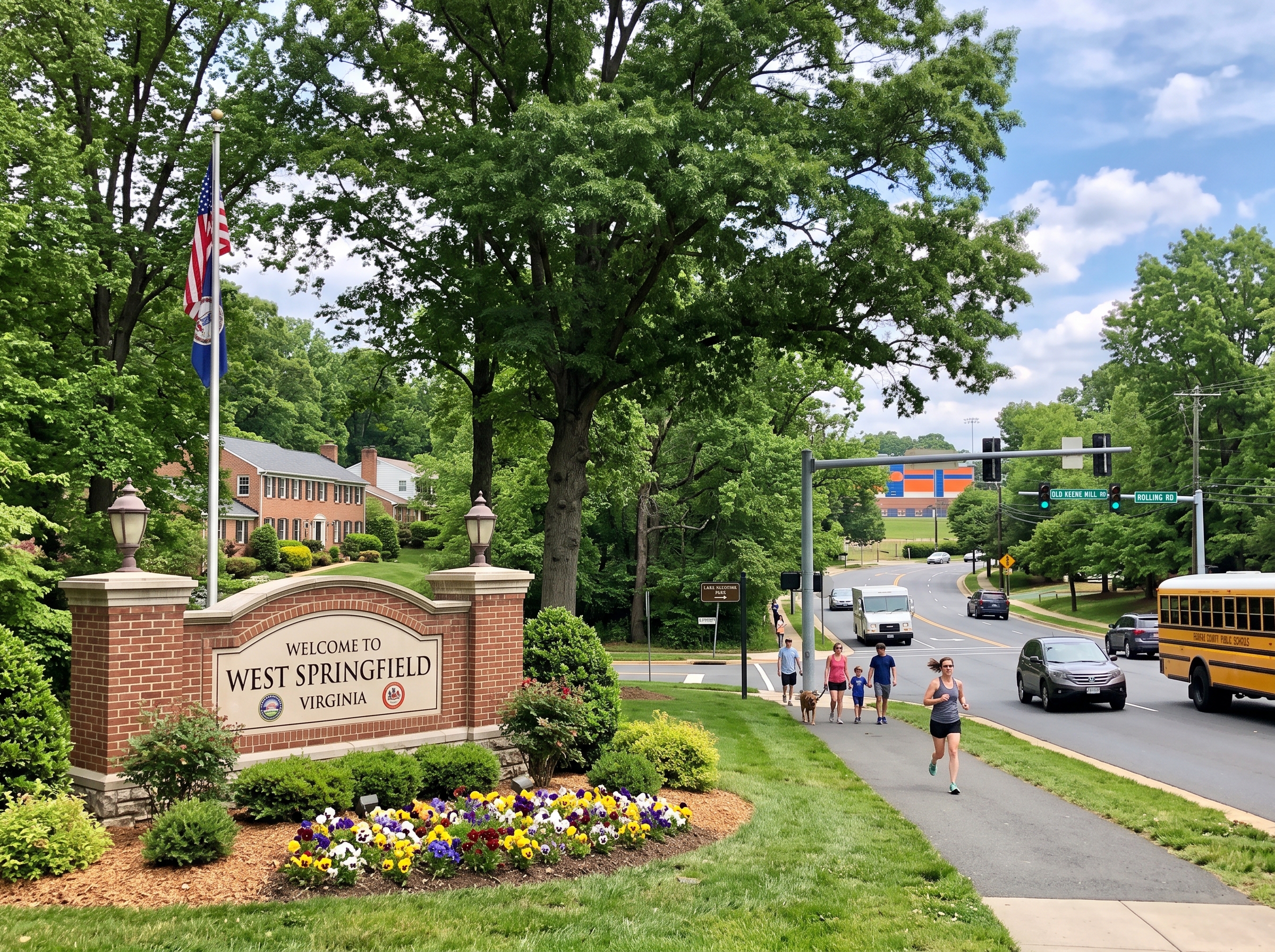
Executive Summary & Essential Community Takeaways
- Premier 4.81-Square-Mile Central Fairfax Enclave: Positioned across central-southern Fairfax County (ZIP code 22152, Springfield Supervisor District), the West Springfield Census-Designated Place (CDP) is a premier suburban residential community defined by the Norfolk Southern Railway to the north, Accotink Creek to the east, the Fairfax County Parkway (Route 286) to the south, and Pohick Creek to the west.
- Celebrated Mid-to-Late 20th Century Subdivisions: Developed from the mid-1960s through the late 1970s, West Springfield encompasses highly sought-after neighborhoods—including Orange Hunt Estates (famed for classic Camelot builder models such as The Bridlewood, The Master, and The Huntsman), Cardinal Forest (a master-planned mix of brick colonials and townhomes surrounding central greenbelts), Rolling Valley, and Terra Grande.
- Ecological Sanctuary of Hidden Pond & Pohick Stream Valley: Anchored by the 25-acre Hidden Pond Nature Center on Greeley Boulevard, providing quiet forested pond views, wildlife boardwalks, and direct connections to miles of multi-use hiking and running trails throughout the Pohick Creek and South Run stream valley networks.
- Flagship West Springfield High School Pyramid: Served by the elite Fairfax County Public Schools (FCPS Region 4) feeder network. Centered around the fully modernized West Springfield High School (home of the Spartans, AP Capstone Diploma, and championship athletics) and Washington Irving Middle School.
- Exclusive Countywide Magnet: Orange Hunt German Immersion: Orange Hunt Elementary School hosts the only German Dual Language Immersion (DLI) program in all of Fairfax County Public Schools, providing 50/50 bilingual instruction in STEM and humanities for grades 1 through 6.
- Exceptional Multimodal Commuter Infrastructure: Flanked by the Rolling Road Virginia Railway Express (VRE) station, the sprawling Rolling Valley Park & Ride Commuter Center (offering express non-stop bus service directly into the Pentagon), and seamless vehicular links to Old Keene Mill Road (Route 644), Fairfax County Parkway (Route 286), and the I-95/I-395/I-495 Springfield Interchange ("Mixing Bowl").
1. Spatial Morphology, Geographic Coordinates & Territorial Extents
The West Springfield Census-Designated Place (CDP) represents one of the largest and most established suburban residential territories in Fairfax County, Virginia. Encompassing approximately 4.81 square miles (12.46 square kilometers) of gently rolling piedmont terrain, West Springfield is centered at geographic coordinates 38°46′54″ North latitude and 77°14′32″ West longitude (FIPS Code 51-84944; GNIS Feature ID 1498565). Falling entirely within the 22152 ZIP code and governed under the Springfield Supervisor District, the community maintains a distinct cultural and geographic identity distinct from the older commercial core of Springfield to the east.
The physical perimeter of the West Springfield CDP is defined by prominent infrastructural, hydrographic, and military boundaries. To the north, the corridor is bound by the Norfolk Southern Railway (Washington District line), which also hosts the Virginia Railway Express (VRE) Manassas commuter rail operations. To the east, the natural riparian basin of Accotink Creek forms a lush wooded buffer separating West Springfield from central Springfield and the Franconia region.
To the south, the community borders the northern perimeter of the Fort Belvoir military reservation and the controlled-access parkway corridor of the Fairfax County Parkway (State Route 286). To the west, the boundary is established by the winding waters of Pohick Creek and a major regional high-voltage utility easement that creates an expansive linear greenway. Within this perimeter, two primary thoroughfares—Old Keene Mill Road (State Route 644) running east-west and Rolling Road (State Route 638) running north-south—form the central transportation spine around which residential subdivisions, neighborhood retail plazas, and public schools are harmoniously organized.
2. Historical Evolution: From Colonial Rolling Roads to Post-War Suburban Hub
The historical origins of West Springfield date back to the colonial plantation era of 18th-century Virginia. The name of modern-day Rolling Road reflects its original historical function: a designated colonial wagon and timber track along which enslaved laborers and tenant farmers literally rolled massive 1,000-pound wooden barrels ("hogsheads") of cured tobacco from interior farms across the Accotink and Pohick valleys eastward to the deepwater Potomac River port of Alexandria.
Similarly, Old Keene Mill Road derives its name from a succession of gristmills and sawmills operated along local creeks by early landowners, including the prominent Keene family. Throughout the 19th century and early 20th century, West Springfield remained a tranquil rural landscape of dairy farms, timber tracts, and family orchards. The area was dotted with small crossroad hamlets, one-room schoolhouses, and country churches that served agrarian families.
The dramatic transformation of West Springfield into a modern suburban hub began in the late 1950s and accelerated rapidly through the 1960s and 1970s. As the Washington, D.C. metropolitan region expanded following World War II, the growth of the Department of Defense, military installations at Fort Belvoir and the Pentagon, and federal civil service agencies created immense demand for high-quality single-family homes outside the urban core. Developers acquired large agricultural tracts, initiating a sustained era of master-planned community development that transformed the forested piedmont into one of Northern Virginia's most desirable bedroom communities.
3. Signature Subdivisions: Orange Hunt Estates & Camelot Builders
Among West Springfield’s most prestigious and architecturally cohesive enclaves is Orange Hunt Estates. Developed beginning around 1965 by Camelot Builders on land originally assembled by major local investors (including developer Abe Pollin’s Caldwell Limited Partnership), Orange Hunt was envisioned as a tranquil haven for executive and military families.
Camelot Builders introduced a structured portfolio of classic suburban models named to reflect aristocratic and equestrian themes:
- The Bridlewood: A stately four-bedroom two-story Colonial Revival featuring a formal center hall, brick-and-siding exterior, attached garage, and spacious entertainment salons.
- The Master: An expansive executive model offering four to five bedrooms, multiple finished living levels, and an expansive ground-floor family room anchored by a masonry fireplace.
- The Red Fox & The Reynard: Highly sought-after multi-level split-level designs that staggered active entertaining spaces from private upper-level bedroom suites, perfectly adapting to the natural rolling terrain.
- The Squire & The Huntsman: Refined rambler and tri-level configurations featuring broad front porches, daylight basements, and generous quarter-acre to third-acre lots backing to wooded common grounds.
Civic pride in Orange Hunt is stewarded by the Orange Hunt Estates Civic Association (OHECA). OHECA manages community communications, publishes the neighborhood directory, sponsors festive seasonal events, and maintains an Architectural Review Committee (ARC) that oversees exterior modifications to ensure that renovations and expansions preserve the visual harmony and long-term property values of the neighborhood.
4. Signature Subdivisions: Cardinal Forest, Rolling Valley & Keene Mill Corridors
Complementing Orange Hunt are several equally influential subdivisions that define West Springfield’s diverse residential fabric:
Cardinal Forest
Commencing development in 1966, Cardinal Forest was engineered as a comprehensive planned unit community that introduced both detached single-family residences and upscale brick townhome clusters nestled amidst preserved parklands. Centered around Cardinal Forest Elementary School (which opened its doors in January 1967) and Cardinal Forest Plaza, the neighborhood is renowned for its interconnected network of paved walking trails, neighborhood swimming pools, and mature hardwood shade trees.
Rolling Valley & Rolling Valley West
Flanking Rolling Road, the Rolling Valley subdivisions showcase classic late-1960s and 1970s suburban architecture. The single-family streetscapes feature a balanced mix of brick-and-cedar split-levels, split-foyers, and classic center-hall colonials. Residents benefit from immediate walking proximity to the Rolling Valley Mall and the Rolling Valley Swim Club.
Terra Grande & Keene Mill Enclaves
Positioned along the southern ridges near Old Keene Mill Road, Terra Grande and adjacent enclaves offer customized mid-century ramblers and expanded split-levels. Many of these parcels enjoy deep setbacks, side-entry two-car garages, and direct pedestrian trail access into the stream valley tributaries of Pohick Creek.
5. Architectural Typologies & Construction Anatomy
The structural integrity of West Springfield’s housing stock reflects the rigorous building standards of the post-war era. Homes constructed by Camelot Builders, Crestwood, and contemporaneous regional contractors utilized dimensional lumber framing, solid brick masonry front facades, poured concrete footings, and copper plumbing infrastructure.
Because these homes were engineered with clear-span roof trusses and non-load-bearing interior partition walls, they have become prime canvases for modern luxury renovation. Homeowners frequently reconfigure traditional compartmentalized layouts into sprawling, light-filled open-concept great rooms. Kitchens are expanded to feature 9-foot to 12-foot quartz or granite prep islands, custom soft-close cabinetry, commercial gas ranges, and integrated breakfast bars.
The prevalence of full daylight walk-out basements on sloping lots has spurred significant lower-level modernization. These spaces are routinely finished into secondary living suites, dedicated home theaters, executive telecommuting offices, and personal fitness facilities with sliding glass doors opening onto expansive stamped-concrete patios, multi-tiered composite decks, and outdoor culinary kitchens.
6. Hidden Pond Nature Center & Pohick Stream Valley Parklands
The environmental centerpiece of West Springfield is Hidden Pond Nature Center, an idyllic 25-acre park and environmental preserve operated by the Fairfax County Park Authority at 8511 Greeley Boulevard. Nestled directly adjacent to Orange Hunt Elementary School, Hidden Pond features a tranquil, spring-fed freshwater pond surrounded by dense deciduous woodlands, vibrant wetland marshes, and perennial wildflower meadows.
The park’s indoor nature center houses live reptiles, amphibians, and interactive environmental education exhibits. Outdoors, visitors traverse an accessible 2,000-foot elevated wooden boardwalk that winds through sensitive marsh ecosystems, offering prime viewing of painted turtles, green herons, red-shouldered hawks, and river otters.
Crucially, Hidden Pond serves as an active trailhead providing seamless pedestrian access to the extensive Pohick Creek Stream Valley Park trail system. Hikers, mountain bikers, and trail runners can travel uninterrupted along crushed-stone and natural trails extending south toward the South Run Recreation Center and Burke Lake Park, experiencing complete wilderness immersion just minutes from suburban commercial corridors.
7. Accotink Creek & South Run Watershed Hydrology
Hydrologically, West Springfield occupies a vital drainage divide in central Fairfax County. The eastern portions of the CDP drain toward Accotink Creek, feeding directly into nearby Lake Accotink, while the western and southern sectors drain into the Pohick Creek and South Run watersheds, eventually discharging into the tidal waters of the historic Potomac River.
Fairfax County’s Department of Public Works and Environmental Services (DPWES) actively oversees watershed protection projects across West Springfield. These initiatives include ecological stream bank stabilization, removal of invasive non-native plant species, and the creation of engineered bioretention rain gardens. The preservation of extensive stream valley buffer zones ensures that neighborhood residential parcels are naturally shielded from severe stormwater erosion while preserving critical wildlife migration corridors.
8. Fairfax County Public Schools (FCPS): The West Springfield High Pyramid
A fundamental driver of long-term real estate stability and community prestige in West Springfield is its assignment to the nationally recognized West Springfield High School Pyramid within Fairfax County Public Schools (FCPS Region 4).
West Springfield High School (Home of the Spartans)
Located at 6100 Rolling Road, West Springfield High School (WSHS) opened its doors in 1966 and recently underwent a comprehensive, multi-million-dollar modernization project that transformed the campus into a collegiate-style educational facility. The campus features state-of-the-art STEM laboratories, professional performing arts auditoriums, cutting-edge digital media studios, and elite athletic facilities.
WSHS is celebrated for academic excellence, offering the prestigious Advanced Placement (AP) Capstone Diploma, specialized engineering academies, and world-class fine arts and choral ensembles. The Spartan varsity athletic program consistently captures Virginia High School League (VHSL) state championships in cross-country, track and field, cheerleading, soccer, and baseball. Graduates matriculate to top national universities, including UVA, William & Mary, Virginia Tech, Duke, Georgetown, and Johns Hopkins.
Washington Irving Middle School
Serving grades 7 and 8, Washington Irving Middle School is situated adjacent to the high school campus on Old Keene Mill Road. Irving Middle provides a nurturing yet intellectually rigorous transitional environment, featuring Honors courses across all academic disciplines, an active World Language academy, and award-winning band, orchestra, and robotics programs.
Elementary Feeder Network
The foundational tiers of the pyramid are anchored by esteemed neighborhood elementary schools, including Cardinal Forest Elementary, West Springfield Elementary, Rolling Valley Elementary, Hunt Valley Elementary, and Orange Hunt Elementary.
9. Specialized Educational Magnet: The Orange Hunt German Immersion Program
A truly singular distinction within West Springfield’s educational ecosystem is housed at Orange Hunt Elementary School (6820 Sydenstricker Road). Orange Hunt is the proud home of the only German Dual Language Immersion (DLI) program in the entire Fairfax County Public Schools system.
Established to foster early bilingualism, biliteracy, and cross-cultural competency, the program operates from grade 1 through grade 6. Participating students spend 50 percent of their instructional day learning mathematics, science, and health taught entirely in German by native-fluent educators. The remaining 50 percent of the day is spent with grade-level English instructors learning English language arts, reading, and social studies.
Research consistently demonstrates that immersion learners develop heightened cognitive flexibility, superior executive functioning, and advanced analytical problem-solving skills. Families across Fairfax County enter a countywide lottery to secure entry into this coveted program, reinforcing the long-term desirability and property values of surrounding West Springfield neighborhoods.
10. Community Recreation, Pools & Youth Sports
Community life in West Springfield is deeply anchored by member-owned aquatic and recreational clubs that serve as the vibrant social hubs of the summer season. Prominent community clubs include:
- Orange Hunt Swim & Tennis Club: Nestled within Orange Hunt Estates, featuring a 25-meter competition lap pool, separate diving well, toddler splash pool, lighted tennis and pickleball courts, and the competitive Orange Hunt Sharks swim and dive teams in the Northern Virginia Swimming League (NVSL).
- Cardinal Forest Pool: Serving residents of Cardinal Forest with heated swimming facilities, shaded pavilions, seasonal raft nights, and social community mixers.
- Rolling Valley Swim & Tennis Club: A beloved community institution on Rolling Road hosting youth swim leagues, adult tennis ladders, and holiday potlucks.
Youth athletic culture is exceptionally robust. Organizations such as the West Springfield Little League (WSLL)—which has represented Virginia in the Little League World Series—provide premier baseball instruction across pristine complexes like Byron Avenue Park. In addition, the Springfield South County Youth Club (SYC) sponsors extensive recreational and travel soccer, basketball, cheerleading, and lacrosse programs.
11. Commercial Infrastructure: Old Keene Mill Road Retail Corridors
Daily convenience and culinary commerce are effortlessly integrated along the Old Keene Mill Road commercial spine. Unlike urban cores burdened by congested vertical retail, West Springfield features well-planned, easily accessible shopping plazas offering generous parking and top-tier retail anchors:
- Old Keene Mill Shopping Center: Anchored by an expansive Whole Foods Market, this premier center hosts artisanal bakeries, boutique fitness studios, gourmet coffee shops, and financial institutions.
- Rolling Valley Mall: Situated at the intersection of Old Keene Mill Road and Shiplett Boulevard, featuring a newly remodeled grocery supermarket, local family-owned Italian trattorias, banking, and professional healthcare suites.
- Cardinal Forest Plaza: Centrally positioned to serve Cardinal Forest and Rolling Valley, offering everyday convenience with specialty ethnic markets, pharmacies, dry cleaners, and casual dining.
Furthermore, the regional retail destination of Springfield Town Center—featuring department stores, fashion boutiques, an upscale cinema megaplex, and fine dining—is situated just five miles east.
12. Multimodal Commuter Logistics & Regional Transportation
West Springfield provides one of the most versatile multimodal commuter networks in the Washington, D.C. metropolitan region.
For rail commuters, the Rolling Road Station of the Virginia Railway Express (VRE) is located directly along the northern border of the CDP on Rolling Road. Operating on the Manassas Line, the VRE provides comfortable, stress-free passenger rail service equipped with complimentary Wi-Fi, whisking commuters directly to the Burke Centre hub, Alexandria, Crystal City (Amazon HQ2), L'Enfant Plaza, and Washington Union Station.
Bus commuters rely on the massive Rolling Valley Park & Ride Commuter Center, located on Old Keene Mill Road. This major transit facility offers extensive free parking and high-frequency express commuter buses (via Fairfax Connector and Metrobus) that travel non-stop along dedicated High Occupancy Vehicle (HOV/HOT) lanes directly into the Pentagon Transit Center and downtown Washington, D.C.
Vehicular travelers enjoy rapid arterial access. The Fairfax County Parkway (Route 286) borders the community’s southern flank, connecting westward to Fair Lakes, Reston, and Dulles International Airport. Eastward along Old Keene Mill Road lies the legendary Springfield Interchange ("The Mixing Bowl"), which provides immediate access to Interstate 95, Interstate 395, and Interstate 495 (Capital Beltway). In addition, the Franconia-Springfield Metrorail Station (Blue Line) is just a short 10-minute drive to the east.
13. Virginia Statutory Assessment Framework Under Code § 58.1-3201
Real property taxation across West Springfield is governed by the statutory framework established under Code of Virginia § 58.1-3201, which mandates that all real estate must be assessed for tax purposes at one hundred percent (100%) of its true fair market value.
The Fairfax County Department of Tax Administration (DTA) conducts comprehensive annual reassessments of every residential parcel in West Springfield. The DTA utilizes computerized mass appraisal market equalization techniques that analyze verified, arm's-length sales of comparable homes within specific neighborhood submarket codes. The valuation models account for lot square footage, topography, structural improvements, effective age, and physical condition.
This standardized statutory methodology guarantees that property valuations are rooted in verified market transactions rather than subjective assessments. Property owners in West Springfield retain the full statutory right to review assessment worksheets annually and submit formal appeals to the DTA and the Fairfax County Board of Equalization (BOE) should property records warrant adjustment.
14. Comparative Analysis Matrix: West Springfield vs. Peer Enclaves
To contextualize West Springfield within the broader Northern Virginia suburban ecosystem, the following matrix compares the community against adjacent central and southern Fairfax County residential enclaves:
| Community | Primary Build Eras | Dominant Architectural Typologies | Mandatory HOA | Primary Park & Nature Asset | FCPS High School Feeder |
|---|---|---|---|---|---|
| West Springfield | 1965–1978 | Brick Ramblers, Split-Levels, Colonials & Townhomes | Varies by Subd (None in Orange Hunt) | Hidden Pond Nature Center & Pohick Trails | West Springfield High (Spartans) |
| Burke | 1976–1988 | Planned Contemporary Colonials & Townhomes | Mandatory (Burke Centre Conservancy) | Burke Lake Park (888 ac) & Ponds | Lake Braddock & Robinson Secondary |
| North Springfield | 1954–1962 | Mid-Century Brick Ramblers & Split-Levels | None (Voluntary Civic Assn) | Lake Accotink Park (Eastern Shore) | Annandale High School |
| Kings Park | 1960–1968 | Traditional Ramblers, Colonials & Tri-Levels | None (Voluntary Civic Assn) | Royal Lake Park & Pohick Stream Valley | Lake Braddock Secondary (7–12) |
| Ravensworth | 1959–1965 | Crestwood Brick Ramblers & Split-Levels | None (Voluntary RFCA) | Lake Accotink Park (496 ac) & CCT | Lake Braddock Secondary (7–12) |
| Long Branch | 1964–1972 | Mid-Century Split-Levels & Colonials | None (Voluntary Olde Creek) | Long Branch Stream Valley Park & CCT | W.T. Woodson High School |
15. Frequently Asked Questions Regarding West Springfield, VA Real Estate
What are the precise geographic boundaries of West Springfield, Virginia?
The West Springfield Census-Designated Place (CDP) encompasses approximately 4.81 square miles in central-southern Fairfax County (ZIP code 22152, Springfield Supervisor District). It is bound by the Norfolk Southern Railway line to the north, Accotink Creek to the east, Fort Belvoir and the Fairfax County Parkway (Route 286) to the south, and Pohick Creek to the west.
What are the most prominent residential subdivisions in West Springfield?
West Springfield is composed of several premier master-planned subdivisions, including Orange Hunt Estates (featuring classic Camelot builder models such as The Bridlewood, The Master, and The Huntsman), Cardinal Forest (a large enclave of brick colonials and townhomes with greenbelts), Rolling Valley, Rolling Valley West, Terra Grande, and Keene Mill Manor.
Which public schools serve West Springfield children?
West Springfield is anchored by the West Springfield High School pyramid within Fairfax County Public Schools (FCPS Region 4). Students attend the fully modernized West Springfield High School (home of the Spartans and the AP Capstone Diploma), Washington Irving Middle School, and neighborhood elementary schools including Orange Hunt Elementary, Cardinal Forest Elementary, West Springfield Elementary, Rolling Valley Elementary, and Hunt Valley Elementary.
What makes the academic curriculum at Orange Hunt Elementary unique?
Orange Hunt Elementary School hosts the only German Dual Language Immersion (DLI) program in all of Fairfax County Public Schools. Spanning grades 1 through 6, students spend 50 percent of their school day learning mathematics, science, and health in German, and 50 percent learning language arts and social studies in English.
What major parks and nature centers exist in West Springfield?
The community’s environmental crown jewel is the 25-acre Hidden Pond Nature Center on Greeley Boulevard, which features tranquil ponds, wetland boardwalks, and live educational exhibits connecting directly into the Pohick Creek Stream Valley Park trail system. In addition, Lake Accotink Park and South Run Park are immediately accessible.
What architectural home styles predominate in West Springfield?
Homes are characterized by late mid-century suburban architecture, dominated by solid brick-front ramblers (ranch styles), multi-level split-levels, tri-levels, split-foyers, and two-story Colonial Revivals. Many feature walk-out daylight basements, attached garages, and mature quarter-to-third-acre lots.
What commuter transit options serve West Springfield residents?
Commuters benefit from the Rolling Road Virginia Railway Express (VRE) station on the northern boundary, the Rolling Valley Park & Ride Commuter Center (offering express non-stop bus service directly into the Pentagon), and seamless vehicular links to Old Keene Mill Road, Fairfax County Parkway, and the I-95/I-395/I-495 Springfield Interchange ("Mixing Bowl").
Does West Springfield have mandatory Homeowners Associations (HOAs)?
HOA governance varies by neighborhood. While townhouse clusters in Cardinal Forest maintain mandatory HOAs covering common ground maintenance, single-family enclaves such as Orange Hunt Estates and Rolling Valley are governed by voluntary civic associations (such as OHECA) that manage community directories and events while maintaining architectural covenants through volunteer review boards.
What commercial shopping options are located in West Springfield?
Retail centers along Old Keene Mill Road include the Old Keene Mill Shopping Center (anchored by Whole Foods Market), Rolling Valley Mall, Cardinal Forest Plaza, and West Springfield Shopping Center, providing supermarkets, specialty dining, boutique fitness, and healthcare facilities.
How are real estate taxes assessed in West Springfield?
Under Code of Virginia § 58.1-3201, all real property is assessed annually at 100 percent of true fair market value. The Fairfax County Department of Tax Administration (DTA) conducts computerized mass appraisal equalizations annually based on verified arm's-length sales of comparable homes within the neighborhood submarket.
Navigating Real Estate in West Springfield & Central Fairfax County
Whether you are preparing to market an established brick colonial in Orange Hunt Estates, exploring a renovated split-level near Hidden Pond Nature Center, or seeking a home zoned for the West Springfield High Spartan pyramid and Orange Hunt German Immersion, partner with trusted Northern Virginia real estate authority Elena Gorbounova for private, data-driven representation.